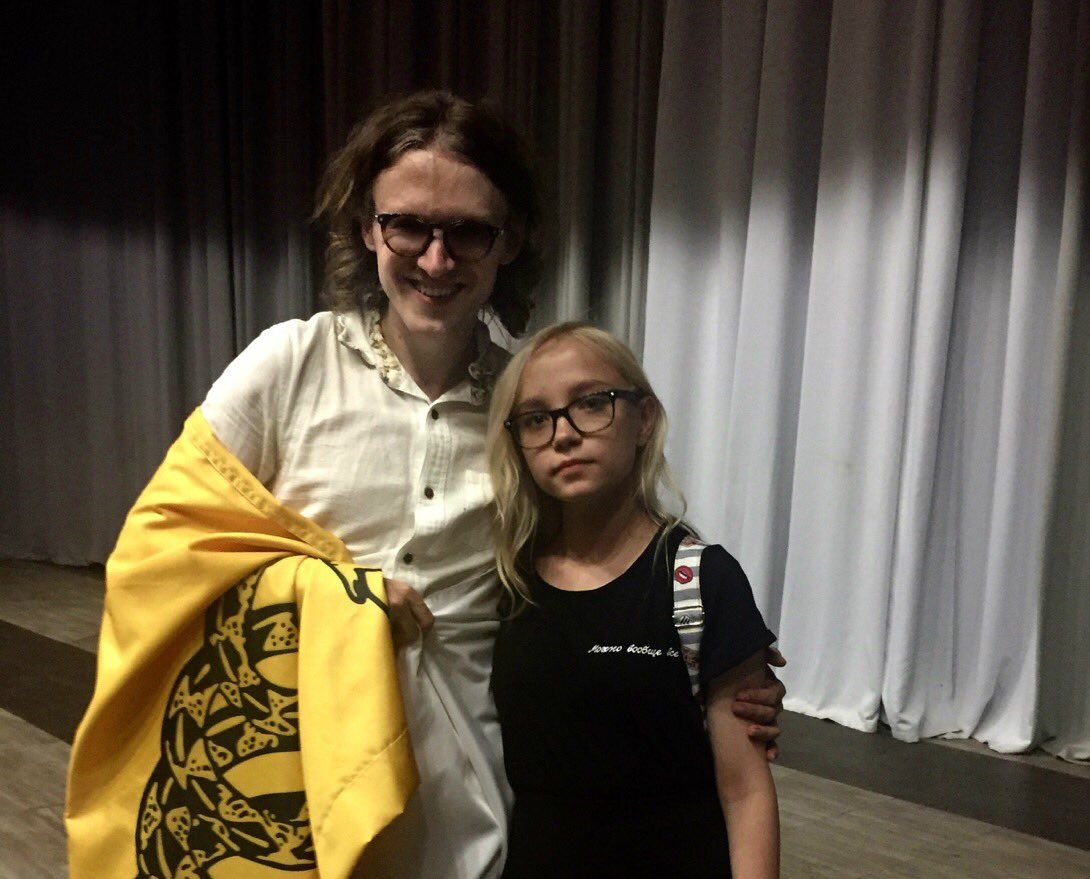
Check out the new video on the Libertarian Band channel! As part of the second series of stories about libertarianism, we have reached such an important term as the NAP, or the Non-Aggression Principle. We analyze how it emerged from the doctrine of deterrence, how it evolved, where it is presumed to evolve, and what its limitations are (since there are many in the libertarian community who want to build absolutely everything based on the NAP).
Of course, a full and thorough analysis cannot fit into six minutes, but we tried not to take up your precious attention for too long. We will talk about other aspects of living in society in the following videos. Work on a new video — about the institution of reputation — has already begun.
In my view, any person is a subject of law by virtue of their belonging to the human race. At the same time, any person can be an object of law by virtue of the fact that other people, in the course of legal interaction with one another, act upon this person as an object. For example, my father may gift me an apartment or, conversely, bequeath some of his property to third parties, thereby disavowing my right to inherit this property, which I have by default. This is a unilateral action affecting my rights; that is, here I am an object of law.
If a person is incapacitated or for some other reason is unable to carry out subject-based legal activity, other persons may act on their behalf and in their interests. And although their direct expression of will is absent here, from the perspective of the persons with whom transactions are carried out on their behalf, they are already a full subject of law. For instance, a transaction carried out by proxy remains a transaction with the person who issued the proxy, not with the person to whom it was issued. But they remain a subject of law and can at any moment delegate the right to perform transactions in their name to someone else—or begin to perform them independently. To do this, they do not need to sign any non-aggression pacts—neither literally nor figuratively. They simply, so to speak, consume the right that they already have and have had all along.
Refusing a subject the exercise of their rights is a usurpation of law. A child has the right to leave home at any moment and live independently, and if they own a share in that house, to demand the division of property. This will likely be an imprudent decision on their part, and if this imprudence is obvious to everyone around, they will try to convince the child that it would be better to change their mind. Or simply not help them (but not hinder them) in the legal formalization of the actions to divide the property. But justifying the usurpation of someone else’s right by the fact that some non-aggression pact has not been signed is a kind of mental gymnastics that is beyond me.
On the left-anarchist channel Prometheus, the analysis of an overview article on libertarianism from the LPR website continues. Once again, the focus is on the non-aggression principle. The article under discussion simply explains what this principle is and indicates that it pertains to ethics. It is implied that the mechanisms for implementing this ethical principle are also ethical, meaning reputational. Naturally, the opponent notes that an ethical principle is an extremely shaky foundation for building a society.
Next, there are many reflections on how, in the author’s opinion, a libertarian society should ensure compliance with the aforementioned principle. Naturally, private military companies are mentioned—heaven forbid—and it is then quite logically pointed out that if they are hired by end clients for aggressive operations against competitors, everything will degenerate into the right of the strongest, and subsequently into the reinstallment of the state. Logistic problems are also pointed out, as a result of which each territory would be “protected” by its own security forces, and deploying security forces from a foreign territory would prove to be a costly endeavor.
What nuances did the author fail to consider?
Firstly, for some reason, he considers a situation in which certain private military companies have a monopoly on violence and contrasts them with classical anarchy, based on universal armament and voluntary territorial militias. But under free market conditions, anyone who wishes has the right to arm themselves, not just licensed companies, so potential lawlessness will be countered not by a powerless crowd, but by armed people.
Secondly, the insurance principle of the functioning of any rights enforcement companies is completely ignored. A situation in which a person hires thug-bodyguards is marginal. Much more often, a person simply buys insurance, and if they are attacked and suffer damage, it is an insurance event, and they can expect a payout from the company. This removes logistic problems (the insurance company has its own agreements with various local security groups for rapid response to serious insurance events, and for minor ones, it simply pays out the insurance and doesn’t sweat it). I won’t recount the script of my video on ancap; I just recommend watching it.
However, the fact that all these questions surfaced during the analysis of the article on libertarianism can safely be attributed to the article’s shortcomings. I hope someone from the LPR editorial staff considers this high-quality feedback from an ideologically kindred organization and uses it to improve the material.
Taking this opportunity, I will also announce that our next video will be entirely dedicated to the non-aggression principle. The video is currently being filmed. I hope we will also be able to resolve some of the left-wing audience’s questions regarding this principle.
Regarding yesterday’s note on comparing Bitcoin with low-inflation fiat, I received a detailed response. In short, it postulates the importance of stable prices when using a currency as a medium of exchange. To ensure this, a decentralized cryptocurrency fiat is proposed: a crypto whose emission parameters are set by a vote of the currency holders.
To this, I can briefly respond: if anything is a fundamental property of prices, it is their variability. Price carries information about the relative need for goods for specific buyers at a specific moment. If you want the price of a specific good, expressed in a specific currency, to remain unchanged, your only option is to peg the exchange rate of that currency to the value of that good—effectively backing the currency with the commodity. There is no problem with creating a Bitcoin sidechain, freezing a certain amount of Bitcoins, and pegging the tokens issued against them, for example, to oil. That’s it; now one barrel of, say, Brent costs one token. Always. You just have to monitor the collateral size, because if oil becomes significantly more expensive in Bitcoins, the collateral will have to be increased. At the same time, when buying some aluminum or grain with “oilcoins,” you will inevitably encounter price changes.
But all of this has nothing to do with direct democracy, because you can never predict in advance what emission parameters the holders of your crypto-fiat will set. Perhaps they won’t want stable prices for some basket of consumer goods, but will simply take advantage of the fact that the emitter always profits from emission—and issue more tokens to quickly buy up Bitcoins with them. Or do you intend to build a managed democracy and prevent holders from acting so unsightly?
After logically poking at the boundary conditions of the two principles (if a person belongs to themselves, they should be entitled to sell themselves, and may also be stripped of themselves by court decision; as for the application of the non-aggression principle, everything boils down to the definition of aggression, which is subjective, and one cannot build stable orders on such a shaky foundation), they point out that left-anarchism has a solution. As a solution, that same direct democracy is proposed: all orders are established by all members of society.
Here I can only point out that a society of total direct democracy would require some criteria for who to include in the set of voters for each specific issue. Where is the line that, once crossed, a person loses the right to vote on a certain topic because it does not concern them? If there is no such line, we get a society where everyone is obliged to ask everyone’s permission for everything—a legal absurdity worse than the city of Morlow from Interstate 60. I hope to see an answer in the following parts of the review (in the article I analyzed, there is no such answer).
The image of legal absurdity—may it haunt you as well
The institute of superherosim already exists, albeit without any special effects. Take William Browder, for instance: offended that the RF killed his employee, he put on some cool gear and went to the lobbyists, ultimately punishing those who violated the NAP with the Magnitsky list. Mikhail Khodorkovsky put on cool gear and began funding the investigation into the murder of his employees in the CAR, and is also creating his own Shevchenko list. Alexander Litreev put on cool gear, flies around at night and deanonymizes shameful cops along with the Rosgvardiya officers who joined them.
Given how poorly the state functions in investigating certain incidents, we cannot guarantee that superheroes are not already operating in the field of direct physical punishment of NAP violators. For example, recently some owner of an award firearm for merits in the annexation of Crimea carelessly scratched himself with it. Let’s laugh at the safety regulation violator; let the superhero remain off-camera. Secret submarines, of course, also sink without any participation from superheroes.
Naturally, once the main enemy of any superhero—the state—is defeated, he will be able to turn his attention to the struggle against smaller bandits. It will be easier for him; he may even be able to afford to unobtrusively appear on camera in his cool gear from time to time, because the fear of retribution is a crucial element of the deterrence doctrine.
The principle of non-aggression is one of the criteria people use to make choices while living among others. However, its consistent application encounters the fact that different people in different situations have different criteria for what constitutes violence. A rock concert is far louder than a hammer drill behind a wall, but a person will readily go to a concert and tolerate the violence against their ears there, while they are far less willing to tolerate a hammer drill. Half a century ago, people were far more tolerant of engine exhaust or smoking indoors than they are today, but it is by no means certain that this trend will continue.
Since universal, objective, natural criteria for such things are absent, one must use various heuristics, such as, for example, the principle of estoppel, which states that someone who violates a certain norm is not entitled to demand punishment for others for violating that same norm. If you smoke indoors, you are not entitled to demand that others do not smoke. If you litter, you are not entitled to demand that others do not litter. Thus, places are formed where everyone more or less refrains from littering, and places where everyone doesn’t give a damn.
Indeed, strong intolerance toward emissions will manifest in some places; we can easily observe such territories called nature reserves or national parks. There, the owners maintain a very careful “non-aggression” on the territory and demand the same from others.
If there is anything constant in human society, it is diversity. No single principle will ever absolutely prevail over all. Not even the NAP. It is enough for you to implement it around yourself to a level that is convenient for both you and those around you.
As I understand it, you are only secondarily concerned with how a proper ancap should appropriately react to such a thing during an ancap (the correct answer: it’s not mandatory, provided you see an opportunity to hold the attacker accountable while maintaining greater dignity). More likely, you want to understand what a specific Svetov could have opposed against a specific attack in a specific Putinist Kazan.
And here, of course, it is important to have accompaniment. Since such symbolic actions, logically, may be recorded on video by the attackers’ accomplices, it is primarily important not to give them the opportunity to obtain footage that portrays the victim in an even more unflattering light, or worse, provides grounds for criminal charges. Therefore, the object of the attack must not chase anyone or attack anyone.
Meanwhile, a private individual who happens to be a witness to the attack by pure chance could well catch up to the attacker, detain them, and take a close-up photo; after that, it would be possible to sue them, as a photo is usually sufficient nowadays to establish identity through open sources. Of course, in Russia, and especially in sultanates like the one in Kazan, the investigation could easily fail to find the suspect, even if their full name, address, and phone number are handed to them on a silver platter, and the case would remain open against unidentified persons. After all, there has been no news regarding the investigation of the attack on Svetov in another sultanate—Kemerovo. But if people with authority were working there, then here the attackers are quite vulnerable. And (finally answering the direct question) after it turns out that it is impossible to legally hold them accountable, you can—and it is even highly desirable to—beat their faces. But this should not be done by Svetov, but by some unidentified persons who are in no way connected to the incident and simply learned about it from open sources. Well, what can you do; some people don’t like political activists, and some don’t like thugs.
NAP is not a non-aggression pact, as the well-known video blogger Mikhail Svetov likes to point out. It is not a norm handed down from above, like a single commandment from a libertarian deity. It is a purely analytically derived principle. If the principle “no one has the right to initiate violence with impunity” is generally observed in a given society, it means that there is—as engineers would put it—negative feedback operating there, which dampens manifestations of violence. Society becomes free from institutionalized coercion, which always leads to an explosive growth in prosperity.
Since the non-aggression principle is not established from above, naturally, no one imposes specific boundaries on everyone—for instance, claiming that a dirty look does not violate the NAP, but stepping on a foot already does. Such specifics are derived from practice, and this boundary can certainly change as customs evolve. The only thing clearly defined in the non-aggression principle is the absence of certain privileged groups who, for some reason, have the right to initiate violence with impunity.
The feedback loop works because the use of violence against an aggressor, whoever they may be, is precisely legitimate. In general, anyone can apply such retaliatory violence; the limitations here are purely technical: first, there must be the physical capability to do so, and second, reliable information about who applied what violence to whom.
The idea of limited government is to delegate the identification of aggressors and the application of counter-violence against them to one specific organization. This relieves the majority of society from such a burdensome duty. However, first, we have no right to forbid people from exercising counter-violence directly, without delegating it to anyone. And second, we have no right to forbid people from delegating rights to counter-violence to any other organization besides the one called the government. The attempt to forbid this is itself a violation of the NAP, which should entail counter-violence against whoever attempted to impose such a ban on people using force.
Thus, the only way for a limited government not to violate the NAP is to be a market monopoly—that is, to serve its clients based on voluntary contracts, and to do so so cheaply and qualitatively that it is simply unprofitable for competitors to enter this market, and the vast majority of people prefer to entrust counter-violence to the government rather than practice it themselves. Robert Nozick advocates approximately this point of view in his book “Anarchy, State, and Utopia”.
In fact, with the same justification, we could ask: “Who will protect the individual from state violence? How can a person prove their agency?”
In response to state violence, a person can resist directly, attempt to appeal to one branch of government regarding violence committed by another branch, flee to another state, or to a place where state orders do not operate. Finally, a person can resign themselves, repent, and become an exemplary citizen so that the state violence directed at them becomes more or less tolerable. None of this will help them prove their agency to the state, but it may somehow influence the severity of the violence.
As is easy to see, a child can do exactly the same in relation to their parents. They can fight with their parents and even kill them, complain to the father about the mother or to the mother about the father, run away to other people, or simply try to survive on the street. Finally, they can become an exemplary child and fulfill all parental whims. None of this helps them prove their agency within the existing orders, but it may somehow influence the severity of the violence they are subjected to.
The power of the state over its subject and the power of parents over a child are equally total in the absence of external factors. To protect human dignity from the power of the state, people organize into a civil society that directly opposes the state, both using tools provided by the state and through direct moral pressure on individual state representatives (we leave political terrorism outside the scope of this consideration, although it glares quite menacingly from the sidelines). Similarly, the family’s power over a child is limited by society, both through official channels, such as complaints to state authorities, and through direct moral pressure on the parents (methods of physical coercion glare menacingly from outside the scope of this issue).
To summarize. The power of one human over another is dangerous and undesirable in itself. Wherever possible, the “ruler-subject” relationship should be transitioned into relationships between negotiating subjects. Wherever this is not possible—for example, due to the weakly expressed agency of one of the parties—power can and must be limited through pressure from other subjects who form public opinion.
Of course, public opinion should not be idealized—it is a tool for interference in private relationships by third parties; it is not for nothing that public opinion is often called the opinion of those who weren’t asked. Libertarianism provides the principle by which the legitimacy of public opinion’s interference in private relationships can be determined: the now-clichéd NAP. The more obvious its violation within the family, the more the opinion of those who weren’t asked becomes sought after.
It is clear that you are unlikely to be interested in the legitimacy of me killing a mosquito on my own territory, for example. Moreover, you would hardly notice if I killed a mosquito on someone else’s territory, unless I was explicitly told that it is a valuable mosquito in private ownership and must not be killed.
It is also not certain that you would be very interested in the legitimacy of killing various meat animals in slaughterhouses for the purpose of subsequent meat sale, although there are people who do contest it. Unfortunately for them: all this meat livestock lives only as long as its breeding is profitable. No profit—no livestock. The population of cows, pigs, and other rabbits will decrease sharply, and those excess to the capacity of the natural habitat will either starve to death, or people will have to carefully eat them without reproducing the existing herds. As soon as humanity manages to set up the production of synthetic meat that is cheaper and tastier than the natural kind, this exact scenario will happen: no one is interested in cleaning up manure when a steak is printed on a printer.
But, judging by your nickname, you are not talking about animals in general, but about rare ones, whose natural habitat is negligible, and who live almost exclusively in zoos, primarily so that people pay money for the right to look at them. These animals are luxury items, and, of course, no one will kill them without serious grounds. The accident with your namesake was a situation where everyone involved suffered: the child who was injured, the mother who experienced serious stress, the zoo, which, to avoid the costs associated with the possible death of the child, was forced to destroy a valuable animal, and finally, Harambe himself.
We do not know how soon zoos will stop being profitable because people will find it repulsive to look at animals in cages. When that happens, nature reserves will be the only places left for animals to live, and people themselves will visit them in cages, or some other way that does not violate the animals’ privacy. In general, the more resources a human is able to obtain without serious transformations of nature, the less their need for those very transformations. In a world where all of a human’s material needs are satisfied by a thought, practically the entire planet will be in the power of virgin nature. That is the kind of harmless animal we are.


'/%3E%3C/svg%3E)