Just submitted an article to the editorial board for the third issue of “Fronda”. And if that’s the case, why not make your own column from the second issue, dedicated to democracy, publicly available? Here it is, please enjoy:
Lessons of Freedom
Hello everyone, it’s Anka-tyan with you again, and today we’re talking about the lessons that a social structure like democracy gives us.
Lesson of Resolution
Ancient Greek democracy began with tyrannicides. Since then, killing a tyrant is considered good manners and a pretty decent prelude to establishing a more free political order. Most tyrants have drawn this lesson, so they try to maintain the outward appearance of democracy. Let’s draw the same lesson for ourselves:
The most direct way to establish democracy is to destroy the tyrant… Destroying an army or an economy is a much more roundabout and unreliable way. Negotiating with a tyrant about his peaceful departure is even less reliable.
Lesson of Vigilance
Fighting for democracy, people don’t want democracy itself. They want freedom from tyranny – that is, from a regime in which they are arbitrarily subjected to violence. Democracy is just a family of various compromise social structures designed to prevent a recurrence of tyranny. The common thing in all stable democracies is the principle of separation of powers. No one owns all power! Tyranny of the popular assembly is just as tyrannical as the tyranny of one person. Let’s formulate our lesson as follows:
Construct a system of self-government so that your community doesn’t give anyone the opportunity to seize power. No expansive interpretations of norms! No extraordinary powers! Any holder of power is a potential tyrant. Be vigilant!
Lesson of Distinguishing Goals and Means
Coordination in a community implies working to ensure it. Someone needs to do this work. We need to find and involve someone in this. How to look for them? In modern democracies, everything usually comes down to two mechanisms: an official is appointed by a higher authority, or they are elected by vote. Voting is just one of the possible meansof achieving a compromise solution in selecting candidates from a group, and it has a lot of drawbacks. There are many other means. The most unbiased means was originally considered lots. There are also exams and other types of competitions, there’s the purchase of positions, there are tenders, there is volunteering… Democracy doesn’t reduce to voting. The lesson is obvious here:
Don’t substitute goals with means. Don’t try to use a tool for everything, even if it’s very fashionable. Use what is simpler, more reliable, and that solves the specific task that has been set.
Lesson of Breaking Out of the Vicious Circle
Как ни распределяй власть, какие ни внедряй сдержки и противовесы, как ни связывай власть имущих законами, система со временем деградирует. Деградировав, она порождает новых тиранов, а потом по их головы приходят новые тираноборцы… Что может помешать соблазну сконцентрировать власть? Только одно: отсутствие того, что можно сконцентрировать.
Если координация происходит добровольно, в этом процессе нет места для того, кто принуждает. Чем больше места занимают добровольные отношения, тем меньше места занимают властные. Отсюда простой урок:
Если вам что-то нужно от других, спрашивайте, что хотят взамен. Не считайте, что вас должны обслужить даром. Если от вас что-то требуют, называйте свою цену. Не считайте, что вы должны обслуживать других даром. Согласны сотрудничать – сотрудничайте. Не согласны – не сотрудничайте. Всякий претендующий на власть должен понимать: принуждать людей себе дороже. Будут саботировать и искать удобного случая ударить исподтишка. Никому не хочется войти в историю в качестве свергнутого тирана.
Подведём итог
С одной стороны, демократия – это способ не дать немногим всю полноту власти над большинством. С другой стороны, демократия это возможность для большинства получить общественные блага дешевле, чем они бы стоили на рынке. Это большой соблазн, но надо отдавать себе отчёт в том, что это тоже тирания, только тирания большинства. Переход к рынку вместо принуждения – это нравственный выбор людей, которые сознательно отказываются быть тиранами. Только этот путь ведёт к настоящей свободе.
Minarchism is an extremely unstable state, where the cancerous tumor called the state has just been pushed into maximum remission by stripping it of as many functions and resources for their execution as possible, leaving only what simply cannot be taken away—either because officials resisted strongly, the people cannot understand how to manage without it, or something else.
Therefore, I understand the question roughly as follows: under which form of government will a minarchist state expand its powers most slowly? My answer: shareholder democracy. Historically, trading republics, such as Venice, were quite close to this method of management.
The point of this form of government is that the right to vote in the administration of the republic belongs to those who contribute to its functioning, and exactly to the extent to which they contribute. Modern technologies fully allow for quite complex voting with share packages, including options for delegating votes and revoking that delegation.
When people allocate their own money, they tend to maximize savings and are least inclined to give anyone the right to forcibly seize citizens’ money. This is precisely what makes them vigilantly monitor any potential abuses by authorized officials, which works more reliably than a simply formally drawn scheme of checks and balances.
One might wonder, how is this worse than a scheme with a benevolent dictator who unilaterally pays for all state functions out of their own pocket, providing state services to others? The problem is that everyone else must be guided by his sole conception of the common good, which can change unpredictably and rapidly. Simply compare the pace and amplitude of changes in the structures of Bitcoin and Ethereum.
At Montelibero, we are implementing exactly this form of government: both in the eponymous fund and in the land cooperative building the village. (These are two different entities with slightly different vote-counting mechanisms: in the village, we simply vote by square meters, and in the fund, a logarithmic formula for calculating vote weight currently applies so that no one can obtain a controlling interest.) So, I am not only reasoning theoretically about the best form of government, but I am also participating in the field testing of the one I consider to be the best.
Enrico Dandolo, Chairman of the Board of the Most Serene Republic of Venice
Many proponents of liberal views often consider the sole source of all problems in social and economic management to be the insufficient involvement of the population in the political process. They believe that the state, and especially its coercive function, is absolutely necessary for existence, but that it should be managed by all people simultaneously and without the mediation of any political elites. This can lead to the concept of direct democracy, where a referendum is held on every political issue and the decision chosen by the majority is adopted. It should be noted that the creation of a direct democracy state is often implied, albeit not always explicitly, even by proponents of anarchic views.
Let us ask ourselves: does the decision-making process itself truly play a key role in how social management works? Of course not, because the most critical role is assigned not to the making, but to the execution of decisions. But are the majority of people capable of taking a direct part specifically in their execution? Let us examine this question in more detail.
If we are talking about decisions of a violent nature—for example, the use of force to compel people to comply with certain norms—then the obvious answer to the previous question is no! The majority of people are unable and will never personally execute violent decisions. When it is said that someone must be forced into something by power, it means the execution of this decision by certain separate security agents, who constitute a specific minority in society. This means that even if a violent decision was made by the majority, it will still be executed by the minority, and it cannot be any other way.
The right to commit violence, even in a state of direct democracy and majority choice, is still completely transferred into the hands of a minority. Moreover, the security apparatus must be capable of ensuring the realization of this right. Thus, a direct democracy state also presupposes that the ability of individuals and private communities for self-defense must be lower than the security forces’ ability to attack. This may mean the introduction of gun laws, if not a complete ban on civilian weaponry.
And why would anyone suddenly decide that this minority with the right to commit violence will not use such a position for its own benefit? Will it really execute decisions made by the majority, while effectively having the power to compel that majority to do anything? In practice, in the best case, it will simply pretend to execute the majority’s decisions, but the process of their execution will be organized to maximize its own interests.
In comparison, a free non-violent society, in which the primary tools for implementing punishments for the violation of certain norms are reputational and financial sanctions, can be organized according to the model of direct democracy. Imagine that as a punitive measure for a certain violation, a decision was made by majority vote to ostracize a person in certain types of relationships, including limiting or refusing them the ability to conduct some purchase and sale transactions. Furthermore, it was decided to subject those who continue full cooperation with the violator regardless of everything to this punishment. In such a case, the majority that made these decisions will also be their direct executor. It is the majority that will, in practice, refuse or limit cooperation with the violators.
If someone really likes the idea of society being managed according to the principles of direct democracy, they should first think about how violence can be eradicated from human relationships and how to completely get rid of it as a tool for implementing decisions. Otherwise, the choice of the majority will simply have no practical meaning if the decisions are still executed by a minority of people.
When discussing the issue of state violence and the restriction of freedom, one sometimes encounters the argument that this is not such a big problem, since in the modern world of democracies and liberalism, most states are limited in their ability to use force and violate the freedom of their citizens, and in this, they cannot cross a certain line. But in reality, no institutional factors prevent even the most democratic and liberal states from turning into brutal dictatorships. As long as they are stationary bandits and can “legitimately” use the instrument of violence, as long as they have agents capable of committing violent acts, and ordinary people have neither the right nor the possibility to resist violence, a tightening of social orders can be fully expected, provided there is only a pretext for it.
And recently, such a pretext appeared – the coronavirus pandemic. Of course, the pandemic must be fought, but the primary method chosen for this by many states was precisely violence and the forced restriction of freedoms. Moreover, there was no sense in such harsh measures, based on research on the effectiveness of different measures in the fight against the pandemic; also, using the example of Sweden, which has already returned to pre-COVID life, I showed how informing and encouraging less risky behavior ultimately yield better results than strict control and bans. Forceful coercion is a less effective tool in implementing any measures, unless coercion and the restriction of freedom is the goal in itself.
Before continuing the topic of COVID measures, I would like to recall one example of how states effectively destroyed the freedom of movement around the world by introducing passport and visa control. The pretext for this was the First and Second World Wars, during which states needed to control the movement of people. Was the control lifted after the wars ended, i.e., after the pretext for it disappeared? It was not! States took the opportunity to forever make any movement of people beyond the borders of their own “pens” strictly controlled.
During the coronavirus pandemic, borders turned out to be completely closed, but the essence of the matter is not only in that. In many countries, people were literally locked in their homes, deprived of work, and their movements were monitored, for example, using COVID apps. Now, a telling example of the implementation of such a policy is Australia, where people deprived of freedom literally have to fight with police, their movements are tracked by the state via a smartphone app, and violators of COVID norms face imprisonment and fines. Also, in many countries, police can easily beat and detain you, for example, for the lack of a mask or a vaccination passport (I am attaching a recent case from France to the post). This is also true for Russia, where police have already beaten and brutally detained people without masks many times.
Now I want to ask one question: is it possible to believe that after the pandemic ends, states will truly lift all restrictive measures and return to people the same freedom they had before? As far as I am concerned, relying on this would be great naivety. Of course, some freedoms will be returned, but at the same time, states will most likely retain some of the control. It is unlikely to be like in Sweden, where all COVID measures except for border ones have already been lifted, since this country did not rely on harsh coercive measures from the start. By the way, borders after the pandemic may also remain more controlled than before it, and it is quite likely that in this case, even Sweden will no longer be an exception. In general, one should not rely on the idea that for some miraculous reason states will not punish their citizens with police force, deprive them of freedom, and strictly control them simply because they are developed democracies. The question is not so much about political and social institutions as it is about the willingness and ability to commit violence.
Daniil (question accompanied by a donation of 149.25 rubles)
What is so good about an effective autocracy? An autocrat can very quickly place people who will strictly follow his instructions in all managerial positions, and then very quickly carry out the necessary reforms. Where a team of reformers using democratic methods manages to cope poorly during the first year and then gets bogged down in endless delays, an autocrat’s team simply goes and does everything in a matter of months.
The second argument in favor of autocracy is that a democratic government leaves after a few years, the opposition takes its place, and begins to pleasurably destroy what was newly built. An autocrat sits on the throne longer, and during this time, the reality he has built has time to take root.
So what kind of madman would actually speak out against an effective autocracy?
The biggest difficulty is that far from every autocracy is effective. I can point as an example to a chapter from The Machinery of Freedom about libertarian foreign policy.
The problem with an interventionist foreign policy is that doing it poorly is much worse than not doing it at all. But that which is worthwhile only if done well is done by the very same people who run the state postal service, and with roughly the same chances of success.
Is it possible to estimate in advance whether a candidate for autocrat will be good, and whether his reign will be marked by minarchist reforms? Alas, all of history is full of examples showing that this is difficult to do. Lee Kuan Yew came to power under left-wing slogans and then began to suppress the communists. Deng Xiaoping was one of the leaders of the CPC even under Mao, and generally, nothing foreshadowed the sharp turnaround he would eventually make. Liberal reforms in New Zealand, one of the freest economies in the modern world, were also carried out by a government elected under left-wing slogans. Thus, if a future decisive reformer wishes to come to power democratically, he will most likely broadcast a left-wing agenda until the election, and his real plans will surface only afterward. Those who initially position themselves as right-wing are left only with coming to power through a military coup, which means they will have difficulties implementing reforms at the grassroots level — illegitimate orders are often sabotaged by those executing them.
So what, are autocracies not needed, and should we humble our pride and limp along in the mainstream current of democracy with universal suffrage? No, this is a disgusting form of social organization, which is only capable of delaying important decisions and squandering huge budgets, but is incapable of carrying out sustainable reforms to reduce the state.
The main problem with autocracy is the monopoly on power, and the solution lies, naturally, in launching competitive mechanisms. Under panarchy, where citizenship is determined by signing a contract, autocracy reveals all its strengths: it is a compact, fast management mechanism that does not procrastinate, but acts. But panarchy allows for the mitigation of autocracy’s weaknesses because a very powerful feedback loop operates within it: citizens support only effective autocrats with their wallets.
Exactly the same arguments can be made regarding a scientific approach to politics. Scientific theories must evolve, while implementing them in practice on an exclusive basis freezes the theory. A different matter is the competition of approaches. Evolutionary development mechanisms work there, and instead of simply trusting a great teacher, be he Mises three times over, we get the opportunity to test theories in action and improve them.
Truly I tell you: for every Lee Kuan Yew, there are a hundred Pol Pots!
Gene Sharp’s essay “From Dictatorship to Democracy” could just as easily have been titled “From the State to Ancap” or “From Bad to Good.” In fact, it is simply a collection of reflections on how to change a political regime if you dislike it, feel morally justified, and assume public support for your position.
The central idea of the book is that the most reliable strategy for this is political disobedience, also known as nonviolent resistance. A consistent denial of the state’s legitimacy can indeed make it illegitimate as this denial becomes increasingly stylish, fashionable, and youthful.
The weak point of the approach proposed by Sharp is that everything must begin with strategic planning, and then the resistance develops its activities strictly according to the plan, centrally deciding which of the 198 methods to choose for today and which for tomorrow. Thus, the best tactic for a dictator is to sow discord within the opposition, letting them fight among themselves to determine under whose banners they should unite in the war against the bloody regime.
Decentralized resistance, according to Sharp, is far less effective, and this is bad news for ancaps wishing to act through political methods.
On the other hand, Sharp explicitly points out that one should not just fight a dictatorship, but already at the stage of resistance plant the seeds of a new society that will already be legitimate by the time the regime falls, and this fall will merely provide them with legality. Thus, if the ultimate goal of the resistance is to adopt the construction of a stateless society with decentralized law and a free, unregulated market, then the idea of building the resistance on these very same principles seems damn logical; Sharp simply did not consider such a goal: his political fantasies did not extend beyond the Swiss cantons.
The least useful part of the book turns out to be the most famous—namely, the appendix listing the notorious 198 methods of nonviolent resistance. The book was written in 1993; in 27 years, the toolkit has changed significantly, and those methods that are still relevant are already more or less well-known. So, I can understand Leonid Volkov, the chief of staff of the Russian resistance, stating that the book is weak, but I do not accept his reproaches that it is harmful. It is definitely worth reading. As for using it in practice—do so with great caution. Especially since, since the book was written, dictatorships have increasingly mutated into electoral autocracies, and the set of methods for abolishing them will be very different.
Among the book’s strengths is its modest size; if one wishes, the essay can be finished in one evening.
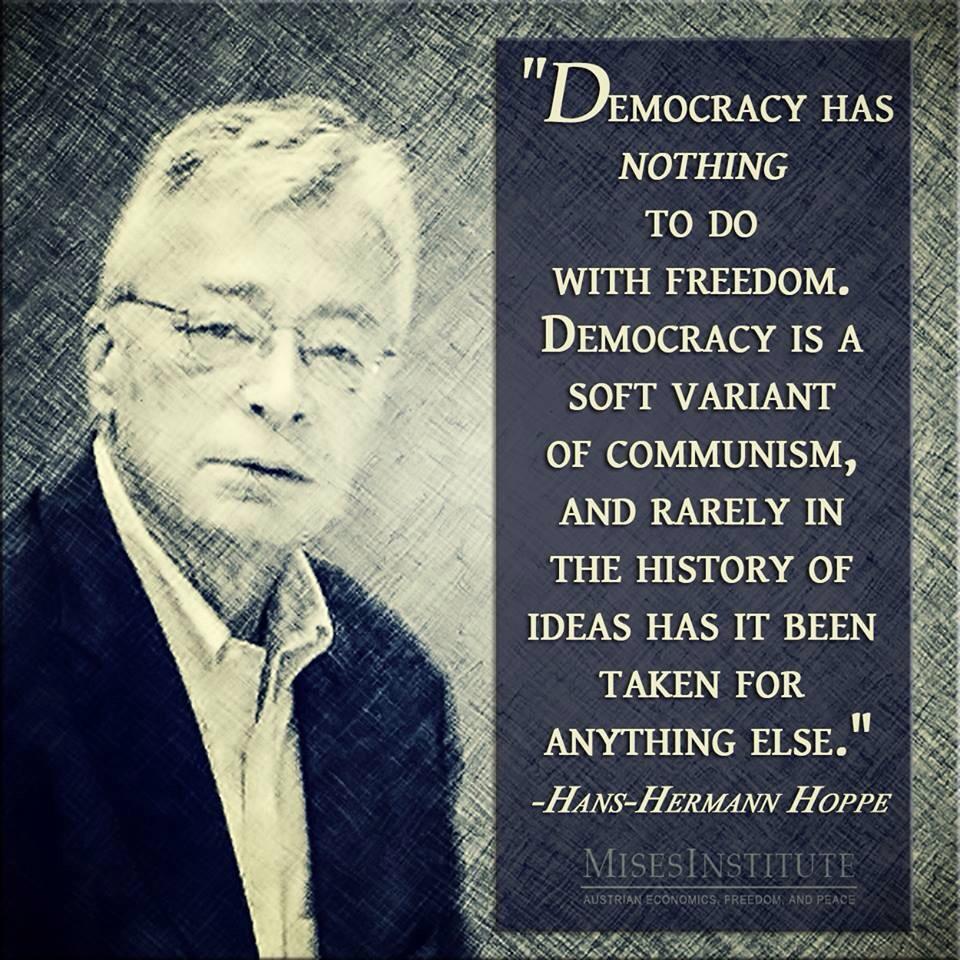
Hans-Hermann Hoppe’s book “Democracy: The God That Failed” is not a cohesive treatise, but rather a collection of essays arranged in an order that allows the author’s ideas to be presented fairly consistently. However, such a composition inevitably leads to self-repetition, and an author with more respect for his readers could have reduced the volume of the book by about thirty percent without compromising the result. But there are advantages to this approach: any of the chapters can be read entirely in isolation from the others if desired. I will not analyze the work chapter by chapter, but will touch upon the main ideas of the book, indicating what seemed valuable to me, and what seemed erroneous or underdeveloped.
Time Preference and Family Values
Hoppe begins by explaining what time preference is, and how it tends to decrease in a more civilized society and increase in a more barbaric one. From this, he concludes that those measures for organizing society that increase time preference are decivilizing measures, and therefore harmful—and vice versa.
He also touches upon another factor affecting a person’s time preference, namely the stages of their life. In childhood, time preference is high; a child is unwilling to wait to achieve their immediate goals. With age, it decreases as a person expands their planning horizons, and toward old age, it should theoretically increase again, since there is less time left to live, and, as Keynes rightly noted, in the long run we are all dead, so there is no point in making plans for a period exceeding the remainder of one’s life.
But, Hoppe joyfully notes, there is such a factor as the family. The desire for the prosperity of one’s lineage allows a person to maintain a low time preference into deep old age, for they know that the wealth they have accumulated will serve the benefit of their descendants. However, this requires the organization of people into stable collectives called families. Therefore, any measures that destroy families increase time preference in society, meaning they are harmful and decivilizing. Hence all of Hoppe’s hatred for communists, hedonists, and homosexuals; hence all of his conservatism. For the sake of instilling conservative values, he is ready to welcome any individual oppressions in the form of expelling individualists from patriarchal collectives, which are the bulwark of true civilization.
It is not difficult to see an elementary logical substitution here. Yes, family values reduce time preference in old age, but who said that this is the only thing capable of reducing it? People frequently do not squander their entire fortune by old age, but they do not necessarily leave everything to their children. Instead, for reasons incomprehensible to Hoppe, they continue to manage their capital prudently until death and bequeath it to various foundations, as did Nobel, Carnegie, or Rockefeller. That is, the family is clearly not the only factor that reduces time preference in old age, nor is it the factor that contributes most highly to the progress of civilization. A foundation, as the founder’s will formalized as a legal entity, often handles the expansion of the planning horizon even better than profligate descendants, who might even be tempted to hasten the benefactor’s end to spend everything sooner. Thus, one of the foundations of Hoppean apology for conservatism turns out to be shaky.
Aristocracy, Monarchy, and Democracy
The central part of the book is an analysis of how a society existing in natural freedom first, for natural reasons, becomes accustomed to seeking advice and the resolution of conflicts from its most competent members, then these individuals gradually turn into a hereditary aristocracy, then the aristocrats are subsumed by the wealthiest, who becomes an absolute monarch, and finally, the monarch is abolished by the Third Estate, and an order reigns in society where absolute power belongs to society as a whole, while temporary appointees rule in its name. At each of the described stages, the personal responsibility of the governors for the results of their management is diluted, the quality of services provided by the elite to society becomes lower, and the price becomes higher.
Fortunately, Hoppe notes, despite all this regress, people have succeeded in developing various useful market mechanisms, and now, in order to return the lost freedom, we do not need to return to natural aristocracy in its archaic form; it is sufficient that all services currently monopolistically imposed by the state be traded on a free market.
In Hoppe’s opinion, reforming the democratic state in this direction will not work, because there are too many managers of public property, the temptation to use power for personal gain is too great, and no libertarian party will be able to recruit enough ideological haters of the state to place them in all government positions. Fortunately, the majority always silently accepts the status quo, so in order to present it with the fact of the state’s abolition, there will be no need to win elections according to government rules; it is enough to rock the boat and then, through the coordinated effort of a determined minority, overturn it.
In short, a certain confusion arises. On one hand, there is the progress of society, during which time preference decreases. On the other hand, there is the regress of systems for managing society, as a result of which time preference increases.
I see little point here in nitpicking the author on the fact that the state hardly matured as a fruit of the evolution of natural aristocracy and its noble activity in resolving conflicts. Rather, it is likely the fruit of the evolution of a gang of robbers and their methods of solving issues through lawlessness, then through “understandings,” and then through laws. It is not so important whether Locke or Hobbes invisibly hovered over the waters on the first day of creation (both hovered, of course), as long as in the process of reconstructing the patterns of history, we arrive by different paths at a single conclusion regarding desired future changes in the organization of society.
The Beautiful Ancap of the Future
The most beautiful part of the book is the description of the functioning of a system of private insurance companies, which simply pay insurance premiums to their clients upon the occurrence of insurance events such as robbery or theft, but as a result, are forced to abolish states out of pure commercial calculation, because this means they will have to pay less to clients in insurance. Hayek’s name is not mentioned once, but this description fully aligns with his idea of spontaneous orders.
Here Hoppe provides a valuable consideration that I have not yet encountered in other authors. It is known that many skeptics argue: if two subjects who have contracts with different protection agencies begin to feud, this should lead to a war between the protection agencies contracted to them. David Friedman responds to this by saying that it is not profitable for agencies to fight, and therefore they will push the clients aside, hash it out among themselves, decide who is right, and present the clients with the fact. This looks logical, but generates bewilderment: how is such a model better than the current state model?
Hoppe provides a different logic. He does not speak of any protection agencies; the company’s task is the insurance of the client’s risks. But only those risks over which the client himself has no power are insured. If a company were to unconditionally pay fire insurance to everyone who insures their house and then sets it on fire, it would go bankrupt instantly; therefore, when drawing up contracts, it is always specified which cases are not insurable. Thus, in the event of a conflict, only the party that was not the aggressor in that conflict should be recognized as having the right to the insurance payout. Moreover, if both parties behaved extremely provocatively, it is not even that important who first resorted to open violence—such a case, where the client was asking for damage to the insured property, is obviously not insurable.
Another interesting reasoning is related to factors affecting the calculation of insurance premiums. They are higher the higher the value of the insured property, and they are lower the lower the costs of its protection. Thus, market logic will lead to the fact that insurance companies, wishing to earn a maximum, will fully contribute to the growth of the price of the client’s property, which is achieved, in particular, through its reliable security and reducing the probability of damage—but exactly this will lead to the margin decreasing, and insurance companies will have to master new markets, meaning come to more dangerous and poor places, for example, those where various criminal groups, like states or other thugs, still conduct their bandit activities. Thus, the activity of insurance companies will naturally lead to the expansion of security and the growth of the once-arisen zone of ancap.
Summary
Despite the fact that the author in a number of cases indulges his own tastes and falls into wishful thinking, the book contains a number of extremely useful ideas that were new to me, which I agree with, and which I will use in the future. Even if these ideas do not belong to Hoppe himself, he still deserves my respect as their popularizer.
What is the downvote mainly used for in politics today? These are dislikes under harmful bills, petitions to repeal harmful laws, rallies demanding the government’s resignation, actions like egging, and so on. In other words, it is a standard tool of direct, rather than representative, democracy.
Let’s try to imagine what the consequences of implementing the downvote for representative democracy would look like.
An elective body, a dozen candidates are running, all of them appear on the ballot; the voter comes to the polling station and gives dislikes to everyone they definitely do not wish to see in the specified position. The candidate with the minimum number of dislikes wins.
What are the downsides of such a system?
The chance of victory sharply increases for a “slippery Joe” who hasn’t managed to offend anyone because nobody really knows who he is. Politicians will compete for the image of the most featureless nobody.
A nobody might turn out to be lacking agency and simply hand over the levers of real control to their puppet master. We get the same result, just from a different angle, and with an even greater dilution of responsibility for political decisions.
What are the pluses?
The concept of a spoiled ballot disappears. An empty ballot means all candidates are liked. A scribbled-out one means none are liked.
No candidate with even a moderately high anti-rating will pass; that is, unpopular measures in a previous position effectively kill a public political career, even if there is a significant support group.
Voter turnout increases sharply: for the pleasure of giving a public politician a dislike, even the paralyzed will drag themselves to the polling station.
The fear of drastic measures will ensure that the state becomes far more inactive, and that is exactly what we libertarians want.
So, I approve of the proposed system for improving representative democracy. It’s just a pity that neither you nor I will live to see this wonderful time…
Regarding yesterday’s note on comparing Bitcoin with low-inflation fiat, I received a detailed response. In short, it postulates the importance of stable prices when using a currency as a medium of exchange. To ensure this, a decentralized cryptocurrency fiat is proposed: a crypto whose emission parameters are set by a vote of the currency holders.
To this, I can briefly respond: if anything is a fundamental property of prices, it is their variability. Price carries information about the relative need for goods for specific buyers at a specific moment. If you want the price of a specific good, expressed in a specific currency, to remain unchanged, your only option is to peg the exchange rate of that currency to the value of that good—effectively backing the currency with the commodity. There is no problem with creating a Bitcoin sidechain, freezing a certain amount of Bitcoins, and pegging the tokens issued against them, for example, to oil. That’s it; now one barrel of, say, Brent costs one token. Always. You just have to monitor the collateral size, because if oil becomes significantly more expensive in Bitcoins, the collateral will have to be increased. At the same time, when buying some aluminum or grain with “oilcoins,” you will inevitably encounter price changes.
But all of this has nothing to do with direct democracy, because you can never predict in advance what emission parameters the holders of your crypto-fiat will set. Perhaps they won’t want stable prices for some basket of consumer goods, but will simply take advantage of the fact that the emitter always profits from emission—and issue more tokens to quickly buy up Bitcoins with them. Or do you intend to build a managed democracy and prevent holders from acting so unsightly?
After logically poking at the boundary conditions of the two principles (if a person belongs to themselves, they should be entitled to sell themselves, and may also be stripped of themselves by court decision; as for the application of the non-aggression principle, everything boils down to the definition of aggression, which is subjective, and one cannot build stable orders on such a shaky foundation), they point out that left-anarchism has a solution. As a solution, that same direct democracy is proposed: all orders are established by all members of society.
Here I can only point out that a society of total direct democracy would require some criteria for who to include in the set of voters for each specific issue. Where is the line that, once crossed, a person loses the right to vote on a certain topic because it does not concern them? If there is no such line, we get a society where everyone is obliged to ask everyone’s permission for everything—a legal absurdity worse than the city of Morlow from Interstate 60. I hope to see an answer in the following parts of the review (in the article I analyzed, there is no such answer).
The image of legal absurdity—may it haunt you as well
It is believed that the state is something absolutely necessary for people, without which there would be chaos, banditry, and ruin. Yet, in different eras, the perception of what the state is and what it should be has differed radically. No matter which government textbook you look at, it always says that in the past, the state was very bad, oppressed people, and they rebelled. But now, the state is good, it does not oppress people, and stability is very important to us all. At the same time, the structure of the state in different countries also differs greatly, and the greater the difference between what is there and what is here, the more “incorrect” the model there is, and the better it would be for those unwise people to do as we do here. Meanwhile, we need to defend ourselves so they don’t do here what they do there.
Why the National State is Needed
Strong national states formed as a response to the constant threat of foreign invasion, as well as as a tool for such invasion. But although territorial seizures continue to this day, this is becoming less justified in the eyes of residents of other countries and less popular among their own citizens. The globalization of the economy has made trade wars far less effective. In other words, the unified national state is becoming less in demand—tasks simply cannot be found for this expensive and inconvenient tool.
The main threat to the state today is not external aggression, but the lack of civil consensus. In democratic states, candidates who rely on the people’s dislike of the political establishment are coming to power one after another. This means that people are not dissatisfied with individuals—they are dissatisfied with the system itself.
Problems of Democracy
Why is democracy providing civil consensus worse and worse? Because it is a dictatorship of the majority. If power stably belongs to the same political force, a stable dissatisfied minority forms, convinced that its interests are not being observed by the government, and therefore completely unmotivated to maintain any loyalty to the government. If the government and opposition regularly switch places, it results in an endless tug-of-war where policy becomes a compromise. Regulations are loosened, then tightened; taxes are decreased, then increased. No political program is implemented, and the voter’s frustration grows.
A minority is ready to obey the majority if it sees the need to unite in the face of external danger. But when there is no external danger, people realize there is no reason to tolerate it. And if external danger is fabricated, in our age of informational transparency, this causes even more irritation and distrust toward the establishment. The “make it the same for everyone” approach is rapidly losing popularity also because in all other sectors, a person easily receives individual service according to their requests—and only in those spheres for which the government is responsible must they somehow put up with unification. The future lies in transferring the individual approach into the political sphere.
For now, the individual approach in politics manifests in how the same candidate is tried to be sold to different categories of voters under different sauces before elections. In other words, political technologists already see the demand of the voters, but, unable to satisfy it, they try to at least give the dish different shades of flavor. But such a marketing strategy cannot work for long. More and more people want to somehow unite with those who share similar views and somehow peacefully separate from those to whom these views are offensive.
Separation
The simplest way of separation within the existing legal political tools is spatial separation. Chechens pushed all Russians off their land and now demonstrate a touching national unanimity to the outside world. American libertarians are moving to New Hampshire—and the state is rapidly deregulating its legislation.
However, physical relocation is only one way of changing conditions. If you don’t like the water company, you have to change your place of residence, but if you don’t like the mobile operator, it is enough to change operators without any moving. Government services have more in common with the services of a mobile operator than with utility infrastructure. At least, most government services look quite mobile.
Panarchy
Today’s state, through taxes, provides citizens with benefits such as education, healthcare, pension provision, law enforcement, control over fire, sanitary, ecological and a bunch of other safety measures, courts, and other small trifles—as well as that for which a strong central government was actually established: border protection against foreign invasion and services for seizing other states. Practically all these services can be perfectly provided on a competitive basis. After all, each of you calls your own insurance company when you get into an accident, so why can’t everyone contact their own police when protection is required?
Market solutions have already been invented and have a practice of successful implementation for absolutely all services that people need. Need, in this case, is determined by the willingness to pay for these services. A system of social relations in which all goods and services are supplied on a free competitive market is called anarcho-capitalism, and this is the liberal ideology brought to its logical limit.
However, such fine fragmentation of government service providers may not seem convenient to everyone, otherwise we would have long lived in such a fully competitive society. There is indeed a demand for a paternalistic state that cares for a person from the cradle to the grave, and it is even quite large. The entire twentieth century passed under the banner of armed struggle between socialism and liberalism, and despite the loud fall of odious totalitarian regimes, it must be admitted that both sides lost in this struggle: classical liberal states have also mostly vanished into oblivion. Therefore, the main challenge facing humanity today is the peaceful separation of socialists and liberals without violating the integrity of national entities (clustering by nationality, having one language and similar cultural norms, is also convenient for people). In fact, we are talking about the simultaneous coexistence of one or several socialist and liberal governments on the territory of one country or block of countries. Such a system is called panarchy, and this idea is being actively developed by intellectuals worldwide, in both developed and developing countries.
Transition Scenarios
Of course, the simplest path to embodying major social transformations is dictatorship. A coup or revolution is not mandatory. It is enough for a populist to come to power, concentrating a constitutional majority in parliament in their hands, subordinating the courts and, most importantly, having broad popularity among the people. A hypothetical Lee Kuan Yew or, conversely, Chavez.
The simplest path, however, also carries the greatest danger. Over time, someone else will replace the dictator and begin to repeal everything that was adopted.
A more complex but more reliable path is a broad public campaign. When very many people demand reforms—loudly, demonstratively and at every convenient opportunity—eventually their inevitability becomes obvious. Once they occur, they are much harder to repeal.
There is also a very simple and familiar path for Russia—catch-up development. Wait until panarchy works in the European Union and the USA, in China and Korea, in South Africa and Brazil—and then finally carry out the necessary transformations, while the lag behind Nigeria still doesn’t look completely hopeless.
And finally, those citizens who require separation can simply present the rest of the state with a fait accompli. Here is your state, here is ours. One territory, different norms. We pay taxes to our government according to the agreement, and we do not pay them to yours. Will you try to use force to return us to your jurisdiction? Guys, a civil war is not budgeted for, and in general, let’s live in harmony, because we have already charged the batteries of our drone. As the famous political scientist Ekaterina Schulmann states, the motto of our time is becoming “What, was that allowed? Yes, it was.”
And if there is no transition?
Well, what will happen if no transition to panarchy occurs?
A couple of inertial scenarios are possible. In the first, Russia sluggishly democratizes, the screws are loosened little by little, and the country gradually turns into something quite decent in Eastern Europe, no worse than some Moldova. In the second, Russia just as sluggishly tightens the screws, pushing particularly active opposition figures abroad, and gradually turns into something bleak in Eastern Europe, like Belarus.
It is also possible that what today exists more in journalistic articles than in regulatory documents will finally take shape. The sovereignization of regions, state corporations, and special services will occur, and the country will slide into clan feudalism. The tendencies for this exist, and as the current president weakens, they may become stronger.
But as long as the state, without reforming in the proper key, continues to somehow degrade, society may simply, by a process of attrition, begin to transition to alternative means of coordination—alongside the state, in spite of the state, and remaining invisible to the state. When people make deals under the table, using private money, resolve their conflicts in a private court, use the services of private security companies and so on, then from a certain moment, the uselessness of the state becomes obvious to literally everyone. In this case, Russia will transition to anarcho-capitalism, bypassing the stage of panarchy.
What to do?
So, you have encountered a fairly long text where unfamiliar terms are introduced, an unusual social structure is described, and strange predictions are made. What to do with this next?
Even if you are a supporter of the status quo, it is still useful for you to know that such a discourse exists and is gaining popularity. You can warily observe the penetration of these ideas into the masses or actively oppose them—but one way or another, it won’t hurt you to familiarize yourself with them, just as it is useful for liberals to know the basics of socialist doctrine, and for atheists—the New Testament.
If you are a convinced democrat, then perhaps you have simply never eaten any fruit sweeter than a carrot. Take a look at what is being proposed to replace modern liberal democracy; it’s possible you will find a grain of truth in these proposals.
Finally, if you like what has been presented, then it is all the more worth studying the texts on this site, discussing them with acquaintances—and from there, it may lead to gradual implementation.


'/%3E%3C/svg%3E)