Transaction security is easy and without power control!

Voluntarist, Bitarch

We have already considered the topic of transaction insurance once before. This method is perfectly applicable to the issue of guaranteeing transaction security and compensating for damages in the event of a breach of agreement by one of the parties. The need to resort to violence and forceful measures of coercion is thus eliminated, meaning this concept is fully implementable in the absence of a state monopoly on law enforcement, and indeed in the absence of any police or security agencies whatsoever. Furthermore, it is compatible with the concept of reputational institutions, which creates additional scenarios for its application. Even now, it is actively used in large transactions and in the lending sector. However, doubts are sometimes expressed regarding its applicability in small, everyday transactions.

The way accident insurance currently works can help us dispel these doubts. You have surely been in a situation where, when buying a ticket for a bus, train, or plane, you were offered insurance. Insurance is also offered when renting transport via a mobile application, even if it is just a bicycle or a scooter. Usually, the cost of such insurance is only a few dozen rubles, yet the compensation in the event of an insured loss reaches tens and hundreds of thousands.

See how easy it is? For a provider of risky services, there is no difficulty in concluding a contract with an insurance company and adding the option for their customers to take out accident insurance. This is even profitable for them, as they can receive additional profit from the insurance company for implementing its services. And in the case of transport rental, this matter is simplified to the press of a single button in a mobile application. Since this type of insurance is so easily implemented, there is no problem in making transaction insurance simple as well.

The parties sign a contract, after which it is uploaded to the insurance company’s application (or perhaps concluded directly within it). Then the application calculates the insurance premium rate and the participants of the contract pay it. That’s it. If one of the parties eventually breaches the agreement and the other party provides the insurance company with evidence of the breach, they will be entitled to an insurance payout, which should be sufficient to cover the damage caused. The party that breached the agreement, of course, will not go unpunished if reputational institutions are used alongside this. They will simply be placed on blacklists until they admit guilt and cooperate.

Even in the case of the most ordinary purchases, this concept is also applicable. At a self-checkout terminal, by pressing the corresponding button, or by asking the salesperson, one could also take out insurance. If the product turns out to be unsuitable, defective, or even worse, causes harm to the buyer, and the seller denies their guilt, there would be an opportunity to compensate for the damage through this insurance (and the seller, of course, would suffer reputational punishment). To attract buyers, sellers could add the insurance function and openly publish data on which insurance companies they work with. And those sellers who are unwilling to insure their sales can simply be bypassed by buyers as unsafe agents.

Some might criticize this idea by pointing out that buyers would now have to pay more for goods, and in general, all transactions would become more expensive. However, this is exactly what is happening right now. Due to VAT, excise duties, customs duties, licenses, and the tax burden on entrepreneurs, more than half of the cost of goods already consists of contributions to the state, including for the maintenance of a giant, organizationally extremely inefficient state judicial and police system. Transaction insurance, on the other hand, is a cheaper and more effective solution. Sometimes insurance premiums, where they are currently applied, amount to less than one percent of the transaction amount or the potential insurance payout. Thus, it is a much better solution than state bureaucracy and forceful control paid for by taxes.

Transaction insurance, supplement

I want to supplement Voluntarist’s yesterday’s post on transaction insurance.

In the Telegram comments, several points were quite rightly noted.

First, classical individual insurance is always based on statistics and probabilities, so it will primarily be applied where transactions are standardized and risks are sufficiently random. It is quite difficult to imagine, for example, insuring a bank against a borrower’s intentional non-payment of a loan while prohibiting the insurance company from forcibly recovering that very loan. If such an insurance service were provided, there would be a fairly strong temptation for bank employees to organize a scheme of issuing non-repayable loans to shell companies for kickbacks, with the bank subsequently receiving insurance when the loan is not returned.

Second, the use of escrow accounts is usually imposed on transaction participants by the platform owner who sets the trading rules. If transactions occur without an intermediary, the use of an escrow scheme is unlikely, especially if the freezing of funds is expected to be long, as in the case of shared construction agreements.

Third, I was reminded of my year-old post about, suddenly, juvenile justice, where I noted certain difficulties with liability insurance.

In this regard, I want to mention another convenient way to reduce the risks of contract non-performance that is not related to violent coercion. These are the good old insurance groups, meaning archaic collective responsibility. In the old days, a person’s entire kinship, tribe, clan, or community—in short, a group of relatives and possibly neighbors—was responsible for them. Therefore, one didn’t have to worry much about personal reputation; instead, a person was judged by who they belonged to.

Of course, in a stateless society, there is no need to necessarily restore communal living, although the factor of belonging to an insurance group would be a compelling reason to cluster in such a way. Then again, there is certainly no need now to organize specifically by kinship, as friends and like-minded people play the role of the kin today. But I want to discuss not interest-based circles, but how transaction risks can be further reduced.

Entrepreneurs wishing to earn the trust of potential counterparties can form associations. Admission to such an association can be based on various criteria. Some may be accepted for an already established good name. Others—for promises to conduct business with impeccable honesty and a large deposit. Others—under the guarantee of respected members of the association. For external counterparties, the association acts as a group guarantor for the transactions of its members.

Every member of the association is, on one hand, interested in the growth of its membership, because this means that in the event of collective responsibility, the losses of each member are reduced. On the other hand, everyone is interested in ensuring that only honest and reliable entrepreneurs enter the association—those who insure others rather than parasitize the collective. The association will cover the costs of a breached contract not only for classic insurance events, but also in cases of force majeure, and even if a member of the association turns out to be a fraudster. But, of course, in the latter case, it would mean a “wolf’s ticket” (blacklisting) for such an entrepreneur.

Finally, I will note that the proven, well-known dishonesty of an entrepreneur by no means means that he will die in a ditch because no one will sell him anything and no one will hire him for anything. It simply means he will not be taken at his word, and all transactions for him will operate on a “money upfront” principle.

Any attempts to depict a stateless society as something totally cannibalistic imply either an incredible scarcity of resources for which people must tear each other’s throats out, or a post-totalitarian syndrome of complete mutual distrust. Naturally, the gradual dying out of non-violent practices in general and the state in particular cannot be accompanied by such catastrophic symptoms.

Interview for admission to the association of agricultural producers

Transaction Insurance

Voluntarist

The topic of non-violent tools for implementing measures against those who violate agreements has been raised by us several times before. Usually, in such cases, the conversation revolves around reputational institutions and ostracism, but besides this, the case of financial instruments providing the possibility of predetermining mechanisms to cover damages caused by a breach of agreement is particularly interesting. Transaction insurance can be called a fairly universal tool of this kind.

To demonstrate what is meant by transaction insurance, let us look at a case of an existing implementation of this practice. It is actively used in lending, especially when it comes to large loans or mortgages. The essence is that the person borrowing the funds also signs an insurance contract, under which they undertake to additionally pay an insurance premium, usually in the amount of a certain percentage of the remaining debt. This percentage is small; its value rarely exceeds 1%, and in the case of a mortgage, one can find an insurance premium rate as low as 0.25% of the remaining debt.

Why is this necessary? If a person finds themselves unable to repay the loan, or if they took it solely for the purpose of stealing the credit funds with no intention of returning them, then these funds are covered by insurance. Given that, in reality, not such a large percentage of people actually violate the terms of the transaction, the funds collected through insurance premiums are quite sufficient to cover the damage caused by a small percentage of deceivers.

As for me, transaction insurance has very great potential. This concept could be applied to a wide spectrum of transactions in principle. During any transaction, the parties could register the contract with an insurance company and contribute a certain small percentage of the transaction amount to an insurance fund. If one of the parties violates the terms of the transaction, the insurance company where the insurance was registered compensates the damaged party.

This method can also be combined with other types of non-violent sanctions, such as the aforementioned ostracism. A violator of a transaction will, of course, end up on blacklists; the insurance company, which had to spend funds from its fund to compensate for the damage, is especially interested in this. The violator’s life will be very difficult; many will refuse to conduct transactions with them or offer less favorable terms that account for the risk that this person might cheat. But, of course, they can get out of this situation if they eventually agree to cooperate and make concessions to those who suffered from their violation. Of course, they may not have the opportunity to compensate for the damage caused at the moment, however, in such a situation, the parties usually agree on more accessible terms for fulfilling obligations. In the credit sphere, a good example is the debt restructuring procedure, when payments are shifted to the future, stretched over time—which reduces the payment amount—or when a part of the interest rate or the debt itself is written off. In the end, all parties prefer some solution to the problem over the absence of one.

Reputational institutions can also be combined with transaction insurance in a different way. If someone is known for their honesty, with many transactions behind them that they did not violate, they may be offered lower insurance premiums, or even their complete absence. If, however, someone is a known violator or an unreliable agent, transactions with them can be concluded only on the condition of paying higher insurance premiums. Thus, it becomes profitable for people not to violate agreements, since the replenishment of the insurance fund will be shifted specifically onto the violators.

Discussion around dangerous psychos

The post about dangerous psychos sparked a surprisingly lively discussion, as well as a comparable number of likes and dislikes; therefore, there is something to discuss.

First, many expressed doubt about the idea that insurance companies would face customer demand for the treatment of insane offenders, instead of shooting them, harvesting their organs, feeding them to pigs, or exiling them (where to?)

Indeed, this is merely an assumption, an extrapolation of the current trend toward humanization, as well as the current trend toward a more complete understanding of the principles of consciousness and the causes of mental failures. Therefore, I assume that this treatment will become cheaper and more reliable. Thus, dangerous psychos will, in most cases, receive their treatment before it leads to a tragedy, and only in the rarest situations—when a clouding of the mind went unnoticed and led to murder—will the conversation turn to post-factum treatment; and only after successful treatment can the conversation about financial compensation begin. In the long term, such an approach remains quite profitable for insurance companies.

Secondly, of course, I count on the fact that if anyone, including a psycho, attacks anyone, they will be stopped by the power of weapons, and then both the holes in their body and their brain will be treated, after which a bill will be presented. So, the general alertness of the ancap community, where people are ready to personally defend their freedom and property, should also work to reduce the significance of the raised problem of violence by the insane.

Thirdly, the question of who guarantees that insurance companies will not begin preemptively treating healthy people for mental disorders caused disputes. It is clear that the roots of this question grow from the practice of punitive psychiatry by the state. Why does the state do this? To ensure that the subjects do not have any “little thoughts” about the forced termination of the social contract with the ruling regime. Why would insurance companies do this? Who the hell knows. Applying forced treatment to one’s own clients is fraught with lawsuits if the client was healthy. Applying forced treatment to other people’s clients is a very strange form of altruism, and even more fraught with lawsuits if the person was healthy. Forcibly treating the uninsured might prove to be a useful preventative measure to avoid waiting until they start attacking clients. Here, one must calculate the benefits/costs. But even here, the forced treatment of healthy people brings no benefit.

However, the theme will live on in cinema for some time

About dangerous psychos

We have psychiatric hospitals and maximum-security prisons.

Their “clients” remind us that there are very real psychopaths, maniacs, serial killers, and other problematic characters. Most of them are not Dexters or Hannibal Lecters, and they do not act in accordance with the public good. Due to the peculiarity of the processes occurring in their brains, there is no clear way to convince them using reasons or arguments.

How can ostracism help against them?

What would a system for searching and destroying or isolating such “Jack the Rippers” look like? If it is isolation rather than destruction, then with whose money and by whose efforts?

анонимный вопрос

People value security and are willing to pay for it. Inadequate aggressors are not just dangerous, but because of their apparent irrationality, this danger seems even more serious than if people applied the cold reason of an insurance agent. The same considerations apply here as to why people fear terrorist attacks more than car accidents, even though mortality from the latter is much higher.

The most obvious market agent that could provide such a service is, of course, insurance companies. They collect premiums while the client is safe and pay out a benefit in insured cases. Therefore, assuming that insurance companies act in good faith and do not cheat their clients, it is in their interest to promote the maximum safety of their clients.

But security from maniacs can be provided in different ways, and this is determined by social mores. Clients may desire security from packs of stray dogs but categorically protest against their wholesale extermination, so those who undertake to satisfy this whim will have to account for the corresponding restriction in means.

Similarly, simple empathy no longer allows our wealthy and prosperous society (and under ancap it is presumably expected to be even wealthier and more prosperous) to demand security from violent psychotics through their extermination; rather, it is a matter of treatment. Again, a mental disorder may be acquired rather than innate, for example, as a result of trauma, and before that, the person could well have been a respected client of an insurance company. Thus, the obvious line of thought in our case would be the search for methods of treatment.

Will this be expensive? Pennies. I did not mention the comparison between terrorist attacks and car accidents for nothing. A disproportionate amount is spent on preventing terrorist attacks. In the same way, violent psychotics will receive a disproportionate amount of attention, although their number is completely negligible. Of course, if a person with mental problems had an insurance policy, they would receive higher quality and more expensive treatment, but even if there was no policy, they would still be attempted to be returned to normalcy, and by quite humane methods.

On the difficulties of mutual understanding with communists

Imagine the following situation. You are the director of the “Ancapistan” insurance company, which governs a certain territory. I am the speaker for the “Ancomistan” commune (we have no leader, but I am usually entrusted with conducting meetings and going on diplomatic trips on behalf of the commune), which also owns a certain territory. We share a common water border on a lake. Ancapistan is on the right bank of the lake, and Ancomistan is on the left. Almost the entire coastline of Ancapistan, except for a single shipping port, belongs to one private individual who uses the water for his chemical plants. You supply us with fertilizers and complex machinery, and we supply you with agricultural products, timber, and metals.

Then, at one fine moment, the aforementioned private individual begins to delay the replacement of filters, and many toxic substances enter the water. Since we share a common lake, several dozen people in Ancomistan (the lake is our only external water resource, whereas you also have a river on your territory) drink water from this lake, and all of them perish. And here is where it gets interesting. In Ancomistan, negligence resulting in grave consequences is punished by 15-20 years of hard labor for the benefit of the commune or by death by hanging. In Ancapistan, it is punished only by compensating the victims for damages. I hold a meeting where I raise the question of how to assess the damages for compensation. 5% of the communards suggest taking money and placing it in the commune’s account at the bank for international trade, 10% suggest sending the private individual to 15-20 years of hard labor, and 85% suggest the gallows, given the cynicism of valuing lives in money. In the end, the commune issues a death sentence and instructs me to send an extradition request. You offer to compensate for the damages, but I show you the paper with the commune’s resolution and continue to insist on extradition. Upon receiving a refusal, I state that in this case, the commune will completely stop supplying resources to Ancapistan and stop buying from it. If we sever trade relations, Ancapistan will lose one of its markets for selling and buying resources. Besides Ancomistan, the only other raw material territories nearby are in Anprimistan. You can sell finished products to them, but due to their poverty, they will not buy your products at the high price we pay. Also, due to the higher complexity of resource extraction, they will not sell you resources at the low price Ancomistan provides.

Ancomistan itself will simply drill water wells and sign a trade contract with Transgumistan, which sells and buys products at almost the same price but is located slightly further away than Ancapistan. As a result, you will have an economic crisis, while our standard of living will practically remain unchanged. Question: will you extradite the private individual to Ancomistan and thereby violate the NAP regarding him, or will you lose one of your markets for buying and selling resources and find yourself in a deep crisis?

Ancom-kun (question accompanied by a donation in the amount of 0.00023397 BTC)

Thank you for this long and interesting story, which demonstrates the problems a territorial commune may face. Fortunately, Ancapistan is merely an insurance company. We insure lives, real estate, transport, risks of industrial disasters, and so on. The fact that an insured enterprise failed to change filters on time and we did not find out about it (although non-compliance with technical regulations by the insured party is grounds for terminating the contract or revising the premium size due to increased risk) means only one thing: our employee was negligent or was bribed by the insured enterprise. Naturally, this means we fire our agent and revise our own regulations to prevent this from happening again. We also refuse to pay insurance to the insured company and sue it for fraud—they did not perform the procedures required by the regulations but did not inform us, thereby saving on insurance premiums. If other clients approach us for insurance due to the lake pollution (for example, fishermen or travel agencies whose activities are affected), we will have to pay them premiums, after which we will file claims against the enterprise for reimbursement of our losses.

Additionally, it seems we insured the life of the enterprise owner. This contract remains in effect, and we are obliged to prevent attempts on his life within the limit of expenses agreed upon by the insurance premium. So, we either take him under protection or provide him with a comfortable shelter and give him the opportunity to safely negotiate with Ancomistan to settle the claims.

Furthermore, Ancomistan takes a principled stand and insists on executing the businessman who offended them, refusing all his offers of financial compensation, even the transfer of the plant to the commune’s ownership. Therefore, the businessman continues to stay in the shelter and manage the plant from there. When the time comes to renew the insurance contract, we face a dilemma: either refuse the renewal or set an exorbitant price, because we are effectively acting not as an insurer, but as a security company. In the end, we reach an agreement: he continues to pay the bills, and we continue to protect him.

After this, Ancomistan begins to blackmail our other clients, threatening them with the termination of contracts if we do not hand over the criminal. We realize that further protection is impractical and finally terminate the contract with him. The former client, not being a fool, immediately signs a contract with another security company operating in the middle of nowhere, and they organize his evacuation. Then, being physically several thousand kilometers away from the vengeful commune, he continues negotiations with them, because he does not wish to wake up one fine day with an ice pick in his head. But his negotiating position becomes stronger, as it is more difficult for the commune in this situation to pressure his new security company. Therefore, most likely, after some time, you will reach some compromise with him.

The question of your sanctions against my insurance company remains. We protected our client within the framework of the contract, and as for what “extradition” is, we don’t understand it at all, because in our language it is called “kidnapping.” Refusing to protect is one thing, but kidnapping a person and handing them over to some bandits for subsequent execution is something entirely different. Nevertheless, we bear part of the responsibility to the commune because we poorly monitored our agent who was tasked with overseeing the compliance of technical regulations for our client. We offer Ancomistan compensation, and since there is no question of direct guilt in this case, we will most likely reach an agreement. After this, I have a claim against our former employee, but that is a completely different story.

Someone here is asking for trouble…

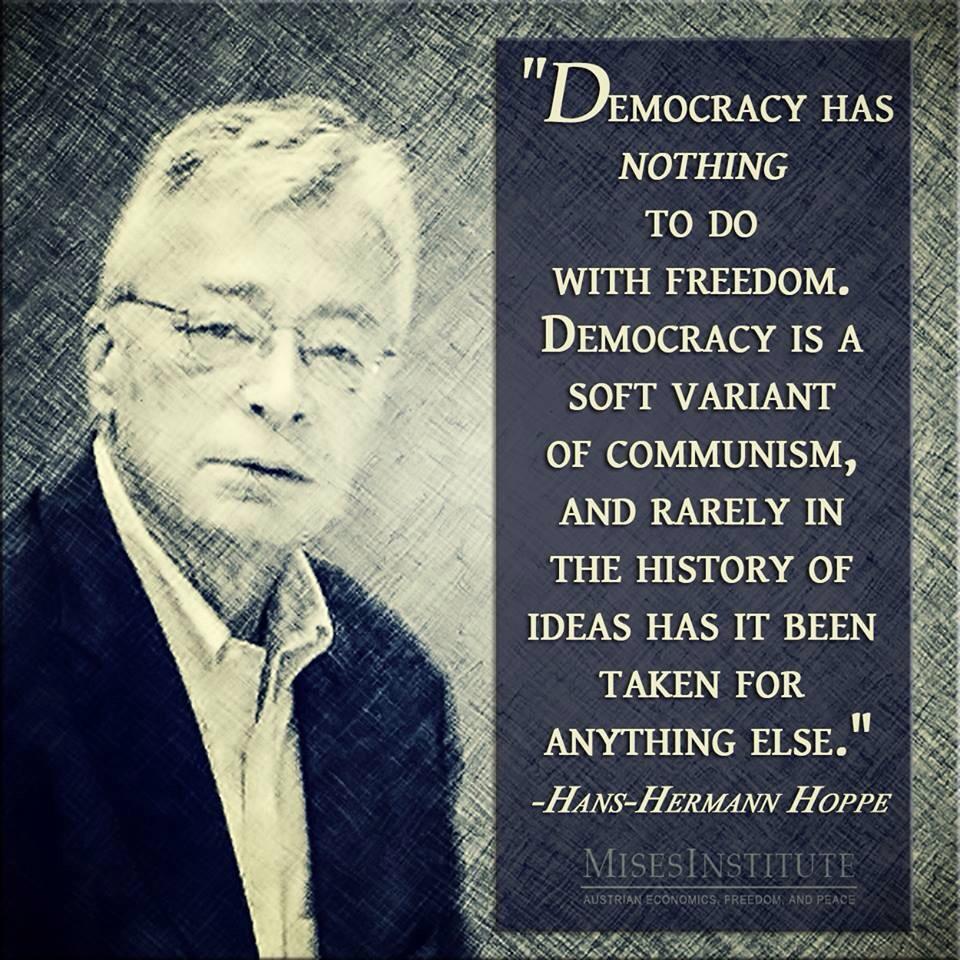
Democracy – a dethroned god. Review.

Commissioned by the Tea Club

Hans-Hermann Hoppe’s book “Democracy: The God That Failed” is not a cohesive treatise, but rather a collection of essays arranged in an order that allows the author’s ideas to be presented fairly consistently. However, such a composition inevitably leads to self-repetition, and an author with more respect for his readers could have reduced the volume of the book by about thirty percent without compromising the result. But there are advantages to this approach: any of the chapters can be read entirely in isolation from the others if desired. I will not analyze the work chapter by chapter, but will touch upon the main ideas of the book, indicating what seemed valuable to me, and what seemed erroneous or underdeveloped.

Time Preference and Family Values

Hoppe begins by explaining what time preference is, and how it tends to decrease in a more civilized society and increase in a more barbaric one. From this, he concludes that those measures for organizing society that increase time preference are decivilizing measures, and therefore harmful—and vice versa.

He also touches upon another factor affecting a person’s time preference, namely the stages of their life. In childhood, time preference is high; a child is unwilling to wait to achieve their immediate goals. With age, it decreases as a person expands their planning horizons, and toward old age, it should theoretically increase again, since there is less time left to live, and, as Keynes rightly noted, in the long run we are all dead, so there is no point in making plans for a period exceeding the remainder of one’s life.

But, Hoppe joyfully notes, there is such a factor as the family. The desire for the prosperity of one’s lineage allows a person to maintain a low time preference into deep old age, for they know that the wealth they have accumulated will serve the benefit of their descendants. However, this requires the organization of people into stable collectives called families. Therefore, any measures that destroy families increase time preference in society, meaning they are harmful and decivilizing. Hence all of Hoppe’s hatred for communists, hedonists, and homosexuals; hence all of his conservatism. For the sake of instilling conservative values, he is ready to welcome any individual oppressions in the form of expelling individualists from patriarchal collectives, which are the bulwark of true civilization.

It is not difficult to see an elementary logical substitution here. Yes, family values reduce time preference in old age, but who said that this is the only thing capable of reducing it? People frequently do not squander their entire fortune by old age, but they do not necessarily leave everything to their children. Instead, for reasons incomprehensible to Hoppe, they continue to manage their capital prudently until death and bequeath it to various foundations, as did Nobel, Carnegie, or Rockefeller. That is, the family is clearly not the only factor that reduces time preference in old age, nor is it the factor that contributes most highly to the progress of civilization. A foundation, as the founder’s will formalized as a legal entity, often handles the expansion of the planning horizon even better than profligate descendants, who might even be tempted to hasten the benefactor’s end to spend everything sooner. Thus, one of the foundations of Hoppean apology for conservatism turns out to be shaky.

Aristocracy, Monarchy, and Democracy

The central part of the book is an analysis of how a society existing in natural freedom first, for natural reasons, becomes accustomed to seeking advice and the resolution of conflicts from its most competent members, then these individuals gradually turn into a hereditary aristocracy, then the aristocrats are subsumed by the wealthiest, who becomes an absolute monarch, and finally, the monarch is abolished by the Third Estate, and an order reigns in society where absolute power belongs to society as a whole, while temporary appointees rule in its name. At each of the described stages, the personal responsibility of the governors for the results of their management is diluted, the quality of services provided by the elite to society becomes lower, and the price becomes higher.

Fortunately, Hoppe notes, despite all this regress, people have succeeded in developing various useful market mechanisms, and now, in order to return the lost freedom, we do not need to return to natural aristocracy in its archaic form; it is sufficient that all services currently monopolistically imposed by the state be traded on a free market.

In Hoppe’s opinion, reforming the democratic state in this direction will not work, because there are too many managers of public property, the temptation to use power for personal gain is too great, and no libertarian party will be able to recruit enough ideological haters of the state to place them in all government positions. Fortunately, the majority always silently accepts the status quo, so in order to present it with the fact of the state’s abolition, there will be no need to win elections according to government rules; it is enough to rock the boat and then, through the coordinated effort of a determined minority, overturn it.

In short, a certain confusion arises. On one hand, there is the progress of society, during which time preference decreases. On the other hand, there is the regress of systems for managing society, as a result of which time preference increases.

I see little point here in nitpicking the author on the fact that the state hardly matured as a fruit of the evolution of natural aristocracy and its noble activity in resolving conflicts. Rather, it is likely the fruit of the evolution of a gang of robbers and their methods of solving issues through lawlessness, then through “understandings,” and then through laws. It is not so important whether Locke or Hobbes invisibly hovered over the waters on the first day of creation (both hovered, of course), as long as in the process of reconstructing the patterns of history, we arrive by different paths at a single conclusion regarding desired future changes in the organization of society.

The Beautiful Ancap of the Future

The most beautiful part of the book is the description of the functioning of a system of private insurance companies, which simply pay insurance premiums to their clients upon the occurrence of insurance events such as robbery or theft, but as a result, are forced to abolish states out of pure commercial calculation, because this means they will have to pay less to clients in insurance. Hayek’s name is not mentioned once, but this description fully aligns with his idea of spontaneous orders.

Here Hoppe provides a valuable consideration that I have not yet encountered in other authors. It is known that many skeptics argue: if two subjects who have contracts with different protection agencies begin to feud, this should lead to a war between the protection agencies contracted to them. David Friedman responds to this by saying that it is not profitable for agencies to fight, and therefore they will push the clients aside, hash it out among themselves, decide who is right, and present the clients with the fact. This looks logical, but generates bewilderment: how is such a model better than the current state model?

Hoppe provides a different logic. He does not speak of any protection agencies; the company’s task is the insurance of the client’s risks. But only those risks over which the client himself has no power are insured. If a company were to unconditionally pay fire insurance to everyone who insures their house and then sets it on fire, it would go bankrupt instantly; therefore, when drawing up contracts, it is always specified which cases are not insurable. Thus, in the event of a conflict, only the party that was not the aggressor in that conflict should be recognized as having the right to the insurance payout. Moreover, if both parties behaved extremely provocatively, it is not even that important who first resorted to open violence—such a case, where the client was asking for damage to the insured property, is obviously not insurable.

Another interesting reasoning is related to factors affecting the calculation of insurance premiums. They are higher the higher the value of the insured property, and they are lower the lower the costs of its protection. Thus, market logic will lead to the fact that insurance companies, wishing to earn a maximum, will fully contribute to the growth of the price of the client’s property, which is achieved, in particular, through its reliable security and reducing the probability of damage—but exactly this will lead to the margin decreasing, and insurance companies will have to master new markets, meaning come to more dangerous and poor places, for example, those where various criminal groups, like states or other thugs, still conduct their bandit activities. Thus, the activity of insurance companies will naturally lead to the expansion of security and the growth of the once-arisen zone of ancap.

Summary

Despite the fact that the author in a number of cases indulges his own tastes and falls into wishful thinking, the book contains a number of extremely useful ideas that were new to me, which I agree with, and which I will use in the future. Even if these ideas do not belong to Hoppe himself, he still deserves my respect as their popularizer.

Containment by “Dead Hand”

In May, Bitarch and I on one side, and Ved Neumann on the other, debated the applicability of the deterrence doctrine to ensure the secession of individuals from the state. Here is a description of the doctrine, and here is a summary article, which also briefly recounts the course of the discussion.

A frequent criticism of the described doctrine was that it remains unknown whether the threat against the key functionaries of the aggressor state will actually be carried out, while the death of a citizen seeking secession could be very swift, leaving them no time to organize retribution. Moreover, if they openly insure themselves somewhere, a sad fate might await the insurance company as well, as a warning against fulfilling various anti-state contracts.

Therefore, today we will talk a bit about how a citizen can ensure the implementation of individual deterrence without putting any outsiders at risk.

The dead hand principle is a kind of threat against a potential aggressor that will be executed only if the potential victim perishes. The most vivid embodiment is a grenade with the pin pulled, held in the very much living hand of the potential victim. Their death will lead to the dead hand relaxing and an explosion occurring. Clearly, a threat based on this principle can be scaled quite arbitrarily, up to a system implementing the automatic launch of intercontinental nuclear missiles in the event of an attack by a potential adversary, without waiting for special commands from a potentially already destroyed command post.

One could fantasize about purely engineering solutions in the spirit of the 20th century that would provide such a threat scheme for a person against the state leadership—for example, by pre-mining residences, deploying rocket launchers, or programmed combat drones, but all this looks disproportionately expensive, clumsy, and unreliable. Our information age implies a slightly different style.

For example, with the appearance of bitcoins, decentralized death betting markets became quite feasible, which is a veiled form of a contract killing. The mechanism is roughly as follows.

On a website that accepts bets on certain events that may or may not happen in real life (for instance, implemented on the Augur protocol), a potential victim of state aggression can place a bet on the death of a certain government official. The size of the bet must be large enough to tempt someone to ensure that very death. The money is bet on the fact that this official already died on some day in the past, which is obviously untrue; therefore, when the official actually dies, this bet will lose, and the winner of the wager will receive it. After the bet is placed, a potential hitman only needs to choose a day to execute the order, bet that the target will die on that specific day, then commit the murder, wait for the oracles to notify the system, receive their winnings, and carefully cash them out. This wager is our grenade, but a dead hand mechanism must still be organized.

One could take a more sophisticated route and place another bet on the same market, this time on one’s own death. If this bet wins, it triggers a smart contract that then places the bet on the official’s death. But it could be simpler: a smart contract that places a bet on the official’s death is given a delayed launch and triggers if it does not receive a cancellation code in time. That’s it; now you can notify the official that, unfortunately, if I accidentally die, your precious life is in great danger, so you had better treat me with the utmost care.

Of course, the more complex the predictions the service allows, the more carefully and moderately the impact can be planned. For example, the trigger could be not only death, but also arrest, and the threat not only death, but the burning of a house, or some other non-lethal nuisance (the most elegant thing I’ve come across was an order to spray a powerful odorant in an official’s residence; a house thoroughly stinking of mercaptans is no longer fit for habitation or sale, yet no one dies even accidentally).

Naturally, to undertake these non-trivial measures, a person must be sufficiently wealthy, but this does not require exorbitant riches, so the task is quite manageable.