Theory of a Free Society

I read the essay “Theory of a Free Society,” which was recently released by Vitaly Tizun. I was pleased that for a relatively small volume—only 80 thousand characters—the text is very substantial.

Vitaly dedicates the first part to a critique of the state, demonstrating the incompatibility of this institution with the needs of the individual, regardless of the form the state takes.

The second part briefly describes the principles of organizing a free stateless society. I particularly liked the clarity of the section explaining the interconnectedness of subjects—there is a fairly original argument, which is encountered quite rarely, that many of the perceived weak points of ancap are linked to viewing a single transaction in a vacuum, while in reality, there is an entire network of contractual interactions. It is a pity that the section on the institution of reputation does not address the factor of the cost of applying reputational sanctions. Propaganda is propaganda, but it is also useful to analyze the potential weak points of ancap; otherwise, after reading the text, one is left wondering: why is it that such a wonderful social system, which is completely natural, fits everyone perfectly, and is capable of self-maintenance, nonetheless does not dominate anywhere to this day.

The third part explains which factors will contribute to the stability of ancap and prevent the return of the state, whether through market mechanisms or by means of military seizure. The section on the doctrine of deterrence was clearly strongly influenced by the ideas of Bitarch, and you have already read something similar from me.

The fourth part outlines the main strategies for achieving ancap, and here as well, much echoes the videos of Libertarian Band.

Overall, the work is very solid, and I readily recommend it to those who want to get a fairly confident understanding of ancap in a very modest amount of time.

Download in epub fb2 mobi pdf

How to build mutual aid in terms of justice and fairness under anarcho-capitalism?

Vladimir

Thanks to the influence of Mikhail Svetov, many perceive ancap as a stateless society for the most morose individualists—and contrast it with the bright world of contractual jurisdictions, territorial and extraterritorial, where people gather into communities, agreeing to live by common rules, and where the most sacred right of every member of such a community is the right to leave it.

But for a human being, it is actually quite uncomfortable to completely enclose oneself within the framework of a narrow community, perceiving the world beyond the fence as a habitat for cynocephali. Rarely does any community in the world outlive its founder. Even the ideologues of left-wing anarchism, who generally adhered to collectivist values, such as Kropotkin, noted that a bleak existence in a closed collective on the sidelines of life is absolutely not what the vast majority needs.

Therefore, for a person wishing to live in a just society, the most important thing is the ability to build it without falling into self-isolation. Does one have such opportunities under ancap? Let’s figure it out.

Only the most hardline communists or theocrats are willing to expect that humanity will entirely adhere to identical notions of justice; therefore, we can start from the premise that under ancap, these notions will vary among different people.

So, you have certain notions of justice, and you would like the arbitrator to adhere to them specifically in the event that you encounter conflicts, even if the other party to the conflict holds different views. To me, the most workable David Friedman model seems to be the one that assumes competition and natural selection between law enforcement agencies, between arbitration agencies, and between legal systems. Thus, the client only needs to ensure one small thing: that the law enforcement agency they approached for a specific conflict uses the services of a court that operates within a specific legal system that meets the client’s notions of justice.

What do you need for this? To conduct effective propaganda of the principles you follow. The more popular your ideas are, the easier it will be to insist that the court rely on them. In turn, in a free market, ideas will be most widespread in those areas of activity where their application is most convenient and provides the maximum economic gain. So, the less your ideas are detached from reality, the easier it will be for you to promote them.

Finally, if there are not many supporters of your notions of justice, you may prefer not to bother with a court, but to attract like-minded people for mutual aid. In doing so, you will earn a reputation as a community that stands firmly by its own. This has advantages: people will be afraid to touch you without a significant advantage in strength. But there are also disadvantages: people will be afraid to enter into contracts with you. Do you need such a reputation? Decide for yourself. There is no state under ancap that would treat everyone with a one-size-fits-all approach and make things equally inconvenient for everyone.

A small, cohesive community with its own notions of justice

Ancap vs. Coronavirus

I was asked to comment on the Dobroum project video about coronavirus. Here is a summary of the content:

Coronavirus highlighted the downsides of the state reaction to epidemics. The first reaction: classify information as secret, suppress leaks. But once the information leaks, clearly excessive measures begin. Officials act strictly according to instructions from above, and the closer the attention to the problem, the fewer people are willing to take responsibility for decisions. Instead of a sensible quarantine, a “security theater” occurs, while maintaining the appearance that everything is under control.

The second part briefly shows how the market solves such issues. Let me reflect on this topic as well.

There is a non-state society that did not emerge yesterday; the transition processes have already died down, and the main institutions associated with ancap are in place. That is, there is decentralized law, a free market, and a developed industry for rights enforcement and insurance. And in this society, an epidemic arises.

Where did it come from? Let’s assume the worst: as with coronavirus, it is either someone’s leaked development or a surge of the local biosphere—all exacerbated by high population density and a relatively low average standard of living by ancap standards.

It doesn’t matter whether the first sick person was insured or not. When they collapse on the street, they will get to a hospital quickly enough. Something unusual happened, and something unusual in a free market is always a signal for entrepreneurs. To interpret the signal correctly, it must be processed. Where is the best place to figure out exactly what happened? In a hospital. Therefore, the sick person will be delivered there.

If they were insured, the insurance company will pay a tip to whoever brought the helpless client to the place of care. The sooner treatment begins, the cheaper it is on average. This means there is an economic incentive to reward the delivery for treatment, regardless of who provides it.

If they were not insured, then again, it is important for all insurance companies to know whether this is an epidemic or a single isolated incident, like food poisoning. After all, if an epidemic is contained quickly, it results in giant savings on insurance payouts; thus, every company has an incentive to pay—whether collectively or independently—for the hospital delivery of anyone who potentially poses an infection risk. And then, of course, to pay for the examination.

Once information about the virus is obtained, it certainly won’t be hushed up, because all stakeholders are driven by the desire to minimize their losses. Therefore, it would likely be possible to organize a compact and sufficiently effective quarantine at a fairly early stage, and the epidemic would fail to develop.

But fine, let’s assume the incubation period is quite long, and the virus is easily transmitted during this period; thus, by the end of the incubation period, there are already many infected, and containing the epidemic failed. Can insurance companies build a hospital in ten days, like the Chinese authorities? Unlikely. It is far more likely that they would rent entire hotels for their clients: one for quarantine, one as a hospital. Sequencing the virus and finding a vaccine formula would be at least as fast as in our reality, because modern private high-tech laboratories handle this no worse than the state. Setting up production and supply would be even faster, as there would be fewer approvals.

Regarding the possibilities of organizing a quarantine under ancap, I have already answered in relation to epizootics. In our case, similar mechanisms would operate.

As a result, I believe that in the worst-case scenario, an epidemic under ancap would affect roughly the same number of people as under a state, but the market would likely slump less, because in the absence of a state, there would be no one to crush it out of panic with sudden regulations. And in any case, it is hard to imagine that humanity, in the absence of “benevolent” state intervention, would find itself helpless against some epidemic.

Here he is, the beauty, in ancap colors

To what extent does the GPL license align with libertarian ethics, and how would things actually stand with open source under ancap?

анонимный вопрос

The GNU GPL (general public license) is an interesting example of how, within the framework of modern state copyright laws, it is difficult to permit the acquirer of an information product to do anything with it. Forbidding is a piece of cake, and then you can take that prohibition to court, and the state will help you with the enforcement of that prohibition. In fact, most prohibitions are built into the legislation by default.

The GPL reserves the right for the author to be called the author, while obliging the acquirer to disclose the source code of any products made based on code distributed under the GPL license, and to further distribute them under the same license—the so-called copyleft system. Otherwise, the acquirer of a product under the GPL license has completely free rein: they can resell the product, modify the code, sell the modified version under their own name, and so on.

How is the situation with code distributed under this license likely to change under ancap? Currently, the creator of the code has the right to insist through legal proceedings that an acquirer of their product who has modified the code must further distribute the resulting product under the same license. Under ancap, they would be able to demand compliance with the license in the same way, but they would no longer have any tools of pressure other than reputational ones. I do not think this will significantly affect established practices, as the values of GNU are quite compatible with libertarian ones, and reputational pressure is usually a sufficiently serious argument for IT companies.

GPLv3 Logo.svg

What is to be done with villages and sparsely populated regions under ancap?

Quite few people live there, and therefore the demand for goods is naturally low. Capital will not flow there because it is not profitable, and schools and hospitals are nowhere to be seen in the village. What is to be done about this?

анонимный вопрос

Actually, it is precisely in all sorts of “bear corners” (remote backwaters), where there are not only no schools and hospitals, but also no police or tax authorities, that ancap is currently most evident. In these sparsely populated regions, where useful resources are distributed sparsely over a large area, instead of classic land ownership rights, there exists more of a tradition of living off certain lands. Exactly what the small entrepreneur does there is a secondary matter. Maybe they fish, maybe they hunt game, maybe they gather cedar cones. Their subsequent task is to transport and sell the harvest, avoiding all sorts of oversight as much as possible.

Such extensive farming is quite capable of supporting a sparse working population. It is not necessary to live in the harvesting grounds year-round, and even less necessary to live there with a family. In a city or a large settlement, there are the benefits of civilization; therefore, it is more convenient to receive medical treatment, educate children, and surf the internet there. A great deal of material on this topic can be found on the Khamovniki Foundation website.

If we are talking not about hunting and gathering, but about agriculture, then here, again, the population density must be very modest, since with modern means of mechanization, a large village is simply not needed: there would be too little arable land per person. So here too, relatively small settlements make sense, and for the benefits of civilization—one goes to the city. We can see roughly how this looks in the example of the USA, where the land market is quite free and well-developed.

It is not always convenient to turn a farm into a shift settlement where only workers live while families remain in the city. Therefore, of course, situations where full families settle on a farmstead will remain quite common. This will be their own responsible decision, and the market is well capable of providing them with the means to quickly get from their wilderness to civilization. Firstly, products from the fields must be transported out, meaning that roads will not disappear even under ancap. Secondly, in the absence of regulations, light aviation becomes an exclusively cheap and mass-market thing, and here again we can cite the USA as an example, where things stand roughly this way.

Such a tiny tractor costs less than a normal pickup

How will courts work under ancap?

анонимный вопрос

Since anarcho-capitalism does not emerge through social engineering, it is obviously pointless to make promises in the vein of “once ancap is established, all courts will operate according to these rules we have set.” We can show how courts operated in historical stateless societies, how they operate now in the non-state sphere, and how they could be organized if the state were consciously outgrown.

The issue of historical non-state legal systems is studied in detail in the book by David Friedman and Peter Leeson Legal systems very different from ours. Someday I will work on its translation, but for now, one can see from the table of contents alone just how many different legal systems existed that did not require state intervention in their operation.

What functions should a legal system perform?

  1. A system of landmarks. With a legal system in place, people can plan their actions, knowing what the procedure should be in the event of a conflict.
  2. Conflict freezing mechanisms. If a conflict occurs, it can always be attempted to be solved by direct force. The presence of a legal system, however, allows for the start of a conflict resolution procedure instead of an immediate fight. For example, summoning the opponent to court, to a duel, or giving them the business card of one’s insurance agent. The faster a lawsuit is initiated, the less damage will be caused, and the cheaper the process will be.
  3. Mechanisms for determining parties in court. A legal system can determine whether a person must defend their interests in court personally, whether they can be replaced by a representative, organize a class action, and so on.
  4. Restrictions on investigative methods. A legal system determines which evidence is considered valid (for example, a blockchain record) and which the court must ignore (for example, testimony given under torture).
  5. Procedure for choosing a judge. A legal system may require that both parties explicitly agree on the figure of the judge (arbitration), or it may prescribe a specific rigid procedure for applying to a pre-known court (for example, at the place where the conflict arose).
  6. Limitation of judicial powers. A judge may have the right to conduct an investigation, or may be required only to consider the evidence provided by the parties. He may have the right to summon witnesses under threat of sanctions, or may be limited to voluntary cooperation.
  7. Limitation of sentencing variability. The more predictable the outcomes of the proceedings, the lower the costs society members bear from uncertainty. Therefore, a legal system usually includes a certain schedule of penalties rather than leaving such things entirely to the discretion of the judge.
  8. Sentence enforcement system. A legal system may assume that both parties deposit funds in advance to secure possible compensation for a claim, may assume that the plaintiff collects the court-awarded amount independently, or may, for example, provide a system of coercion to execute sentences (for ancap, i.e., a society with an even distribution of the balance of violence potential, such coercion can only be non-violent).

Under ancap, various market agents can provide either a full range of legal services or individual specialized services. For example, a detective agency may provide only the search for evidence for court, a collection service only ensure recovery, a law firm represent the client’s interests in court, and the court itself organize the proceedings and issue decisions according to a pre-agreed legal system.

The development of legal systems is an evolutionary process, and it is impossible to predict in advance which solutions will be in demand in the market and which will not. Whether legal systems will be created by individual authoritative lawyers, consortia of legal service providers, or borrowed directly from existing systems is also impossible to predict.

More detailed information on the mechanisms of interaction between different elements of the legal system under ancap can be read in David Friedman’s book The Machinery of Freedom, chapter Police, Courts, and Laws in a Free Market.

“Movement for Equal Legal Rights” instead of anarcho-capitalism

Bitarch’s Column

Recently, I posted a dilogy about “making porridge from an axe.” The second part, about preparing ancap from left-wing ideas, was based on an article that I now want to offer you. Instead of publishing it in its original form, I rewrote it completely, so the presentation turned out somewhat different. Bitarch was dissatisfied, so now I am publishing the original close to the initial text.

Let’s be honest—promoting anarcho-capitalism (Rothbard’s ancap) in its pure form to a mass audience is practically impossible. In the real world, unlike the “pink pony worlds” of libertarian public pages and chats, ancap, along with minarchism, is considered an extreme right-wing ideology that defends the interests of that very 0.1% who are so strongly hated in Western mass culture, media, and universities. In Russia, this is slightly less noticeable due to the remaining memory of the failures of socialism in the USSR, and also a general hatred of the state, which is still difficult to find in the developed world. Nevertheless, the majority of the population, both in the West and here, holds social-liberal (Alexey Navalny, Angela Merkel, Emmanuel Macron) and left-wing (Bernie Sanders, Jeremy Corbyn, mainstream politicians in Scandinavia) views.

From my experience promoting libertarianism, I can confidently say that for such people, the conditional “average Joes,” one might as well not try to promote classical libertarianism (ancap and minarchism)—you’ll just waste your time! They only respond to panarchy with an emphasis on socially-oriented ECUs or Svetov’s conservative communities. But it’s not all that bad—if you try, you can repackage ancap into a wrapper that is more attractive to the common person.

If you ask an average American what made the twentieth century remarkable, he will most likely name various civil rights movements and their significant achievements as one of the first points. The last century began with the suffragette movement for equal voting rights for women and men, which achieved success quite easily. Then, in the 1950s-1960s, mass actions took place for equal rights for Americans regardless of skin color (the abolition of segregation – Civil Rights Act, 1964). Almost immediately after success in this area, riots and protests in support of LGBT began (Stonewall riots, 1969), which also proved successful. A bit later, in 1973, after numerous anti-war demonstrations, conscription slavery was abolished.

Similar processes took place in Western Europe, but instead of the abolition of segregation (which never existed there), the youth protested, and they were eventually given rights as well. In the USSR, there were no protests on such a scale due to the totalitarian ideology and the suppression of any dissent, and since all formal rights had already been handed down from above, everything was limited to dissatisfaction with the economic situation and the dissident movement for the observance of human rights.

What united all these protests? The answer is simple—the struggle for equal legal rights (i.e., that very negative “freedom from”)! It was only later that similar movements degenerated into a struggle for positive rights (privileges)—quotas for Black people in universities, alimony for women, bans on hate speech in favor of homosexuals, and so on. Initially, however, all these movements only demanded that the state “not interfere”—not forbid women from voting, Black people from marrying white people or entering public restrooms, not persecute homosexuals for their behavior. And surprisingly—all these movements quickly achieved success when they demanded equal legal rights.

And what does ancap have to do with this, you ask?! The point is that it can be presented in exactly the same way as a movement for equal legal rights. The main argument is that currently some people can do things with impunity that others are not allowed to do. For example, why can some thug with a badge (“tax officer”) take away half of another person’s salary and get away with it, but if I do the same, I’ll go to prison for several years? Or why can men with certain patches beat people on the street with batons and face no consequences, while I’ll be sent to prison even for throwing a plastic cup in their direction? Is that fair?! No, it’s absolutely not fair!

The same injustice can be explained to teenagers who wish to emancipate themselves but cannot do so because the state has completely arbitrarily, on a whim, established the age of consent, the age for obtaining a driver’s “license” (actually—another privilege from bandits), and “legal adulthood” (also arbitrary; a person at 17 cannot enter into contracts, but at 18 they can—isn’t that absurd).

To raise the emotional tone of the target audience, it would be a good idea to appeal to the theory of the stationary bandit, and also to call anyone who considers such inequality fair a maniac and a rapist (because that is how it actually is; we aren’t making anything up).

From all this, it follows that one doesn’t even have to talk about ancap—if people achieve equal legal rights, it will happen on its own!

How are ecological problems solved in an anarcho-capitalist society?

I was arguing with a buddy; he says that in the PRB (Beautiful Russia of the Future), you can’t just take and distribute state land (which is 92% of it) as homesteads, because people will take it, cut down all the forests, sell the wood to China, and then leave. How realistic is this? Will an ecological catastrophe occur?
How are environmental problems solved in an anarcho-capitalist society? I heard there are several books on this topic.

Anonymous Ancap (question accompanied by a donation of 0.00021605 BTC)

If state land were distributed in modern Russia, then after some time, those who invested enough in this land and built a profitable business on it would start having that business squeezed out of them. Foreseeing these obvious consequences, people would be interested in squeezing as much as possible out of the obtained land as quickly as possible, and conducting more or less intensive farming only on a very modest scale, below the radar.

If the same were done in the Beautiful Russia of the Future, where judicial reform has already been carried out, property rights are protected, and there are several precedents of the successful protection of these rights, then it’s a different story. One could clear part of the forest, selling the logs to China, and use the proceeds to purchase wood processing equipment, gradually scaling a normal business, without forgetting to plant new forests to replace those cut down.

Thus, the optimal strategy for an entrepreneur will depend on their planning horizon, which is further the greater their confidence in tomorrow. Confidence, in turn, is strengthened by the presence of institutions that protect property rights.

Now about environmental problems. Ecology is a complex of knowledge and technologies for organizing a comfortable living environment for humans. The greater the solvent demand for such an environment in a specific territory, the higher the probability that the owner of the territory will prefer to invest in increasing the ecological attractiveness of the plot, even to the detriment of the existing business on that plot—because the demand for ecology also allows one to make money.

As for emissions, there is no fundamental difference between a simple garbage dump on someone else’s plot and, say, releasing harmful substances in the form of smoke into the atmosphere. This activity will meet opposition from neighbors, which will be more pronounced the greater their desire to have a healthy ecological environment right here. Were the polluter’s business somewhere on the internet, they could avoid responsibility for a long time, but land cannot run away; it is a large, stationary target. Therefore, anyone who, at their own risk, sets up a smoking factory that bothers the neighbors risks soon being left without a factory, and realizing that it is cheaper to install a filter on the smokestack, they will do so.

One might object, saying that in Africa, the compliance with environmental standards by enterprise owners is not very good. This is because the balance of violence there is not very stable. As long as it is cheaper to protect a factory from an attack than to re-equip it according to the latest word in ecological science, the owner will invest in protection. But in the absence of a state, under conditions of a sufficiently stable and sufficiently wealthy local community, the balance of violence can be maintained for a very long time, which means everything will be OK with the ecology as well.

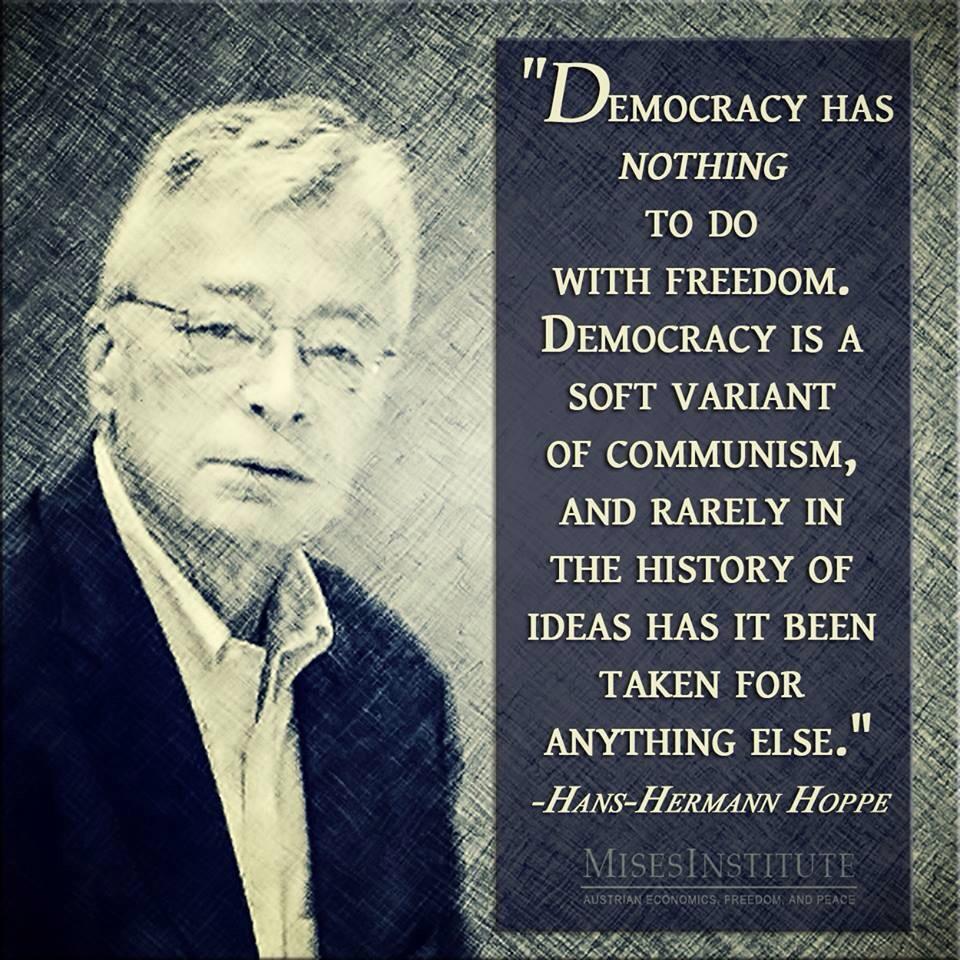
Democracy – a dethroned god. Review.

Commissioned by the Tea Club

Hans-Hermann Hoppe’s book “Democracy: The God That Failed” is not a cohesive treatise, but rather a collection of essays arranged in an order that allows the author’s ideas to be presented fairly consistently. However, such a composition inevitably leads to self-repetition, and an author with more respect for his readers could have reduced the volume of the book by about thirty percent without compromising the result. But there are advantages to this approach: any of the chapters can be read entirely in isolation from the others if desired. I will not analyze the work chapter by chapter, but will touch upon the main ideas of the book, indicating what seemed valuable to me, and what seemed erroneous or underdeveloped.

Time Preference and Family Values

Hoppe begins by explaining what time preference is, and how it tends to decrease in a more civilized society and increase in a more barbaric one. From this, he concludes that those measures for organizing society that increase time preference are decivilizing measures, and therefore harmful—and vice versa.

He also touches upon another factor affecting a person’s time preference, namely the stages of their life. In childhood, time preference is high; a child is unwilling to wait to achieve their immediate goals. With age, it decreases as a person expands their planning horizons, and toward old age, it should theoretically increase again, since there is less time left to live, and, as Keynes rightly noted, in the long run we are all dead, so there is no point in making plans for a period exceeding the remainder of one’s life.

But, Hoppe joyfully notes, there is such a factor as the family. The desire for the prosperity of one’s lineage allows a person to maintain a low time preference into deep old age, for they know that the wealth they have accumulated will serve the benefit of their descendants. However, this requires the organization of people into stable collectives called families. Therefore, any measures that destroy families increase time preference in society, meaning they are harmful and decivilizing. Hence all of Hoppe’s hatred for communists, hedonists, and homosexuals; hence all of his conservatism. For the sake of instilling conservative values, he is ready to welcome any individual oppressions in the form of expelling individualists from patriarchal collectives, which are the bulwark of true civilization.

It is not difficult to see an elementary logical substitution here. Yes, family values reduce time preference in old age, but who said that this is the only thing capable of reducing it? People frequently do not squander their entire fortune by old age, but they do not necessarily leave everything to their children. Instead, for reasons incomprehensible to Hoppe, they continue to manage their capital prudently until death and bequeath it to various foundations, as did Nobel, Carnegie, or Rockefeller. That is, the family is clearly not the only factor that reduces time preference in old age, nor is it the factor that contributes most highly to the progress of civilization. A foundation, as the founder’s will formalized as a legal entity, often handles the expansion of the planning horizon even better than profligate descendants, who might even be tempted to hasten the benefactor’s end to spend everything sooner. Thus, one of the foundations of Hoppean apology for conservatism turns out to be shaky.

Aristocracy, Monarchy, and Democracy

The central part of the book is an analysis of how a society existing in natural freedom first, for natural reasons, becomes accustomed to seeking advice and the resolution of conflicts from its most competent members, then these individuals gradually turn into a hereditary aristocracy, then the aristocrats are subsumed by the wealthiest, who becomes an absolute monarch, and finally, the monarch is abolished by the Third Estate, and an order reigns in society where absolute power belongs to society as a whole, while temporary appointees rule in its name. At each of the described stages, the personal responsibility of the governors for the results of their management is diluted, the quality of services provided by the elite to society becomes lower, and the price becomes higher.

Fortunately, Hoppe notes, despite all this regress, people have succeeded in developing various useful market mechanisms, and now, in order to return the lost freedom, we do not need to return to natural aristocracy in its archaic form; it is sufficient that all services currently monopolistically imposed by the state be traded on a free market.

In Hoppe’s opinion, reforming the democratic state in this direction will not work, because there are too many managers of public property, the temptation to use power for personal gain is too great, and no libertarian party will be able to recruit enough ideological haters of the state to place them in all government positions. Fortunately, the majority always silently accepts the status quo, so in order to present it with the fact of the state’s abolition, there will be no need to win elections according to government rules; it is enough to rock the boat and then, through the coordinated effort of a determined minority, overturn it.

In short, a certain confusion arises. On one hand, there is the progress of society, during which time preference decreases. On the other hand, there is the regress of systems for managing society, as a result of which time preference increases.

I see little point here in nitpicking the author on the fact that the state hardly matured as a fruit of the evolution of natural aristocracy and its noble activity in resolving conflicts. Rather, it is likely the fruit of the evolution of a gang of robbers and their methods of solving issues through lawlessness, then through “understandings,” and then through laws. It is not so important whether Locke or Hobbes invisibly hovered over the waters on the first day of creation (both hovered, of course), as long as in the process of reconstructing the patterns of history, we arrive by different paths at a single conclusion regarding desired future changes in the organization of society.

The Beautiful Ancap of the Future

The most beautiful part of the book is the description of the functioning of a system of private insurance companies, which simply pay insurance premiums to their clients upon the occurrence of insurance events such as robbery or theft, but as a result, are forced to abolish states out of pure commercial calculation, because this means they will have to pay less to clients in insurance. Hayek’s name is not mentioned once, but this description fully aligns with his idea of spontaneous orders.

Here Hoppe provides a valuable consideration that I have not yet encountered in other authors. It is known that many skeptics argue: if two subjects who have contracts with different protection agencies begin to feud, this should lead to a war between the protection agencies contracted to them. David Friedman responds to this by saying that it is not profitable for agencies to fight, and therefore they will push the clients aside, hash it out among themselves, decide who is right, and present the clients with the fact. This looks logical, but generates bewilderment: how is such a model better than the current state model?

Hoppe provides a different logic. He does not speak of any protection agencies; the company’s task is the insurance of the client’s risks. But only those risks over which the client himself has no power are insured. If a company were to unconditionally pay fire insurance to everyone who insures their house and then sets it on fire, it would go bankrupt instantly; therefore, when drawing up contracts, it is always specified which cases are not insurable. Thus, in the event of a conflict, only the party that was not the aggressor in that conflict should be recognized as having the right to the insurance payout. Moreover, if both parties behaved extremely provocatively, it is not even that important who first resorted to open violence—such a case, where the client was asking for damage to the insured property, is obviously not insurable.

Another interesting reasoning is related to factors affecting the calculation of insurance premiums. They are higher the higher the value of the insured property, and they are lower the lower the costs of its protection. Thus, market logic will lead to the fact that insurance companies, wishing to earn a maximum, will fully contribute to the growth of the price of the client’s property, which is achieved, in particular, through its reliable security and reducing the probability of damage—but exactly this will lead to the margin decreasing, and insurance companies will have to master new markets, meaning come to more dangerous and poor places, for example, those where various criminal groups, like states or other thugs, still conduct their bandit activities. Thus, the activity of insurance companies will naturally lead to the expansion of security and the growth of the once-arisen zone of ancap.

Summary

Despite the fact that the author in a number of cases indulges his own tastes and falls into wishful thinking, the book contains a number of extremely useful ideas that were new to me, which I agree with, and which I will use in the future. Even if these ideas do not belong to Hoppe himself, he still deserves my respect as their popularizer.

On tangled court cases

Let’s imagine the following situation arising in an imaginary ancap society. In my opinion, someone has caused damage to my property, but in the opinion of that someone, he caused me no damage. And the circumstances of this case are such that it is very, very controversial; it is difficult for an objective party to determine who is right. As a result, this leads to a situation where, across a large sample of different courts, half of them side with me, and the other half side with the party I am accusing. To my suggestions to pay at least a portion of the compensation demanded by me (and by the courts that sided with me), the opponent categorically brushes them off, because, in his opinion, he did not cause damage to my property, and therefore does not owe me a single penny.

Under the conditions of a state, such a problem is reliably solved by a hierarchy of courts. Yes, someone will remain dissatisfied, but that is the whole essence of the institution of the court. In the conditions of ancap, however, we arrive at a complex conflict where my bailiffs and my opponent’s security must, in effect, start fighting each other, since both conflicting parties are equally right. What solution does ancap offer for such situations? And how should I personally behave in such a situation?

SK (the question is accompanied by a donation in the amount of 0.00088285btc)

The function of a court is to help the parties resolve their conflict. The only way to do this is for both parties to the conflict to recognize the jurisdiction of a particular court in a specific case. If the case is complex and convoluted, we cannot know in advance the position of any specific pre-designated court until it completes the proceedings. Therefore, all the parties to the conflict need to do is find a court that has a good enough reputation, is acceptable in price, and is willing to take on the case. Then, both parties enter into an agreement with the court that they are ready to execute its verdict in this case, and only after that does the court even begin to delve into the subject.

Since the case is so murky, the final court decision will likely be quite a compromise, such as one party receiving partial satisfaction of their claims while paying some compensation to the other party. But, however, we cannot know this in advance.

Naturally, each party to the conflict will be interested in the impartiality of the court; therefore, they will probably consider it important to include a clause in the contract stating that they reserve the right to withdraw from the process before the end of the proceedings if they can demonstrate the court’s interest in a particular outcome.

If one of the parties refuses in advance to recognize any verdict other than one that completely relieves them of obligations, they are thereby refusing the court as such, which means they intend to continue an open conflict with the second party. In this case, the party that agrees to the court can wave this readiness around, saying, “I am not the one starting a war here, I am merely defending myself,” and thereby gain new allies while gradually stifling the aggressor with sanctions, forcing them into peaceful negotiations.

By the way, peaceful negotiations, without any external arbitrator, are also a way of resolving a conflict, so a court is not a mandatory procedure for this at all.

As has been noted repeatedly by many, the state of affairs in international politics very much resembles ancap