Democracy – a dethroned god. Review.

Commissioned by the Tea Club

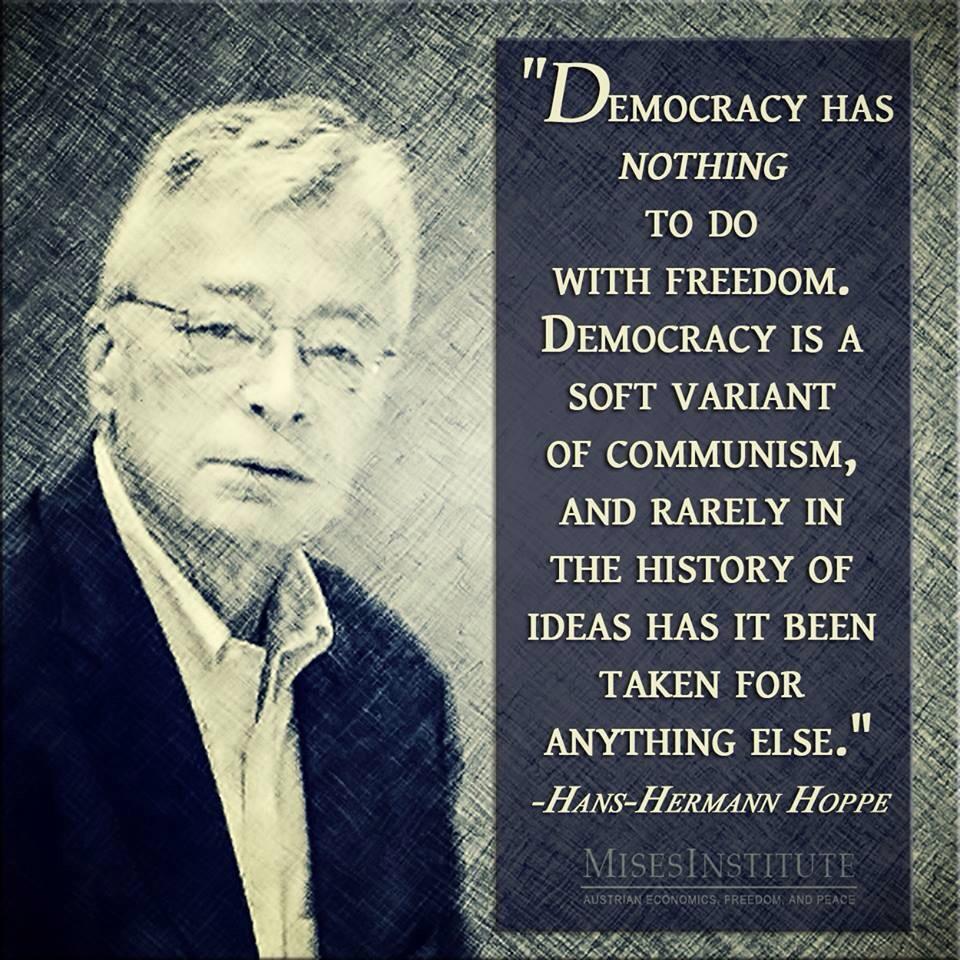
Hans-Hermann Hoppe’s book “Democracy: The God That Failed” is not a cohesive treatise, but rather a collection of essays arranged in an order that allows the author’s ideas to be presented fairly consistently. However, such a composition inevitably leads to self-repetition, and an author with more respect for his readers could have reduced the volume of the book by about thirty percent without compromising the result. But there are advantages to this approach: any of the chapters can be read entirely in isolation from the others if desired. I will not analyze the work chapter by chapter, but will touch upon the main ideas of the book, indicating what seemed valuable to me, and what seemed erroneous or underdeveloped.
Time Preference and Family Values

Hoppe begins by explaining what time preference is, and how it tends to decrease in a more civilized society and increase in a more barbaric one. From this, he concludes that those measures for organizing society that increase time preference are decivilizing measures, and therefore harmful—and vice versa.

He also touches upon another factor affecting a person’s time preference, namely the stages of their life. In childhood, time preference is high; a child is unwilling to wait to achieve their immediate goals. With age, it decreases as a person expands their planning horizons, and toward old age, it should theoretically increase again, since there is less time left to live, and, as Keynes rightly noted, in the long run we are all dead, so there is no point in making plans for a period exceeding the remainder of one’s life.

But, Hoppe joyfully notes, there is such a factor as the family. The desire for the prosperity of one’s lineage allows a person to maintain a low time preference into deep old age, for they know that the wealth they have accumulated will serve the benefit of their descendants. However, this requires the organization of people into stable collectives called families. Therefore, any measures that destroy families increase time preference in society, meaning they are harmful and decivilizing. Hence all of Hoppe’s hatred for communists, hedonists, and homosexuals; hence all of his conservatism. For the sake of instilling conservative values, he is ready to welcome any individual oppressions in the form of expelling individualists from patriarchal collectives, which are the bulwark of true civilization.

It is not difficult to see an elementary logical substitution here. Yes, family values reduce time preference in old age, but who said that this is the only thing capable of reducing it? People frequently do not squander their entire fortune by old age, but they do not necessarily leave everything to their children. Instead, for reasons incomprehensible to Hoppe, they continue to manage their capital prudently until death and bequeath it to various foundations, as did Nobel, Carnegie, or Rockefeller. That is, the family is clearly not the only factor that reduces time preference in old age, nor is it the factor that contributes most highly to the progress of civilization. A foundation, as the founder’s will formalized as a legal entity, often handles the expansion of the planning horizon even better than profligate descendants, who might even be tempted to hasten the benefactor’s end to spend everything sooner. Thus, one of the foundations of Hoppean apology for conservatism turns out to be shaky.

Aristocracy, Monarchy, and Democracy

The central part of the book is an analysis of how a society existing in natural freedom first, for natural reasons, becomes accustomed to seeking advice and the resolution of conflicts from its most competent members, then these individuals gradually turn into a hereditary aristocracy, then the aristocrats are subsumed by the wealthiest, who becomes an absolute monarch, and finally, the monarch is abolished by the Third Estate, and an order reigns in society where absolute power belongs to society as a whole, while temporary appointees rule in its name. At each of the described stages, the personal responsibility of the governors for the results of their management is diluted, the quality of services provided by the elite to society becomes lower, and the price becomes higher.

Fortunately, Hoppe notes, despite all this regress, people have succeeded in developing various useful market mechanisms, and now, in order to return the lost freedom, we do not need to return to natural aristocracy in its archaic form; it is sufficient that all services currently monopolistically imposed by the state be traded on a free market.

In Hoppe’s opinion, reforming the democratic state in this direction will not work, because there are too many managers of public property, the temptation to use power for personal gain is too great, and no libertarian party will be able to recruit enough ideological haters of the state to place them in all government positions. Fortunately, the majority always silently accepts the status quo, so in order to present it with the fact of the state’s abolition, there will be no need to win elections according to government rules; it is enough to rock the boat and then, through the coordinated effort of a determined minority, overturn it.

In short, a certain confusion arises. On one hand, there is the progress of society, during which time preference decreases. On the other hand, there is the regress of systems for managing society, as a result of which time preference increases.

I see little point here in nitpicking the author on the fact that the state hardly matured as a fruit of the evolution of natural aristocracy and its noble activity in resolving conflicts. Rather, it is likely the fruit of the evolution of a gang of robbers and their methods of solving issues through lawlessness, then through “understandings,” and then through laws. It is not so important whether Locke or Hobbes invisibly hovered over the waters on the first day of creation (both hovered, of course), as long as in the process of reconstructing the patterns of history, we arrive by different paths at a single conclusion regarding desired future changes in the organization of society.

The Beautiful Ancap of the Future

The most beautiful part of the book is the description of the functioning of a system of private insurance companies, which simply pay insurance premiums to their clients upon the occurrence of insurance events such as robbery or theft, but as a result, are forced to abolish states out of pure commercial calculation, because this means they will have to pay less to clients in insurance. Hayek’s name is not mentioned once, but this description fully aligns with his idea of spontaneous orders.

Here Hoppe provides a valuable consideration that I have not yet encountered in other authors. It is known that many skeptics argue: if two subjects who have contracts with different protection agencies begin to feud, this should lead to a war between the protection agencies contracted to them. David Friedman responds to this by saying that it is not profitable for agencies to fight, and therefore they will push the clients aside, hash it out among themselves, decide who is right, and present the clients with the fact. This looks logical, but generates bewilderment: how is such a model better than the current state model?

Hoppe provides a different logic. He does not speak of any protection agencies; the company’s task is the insurance of the client’s risks. But only those risks over which the client himself has no power are insured. If a company were to unconditionally pay fire insurance to everyone who insures their house and then sets it on fire, it would go bankrupt instantly; therefore, when drawing up contracts, it is always specified which cases are not insurable. Thus, in the event of a conflict, only the party that was not the aggressor in that conflict should be recognized as having the right to the insurance payout. Moreover, if both parties behaved extremely provocatively, it is not even that important who first resorted to open violence—such a case, where the client was asking for damage to the insured property, is obviously not insurable.

Another interesting reasoning is related to factors affecting the calculation of insurance premiums. They are higher the higher the value of the insured property, and they are lower the lower the costs of its protection. Thus, market logic will lead to the fact that insurance companies, wishing to earn a maximum, will fully contribute to the growth of the price of the client’s property, which is achieved, in particular, through its reliable security and reducing the probability of damage—but exactly this will lead to the margin decreasing, and insurance companies will have to master new markets, meaning come to more dangerous and poor places, for example, those where various criminal groups, like states or other thugs, still conduct their bandit activities. Thus, the activity of insurance companies will naturally lead to the expansion of security and the growth of the once-arisen zone of ancap.

Summary

Despite the fact that the author in a number of cases indulges his own tastes and falls into wishful thinking, the book contains a number of extremely useful ideas that were new to me, which I agree with, and which I will use in the future. Even if these ideas do not belong to Hoppe himself, he still deserves my respect as their popularizer.

Monopolies-2, review

On November 4, I was very sad. I am used to watching the broadcast of the Adam Smith readings held in Moscow every year, but this year the organizers deprived me of this opportunity for the first time, so I wish them a speedy removal and replacement. As I understand it, although the Adam Smith Center is formally responsible for this, in fact, the organization was entrusted to the same team that organized the summer debates between Shulman and Solovyov, as well as the lecture by Hans-Hermann Hoppe. These guys always disregard the broadcast and insist that no one else should conduct it. Monopolists, for goodness’ sake. Monopoly is expensive and bad. Always. Even if it is a monopoly on libertarianism or on organizing libertarian conferences. (Update: as I have been told, the team is actually different. Nevertheless, in my opinion, the refusal to provide a live broadcast remains a wrong move)

Fortunately, the Adam Smith Center does not have a monopoly on organizing libertarian conferences. On November 10, the second conference in the TED Talks format dedicated to monopolies took place in Moscow. The conference is conducted by the Moscow branch of the Tea Club. It is known that the LPR has rather strained relations with the Tea Club, but it is precisely thanks to their competition that we have more high-quality educational content online, so we can only welcome their rivalry.

Alas, the Tea Club also failed to provide a broadcast, but on the other hand, they began publishing recordings of the speeches on November 16 and finished on November 27. The recordings are collected in a playlist; I watched them all at once today and, as per tradition, will briefly go through all of them.

  1. Dmitry Kornienko. How the state teaches history. This discusses specifically the experience of the Russian state, without invoking foreign examples. Mention is made of an important difference between Soviet education and modern Russian education: the monopoly on knowledge has disappeared, although the monopoly on education has remained. One can lie, but students will know that you are lying and have no reason to remain silent about it. Thus, the tasks of forming a unified understanding of history have become more difficult, and, in essence, the state monopoly is ceasing to cope with them.
  2. Igor Drandin. Monopoly on discourse. Igor has extensive experience in the unpleasant role of being the liberal punching bag on federal TV channels; he shares the secrets of this non-trivial profession and speaks about the pros and cons of appearing on television. The most compelling argument presented by Igor is that TV debates are a very tough school of debating, and it is foolish to refuse such training if enemies practice this exercise daily. For instance, Navalny lost in debates to Girkin, Svetov to Kagarlitsky and Roizman—they lack the skill, as blogging and lecturing train one for something entirely different. Meanwhile, in public politics, the skill of debating is just as useful as the skill of speaking at rallies. I will note, however, that television itself is unnecessary for acquiring such skills, and it would be great if Drandin himself could find a way to pass these acquired skills to those politicians who did not participate in TV debates.
  3. Vyacheslav Shirinkin. Monopoly on a favorite band. Not all monopolization processes are linked to the state. Vyacheslav talks about various psychological aspects related to people’s love for exclusivity, as well as how to break into a market with a high barrier to entry.
  4. Vadim Novikov. To be or not to be for antitrust in Russia? Unfortunately, the recording turned out to be ruined, and the sound is very poor. The main thesis of the report: there is no point in tackling complex cases until the simple ones are sorted out. First, defeat protectionism in foreign policy, then try to defeat it in the domestic market.
  5. Roman Yuneman. Electoral monopoly. A candidate who won the elections to the Moscow City Duma shows in detail how the tool used to take away his victory is unlike an engine for fair elections, and why it is now important not only to contest the election results of a specific district in court but also to prevent the flawed practice of electronic voting from spreading across the entire country. The report is especially useful for the heralds of technological progress as a sort of sobriety check: if the goal is to counter falsifications, then simple mechanisms are better than complex ones.

Series of videos about panarchy

This summer, another small channel called LibertyUKR appeared on the vastness of YouTube; although foreign, it is Russian-speaking. It is interesting because it consistently posts videos analyzing libertarianism within the framework of panarchism. The presentation of the material still needs a lot of work, but the pace of content creation is somewhat higher than on the one I personally collaborate with.

Recently, a video about copyright and patent law appeared on the channel, the seventh video in the general cycle. Before filming, they sent me its text to polish a little. I tried. As a result, a completely independent work emerged, which I will either post as a separate article sometime or we will make our own video out of it. So, the collaboration with the channel didn’t quite work out, but they will manage on their own.

https://youtu.be/GwyHEMwzmp0

Survey about the roads

The Tea Club sent me three books they published: Hayek’s “The Road to Serfdom,” Hoppe’s “Democracy: The God That Failed,” and Sharp’s “From Dictatorship to Democracy.” I plan to write reviews for all three, and you can choose which one I should start with.

There are three roads: to democracy, from democracy, and to serfdom. Which one will you take, and which one will you lead your mother down?
Обзор какой книжки вы бы хотели увидеть первым?
  • Хайек, Дорога к рабству 47%, 58 votes
    58 votes 47%
    58 votes - 47% of all votes
  • Хоппе, Демократия: низвергнутый бог 41%, 51 vote
    51 vote 41%
    51 vote - 41% of all votes
  • Шарп, От диктатуры к демократии 12%, 15 votes
    15 votes 12%
    15 votes - 12% of all votes
Total Votes: 124
08.11.2019 - 07.04.2020
Voting is closed

Есть три книжки: к демократии, от демократии и к рабству. Какую обозреть первой?

You can order the books through the Tea Club Telegram store.

Release of the Russian Elephant

On September 3, I published an interview with the Russian Elephant, where the venerable animal explained the goals of the project in detail and answered all other questions as vaguely as possible. Generally speaking, this is a rather correct tactic for presenting information about a project that is still under development and for which interest needs to be stirred up. Well, today the project was released.

As of today, only two options are available on the Russian Elephant website: donate money for the project’s development and create a case page for the Elephant. To create a page, you are expected to create your own account and then link it to your Twitter by posting a message with a generated code. Thus, the principle designated by the Elephant—”I will never forget you, you will never see me”—will only work fully if the Twitter account is anonymous, but this in turn calls into question the very necessity of such a link. In short, I didn’t understand the Twitter linking. In any case, after successful linking, the user finally gets the opportunity to upload their materials to the site for subsequent verification and publication.

It is assumed that the user will upload one or more photos to the Elephant’s site depicting a criminal, as well as a text description of their crime. As I understand it, it is desirable that the criminal event is also visible in the photos; otherwise, it is unclear why the Elephant should take the information on faith.

It is promised that we will soon see the actual database with evidence of various crimes, and then a list of successful cases—without which the whole endeavor is pointless. But for now, let’s fill up this piggy bank.

Я тебя никогда не забуду, ты меня никогда не увидишь (С) Русский Слон

Ancoms discuss libertarianism, part 2

On the left-anarchist channel Prometheus, the analysis of an overview article on libertarianism from the LPR website continues. Once again, the focus is on the non-aggression principle. The article under discussion simply explains what this principle is and indicates that it pertains to ethics. It is implied that the mechanisms for implementing this ethical principle are also ethical, meaning reputational. Naturally, the opponent notes that an ethical principle is an extremely shaky foundation for building a society.

Next, there are many reflections on how, in the author’s opinion, a libertarian society should ensure compliance with the aforementioned principle. Naturally, private military companies are mentioned—heaven forbid—and it is then quite logically pointed out that if they are hired by end clients for aggressive operations against competitors, everything will degenerate into the right of the strongest, and subsequently into the reinstallment of the state. Logistic problems are also pointed out, as a result of which each territory would be “protected” by its own security forces, and deploying security forces from a foreign territory would prove to be a costly endeavor.

What nuances did the author fail to consider?

Firstly, for some reason, he considers a situation in which certain private military companies have a monopoly on violence and contrasts them with classical anarchy, based on universal armament and voluntary territorial militias. But under free market conditions, anyone who wishes has the right to arm themselves, not just licensed companies, so potential lawlessness will be countered not by a powerless crowd, but by armed people.

Secondly, the insurance principle of the functioning of any rights enforcement companies is completely ignored. A situation in which a person hires thug-bodyguards is marginal. Much more often, a person simply buys insurance, and if they are attacked and suffer damage, it is an insurance event, and they can expect a payout from the company. This removes logistic problems (the insurance company has its own agreements with various local security groups for rapid response to serious insurance events, and for minor ones, it simply pays out the insurance and doesn’t sweat it). I won’t recount the script of my video on ancap; I just recommend watching it.

However, the fact that all these questions surfaced during the analysis of the article on libertarianism can safely be attributed to the article’s shortcomings. I hope someone from the LPR editorial staff considers this high-quality feedback from an ideologically kindred organization and uses it to improve the material.

Taking this opportunity, I will also announce that our next video will be entirely dedicated to the non-aggression principle. The video is currently being filmed. I hope we will also be able to resolve some of the left-wing audience’s questions regarding this principle.

Monopolies are returning

About three weeks ago, among other things, I happened to announce an event by the Tea Club with the long title “The Splendor and Misery, Fear and Hatred of Monopolies.” At the time, I complained to the club that their previous event had been poorly recorded and expressed hope that they would succeed on their second attempt. In short, they succeeded.

Recordings of all five speakers’ presentations have been posted and collected in a playlist on the Tea Club’s YouTube channel (by the way, please subscribe). It contains only the lectures, without the Q&A sessions, so it’s quite compact, which motivates one to attend such events in person whenever possible.

I will briefly share my impressions.

  1. Alexander Litreev. Monopoly in the Network. He discussed how the state, in its attempts to monopolize internet censorship, constantly swings for a dollar but hits for not just a penny, but rather millions of rubles in losses for innocent parties, all while completely failing to achieve its actual goals. It was delivered energetically; I learned a few new things, although mostly well-known facts were presented.
  2. Sergey Zhavoronkov. Can a Monopoly Be Useful?. He explains the difference between market and non-market monopolies, and why the former are not scary, while the latter cannot be cured by antitrust laws. My impression was mixed: Sergey distorted the plot of the trampoline case, confusing the Altai Krai with the Altai Republic, and a square with a shopping center—in short, it would have been better to stick to a simple mention without a retelling. Otherwise, suspicions arise as to whether he was mistaken in the details of less-known historical anecdotes, and then the logic itself can be called into question.
  3. Matvey Tzen. Monopoly on Violence. The longest lecture, but the most saturated with various little-known historical anecdotes. He talks about the difference between positive and natural law, the difference between laws and law enforcement practice, why Weber, with all due respect to his merits as a sociologist, is not particularly revered today in legal terms, but most importantly—why the state dislikes grassroots initiatives to help the state. I liked it very much.
  4. Egor Zhigarev. Is There a Monopoly in the Video Game Market?. The most compact presentation on the most specialized topic. In short, the industry is highly competitive, and no matter how hard market agents try, none of them have managed to even come close to a monopoly.
  5. Alexey Markov. The Splendor and Misery of Monopolies. Also a narrative very rich in historical anecdotes. He discusses the history of the very concept of monopoly, and how they were initially perceived as an unconditional good, while the idea of the benefit of competition is a merit of later economists. He analyzed cases of several monopolies, from the Russian Company to Gazprom, and how they all decayed. He also touched upon a specific case of monopoly, such as the patent monopoly, and where that can lead.

In short, the experience turned out to be very successful, and now the organizers want to make it a regular occurrence. The format was named TNT – Tea’n’talks. An announcement for the second part of “Monopolies” has already been posted on the newly created TNT page on the Tea Club website.

So as not to weary the readers, I will probably announce further events in this genre very selectively, so you’re on your own from here on. I hope you enjoy them.