Among the left, there is a certain prevalence of the idea that rights to the so-called means of production should belong to the workers

Imagine an economy where the property of all or most enterprises producing goods and providing services is under the shared ownership of the workers, who gain and lose it upon joining or leaving the collective, decisions are made through the expression of the workers’ will,
and the net profit of the enterprise is divided equally among everyone.

Please provide a critique of such a model. How should one respond to opponents proposing this model? What points should be highlighted? Thank you.

анонимный вопрос

Before imagining an economy consisting entirely of such enterprises, it makes sense to look at how they might form within a regular economy where ownership of the means of production exists.

So, there is a group of people who want to implement a certain idea and intend to start a business. They need a set of competent workers for several different positions, as well as startup capital. Presumably, the workers are there—they are the founders themselves. Where do they get the capital? In a modern economy, they can chip in in certain proportions, and each will receive a share in the founding enterprise corresponding to the amount contributed. Within the proposed model, shares are strictly equal, meaning they must contribute strictly equal amounts, which reduces the system’s flexibility, as a potentially valuable worker might not have enough savings to join the enterprise, or may not be willing to risk them. When the functions of capitalist and worker are separated, this is not a problem. When they are forcibly combined, not everyone can handle it.

What are the alternatives to chipping in equally? One could take a loan from a credit institution. But for a bare idea, a loan will only be granted at serious interest rates. These could be lowered by providing collateral, but the conditions of the problem assume no collateral, and it is impossible to pledge the shares of the future enterprise, because the enterprise must remain in equal shared ownership of the workers, not some capitalists.

But fine, let’s assume a group of people chipped in a very small amount, opened a micro-business, and gradually grew it by investing most of the profits into expanding production—and now they start lacking manpower. They need to hire someone else and allocate an equal share to them, proportionally reducing the shares of each founder. The larger the starting contribution was, the longer they had to deny themselves the basics to get the enterprise running—the harder it will be to make the decision to simply give away an equal share for free. If they intend to hire a highly valuable specialist, the founders will think it over and decide it’s worth it. But with equal probability, it could be about hiring someone with low qualifications. For example, production has grown, delivering to customers independently is no longer convenient, and a courier is needed. And this courier, a position that literally any random person could handle, becomes an equal shareholder in a successful startup? It is not hard to see that old workers will face such psychological problems every time a new vacancy opens.

Similar difficulties await the person who was there at the start, invested a lot of effort into the enterprise, and now, for one reason or another, would like to leave. They realize that they have no way to monetize their share, and all their merits toward the company are wiped out the second they quit. They must now look for a new place and persuade a new collective to take them as a shareholder. Obviously, under the conditions of a well-functioning institution of reputation, a person who was in good standing in one company will be able to find a place in another without problems, but still, relying on the hope of obtaining a share in a more productive enterprise instead of the individual value of one’s labor is not such a flexible scheme.

The real nightmare begins if, due to changes in market conditions or other reasons, it becomes necessary to reduce staff; otherwise, the company will start incurring losses. That’s it, a scandal is guaranteed. Everyone accuses everyone else of causing the company’s situation to worsen, no one is ready to jump overboard and lose their share, but without this, instead of a regular share of profit, all shareholders must instead regularly contribute to a loss-making enterprise in equal shares. It remains unclear exactly how to decide who to throw out. In a regular company, the management makes the decision based on production necessity. But here, everyone is a shareholder, and everyone has a vote. That is, it will have to be decided democratically at a general meeting, and it may very well turn out that it is not the least necessary employees who have to leave, but the least eloquent.

Thus, such enterprises lose to companies without socialist burdens on labor relations in terms of flexibility, and therefore, they will likely fall behind in the competitive race. In essence, nothing prevents anyone from opening enterprises of this type right now in countries without labor codes, like Georgia. But practice shows that few people need this. Even if people unite in an artel or cooperative, they still prefer to retain the right to a share in the company, and upon leaving, they demand their share in money or equipment, and when accepting a new member, they find it justified to require an entrance fee—again, in monetary or in-kind form.

In essence, the entire toolkit of market manipulations with shares is precisely an additional expansion of possibilities over the limited functionality of equal shared conditional ownership, and if it was evolutionarily developed in the course of humanity’s economic progress, it would be very strange to abandon it on a mass scale. But to each their own; anyone who wishes can start working according to this scheme as early as tomorrow.

So, is it a completely unviable scheme? Not at all. Caribbean pirates operated on almost these very principles. You can read more about this in the recently translated chapter of David Friedman’s book on legal systems that differ greatly from ours. In essence, the only difference between the pirate scheme and the proposed socialist one was that the pirates did choose leadership for themselves and paid them not an equal share of the loot, but an increased one. Pirates were also helped by the fact that the problem of startup capital was not so acute for them: they did not build ships, they captured them. But socialists, in fact, can quite well envision their system as the expropriation of existing enterprises from owners in favor of workers, so they can be just as successful as sea robbers.

Thus, it can be stated that within the framework of relatively simple economic activity, and especially in resource economies with low capital intensity, the socialist scheme can quite well take root, but the more serious the division of labor, the more difficult it will be to adapt it to the needs of the collective members, and the closer it will in fact resemble a regular market scheme with private ownership of the means of production.

Tokenomics problems and contract jurisdictions

Regarding the conclusions about the unsuitability of blockchain for real estate registration, I partially agree. In its pure form—yes. I have been working on this issue at the University of Bologna for four years. Last year, when I visited Kyiv, I gave a presentation on how to apply blockchain as a real estate registry. So, if you are interested in learning more: theory, protocols, system architecture, regulation. I presented it quite simply in my presentation at the blockchain hub.

Alexey Konashevich

https://youtu.be/F9IYLtXrn78

Thank you, I watched the presentation with great interest. My concept of property rights registration was approached slightly from a different angle and sketched out in much broader strokes. Not being a programmer, I was answering not the question of “how,” but rather the question of “who would handle this without the state, why would they do it, and why would they do it well.”

Your presentation implicitly suggests that the state, as a monopoly territorial jurisdiction in the validation system for the transfer of property rights, is a resource-intensive atavism that does not increase system efficiency but complicates its optimization.

In order to formally describe the functioning system of decentralized legal mechanisms, you build “smart laws” on top of smart contracts—an additional abstraction that validates smart contracts, separating legal ones from illegal ones. Then you raise the question of who creates the smart laws and introduce a new abstraction, e-voting:

But in the world of decentralized ledgers, it doesn’t work that way. E-voting for a law is, essentially, its validation by a group of independent validators. What happens if a certain minority votes against a law in current legal reality? They are forced to obey the law passed by the majority. What happens under decentralized law? The minority has the opportunity to create a fork. Two alternative smart laws emerge, each describing its own set of permissible smart contracts, and different voluntary transactions can take place in different legal fields.

Essentially, these are the same good old contractual jurisdictions that I’ve already talked the audience’s ears off about here.

Oil, economy, limbo

No sooner had armchair political scientists managed to properly dive into virology than they already had to master the intricacies of the oil industry. I decided not to fall behind and watched an MBX Media story yesterday about what exactly happened and what to expect now.

First, Mikhail Krutikhin spoke about how May WTI futures hit rock bottom and started digging deeper. This joke has already been retold many times, and in Krutikhin’s specific case, it was so-so, because from his words, it seemed as if it wasn’t a triviality not worth noticing. However, I see no reason why the same story couldn’t repeat itself toward the end of May, because to prevent it, either oil demand needs to rise or supply needs to fall; otherwise, it will be even worse than now, because there will be even less free storage capacity in a month.

Next, Grigory Bazhenov spoke and repeated what he had already explained on his channel in a separate video—how taxes are structured in the Russian oil and refining industry. In short: oil prices could drop to zero, but gasoline prices won’t budge—the budget will take all the winnings. Thus, Russian refining faces downtime, and the weakest players in the industry—the private companies without integration with oil-producing companies—face bankruptcy. Gas stations will somehow survive, but in conditions of reduced throughput, they will lead a rather miserable existence.

Finally, Mikhail Khodorkovsky took the floor and spoke about the situation in oil production. According to the agreements signed by Russia, it must reduce production by a quarter. If production is reduced carefully, trying not to ruin the wells in the process, a maximum reduction of ten percent can be achieved. Moreover, free storage capacity is running out and exports have collapsed, so production will have to be scaled back sharply, which means irreversibly. A shut-in well will become unusable after a couple of months, and to restore production, it will need to be drilled again. But in old, heavily watered-out fields, such drilling will simply not pay off at reasonable prices. So Russia faces a choice: either pump oil regardless of the agreements and then pay those who kindly agree to take it, or irreversibly lose up to a third of production. At the same time, it is quite likely that the decision will be made not by the market, but purely administratively, and some will be allowed to work while others are put to the knife.

In connection with this, I want to make a prediction. Quite quickly, an obvious consideration will arise before the Russian leadership. If it wants its oil industry not to die, Russian oil must be bought. There is no hope for exports, which means the Russian economy must consume the oil. But it cannot do this while sitting in quarantine. Therefore, to hell with the quarantine. Of course, some other official reason will be given. For example, “at the request of the workers of North Ossetia.” Or “after studying the successful Swedish and Belarusian experience.”

Why are people put in quarantine in other states? To save human lives. Forgive me, I can believe many things, but not that human lives are important to Putin. So he will hesitate for a bit and then wind up all this self-isolation. Well, maybe except for Moscow—they’ve become too spoiled, let them shrink a little. So prepare for the fact that the heroic sitting at home was completely in vain: we will all get sick until we achieve herd immunity. Some will not survive. With our economy and medicine, the Swedish path was an alternative-less option from the start. What is this “flattening the curve” of yours? It’s like the game of limbo, where you have to pass under the bar. The lower the bar, the harder the task. The height of the bar is determined by the level of medicine. With Russian medicine, don’t even try—there’s no point in embarrassing yourself.

Germany is flattening the curve

What to do? I have already dedicated a separate post to crisis strategies, and I adhere to the previous recommendations: going into the shadows, building horizontal connections, mastering cryptocurrency payments, and reducing all interaction with the state to demanding direct payments, tax reductions, the cancellation of regulations, the reduction of security forces, and so on.

The Road to Serfdom. Review

Commissioned by the Tea Club

Many reviews and critiques have been written about Hayek’s “The Road to Serfdom,” where the book is placed within its historical context, its position among Hayek’s publications is identified, and a brief analysis of its ideas is provided. As much as I would like to avoid all this academicism, it is impossible, as the entire book is a political pamphlet on the pressing issues of the day, and the only reason the work remains relevant to this day is that ideas do not die—and this applies not only to Hayek’s own ideas, but also to those he fought against.

“The Road to Serfdom” was published in Great Britain in 1944, when the country was finishing its fifth year of war with the National Socialist Reich. Victory over the Reich was simply a matter of time, and one could have calmly begun to reflect on the postwar restructuring of the world, but the author felt it was far more important to draw the public’s attention to the fact that the dragon-slayer was beginning to increasingly resemble the one he was fighting. Hayek saw the victory of the Labour Party in the upcoming general elections as the most terrifying danger for Britain. That is exactly what happened. As a result, Great Britain accumulated an economic lag behind freer countries right up until the Thatcher reforms.

The main idea Hayek fights against in his book is the notion that economic planning brings prosperity. He painstakingly demonstrates that the temptation to slightly regulate from above for the greater benefit of society is the first step toward regulating everything and everyone to the point where it is impossible to breathe: there is no natural optimum on this road, upon reaching which the government would stop on its own and declare that things are now good and nothing more needs to be tweaked. He also shows that regulation is total, and economic freedoms are inseparable from political ones, so people far removed from economics should not look benevolently upon interventionist efforts, thinking that as long as political freedoms are left untouched, economics is a narrow specialized topic and experts know best how to steer it.

Hayek did not claim that everything was hopeless and that, having stepped onto the road to serfdom, humanity would be unable to stop. If he had believed so, he would have had no need to write the book. He did, however, argue that the further one goes down this road, the harder it is to stop, and therefore socialism is best fought at the far approaches. Unfortunately, practice has shown the exact opposite: it is extremely difficult to deny socialists small concessions while society as a whole is liberal, but when everything is already regulated to shreds, both society and the government tire of the constant tightening of the screws. A sufficiently strong demand for deregulation emerges, it is carried out, and people breathe a sigh of relief, but it soon turns out that the leviathan, having retreated in one place, is already pressing in another.

In the article Barrier on the Road to Serfdom: Dead End or Detour?, Bitarch and I mentioned John Meadowcroft’s thesis that it is the hybrid society that proves to be stable, unlike the liberal or totalitarian ones, and we also pointed out that neither increasing transparency nor reducing direct state participation in the economy helps avoid the fact that the overall regulation of society continues to grow slowly.

The book “The Road to Serfdom” is a good example of rhetoric that can and should be used when working with politicians. The fact is that most of the arguments in the book are no longer relevant, unless, of course, you are dealing with hardline Marxists; against more or less modern supporters of state regulation, it makes sense to apply Hayek’s later texts, such as “The Fatal Conceit.”

This question stumped me in an argument. Why is it necessary to privatize a state enterprise if it is profitable?

Bvl72

Let’s figure out where this enterprise came from.

First, the state could have collected taxes from citizens, spent less on citizens’ needs than was collected (or borrowed money, or printed new money) — and bought a profitable enterprise. Thus, this results in a misappropriation of funds: money was collected under the pretext of providing services to citizens, but instead was spent on running a business. Legal logic dictates the solution: sell the enterprise, divide the proceeds among the citizens — and henceforth, do not acquire enterprises at the expense of the budget.

Second, the state could have provided the state-owned company with preferences, thanks to which it prospers. For example, the state enterprise fulfills government orders, or trades duty-free, or has preferential loans, or uses insider information, or is simply a monopoly. Thus, we have unfair competition, as a result of which the competitors of the state enterprise receive less profit or even incur losses. Legal logic requires eliminating this conflict of interest and removing the referee from the field of play.

Third, the state could have bought out a loss-making private enterprise in a pre-bankruptcy state, and then the market conditions changed, and that same activity began to yield a profit. In other words, the state took a significant entrepreneurial risk, which in this particular case paid off — but how many cases were there where the purchased loss-making enterprise continued to suck money from the budget, or eventually went bankrupt! Thus, taxpayers are exposed to the risk of serious economic losses without their consent. Legal logic requires coordinating investment policy with shareholders, and if the management of an investment fund behaved this way, it would lead to their removal.

In short, any attempt by the state to engage in entrepreneurial activity one way or another violates the rights of citizens, and therefore consistent libertarian reforms must inevitably include the full privatization of state property.

Imagine that the doctrine of containment had been developed as early as the 17th-18th century

Suppose states and simply wealthy people had access to killer bees. In that case, the war between the North and the South would not have happened, and slaves in the South would not have been freed. On the other hand, Lincoln would not have employed the flawed practice of printing greenbacks, which led to the Long Depression, and perhaps in the end the world would not have fallen into leftism and we would still be on the gold standard (oh, dreams, dreams). However, even today, one might be able to travel to the Confederacy and legally buy oneself a slave girl for a few gold coins. Or not? In short, my question is: who would have freed the slaves had DS been developed before the US Civil War?

анонимный вопрос

Throughout the nineteenth century, slaves were freed all over Eastern Europe, in Russia, and toward the end of the century, in Japan as well. The government freed them without waiting for revolutions and civil wars. There were a multitude of prerequisites for this, primarily economic. In Australia, an economic boom also occurred after the abandonment of slave labor in agriculture, and the economy there was quite similar in structure to the economy of the southern US states.

Even if the southern states had managed to resist this trend for a while, slaves would have been finally freed in the 20th century by tractors and cotton pickers.

There is an opinion that the Union and the Confederacy would have developed much more dynamically had a war not occurred between them. The Union would have had to temper its protectionist zeal because the Confederacy, advocating for a free market, was right next door. The Confederacy would have had to soften the condition of slaves, aiming roughly for the prosperity level of Irish immigrants in the North, so that the flow of fugitives would remain within more or less acceptable proportions. And, of course, both countries would not have suffered such human losses and would not have damaged their economies so severely. By the way, in the absence of war, two transcontinental railroads would have been built instead of one.

So, Lincoln paid for his disregard for the Constitution quite justly.

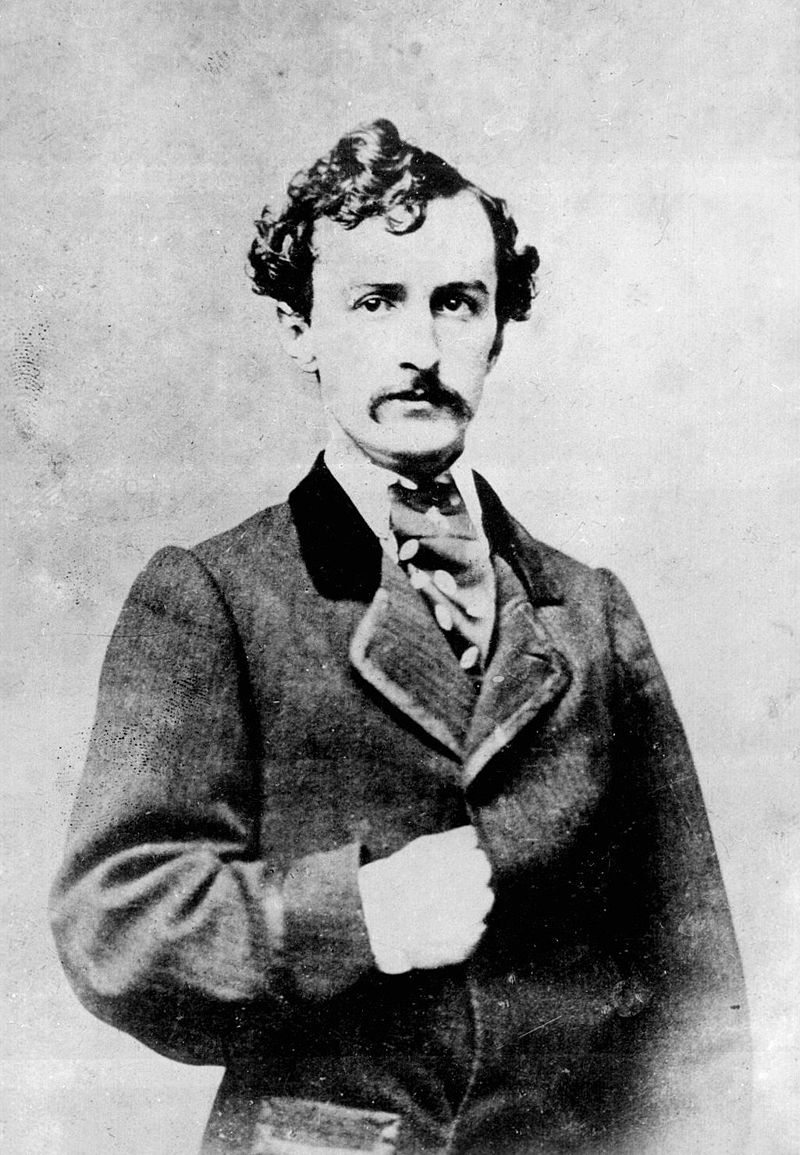
Therefore, today John Booth, who rid humanity of this unpleasant tyrant, deservedly graces the cover of the post

How will ancaps solve the problem with the Gypsy ECU?

анонимный вопрос

As far as I can tell, Roma have an extraterritorial jurisdiction that is not contractual. You cannot simply show up from the outside and enroll as a Romani person. This jurisdiction may enter into informal contracts with other mafia-style extraterritorial jurisdictions, or remain in a state of nature relative to other jurisdictions.

What are the characteristics of the Romani community? It is a fairly ordinary nomadic tribe that has preserved a number of archaic traits, specifically, the fact that they do not consider outsiders to have legal standing. Regarding their own, the Roma are guided by principles of respect for property that are customary and clear to any ancap, plus some quirks regarding the regulation of personal and family life, which, however, are characteristic of many other ethnicities. As for an outsider, they can be cheated, robbed, or even killed; this is not considered immoral, is not prosecuted within the Romani jurisdiction, and the only regulator is utilitarianism: if you get too arrogant, you’ll have to move camp sooner than you’d like.

However, let us transport ourselves to a bright future where ancap dominates a fairly significant territory, and the Roma appear there. To start with, under ancap, land is either no one’s or private. Therefore, for a camp to settle, they will either need to find a piece of unclaimed land, which usually means some distance from populated areas, or rent a plot.

Rent land to the Roma for living? Why not, if you take money upfront and have enough strength to evict them from the place by force. So, if the Roma want to live closer to their foraging base, they will have to deviate from their principles and shell out. This is exactly the same attitude they will mostly encounter among everyone else: only secured transactions. There is nothing terrible about this; after all, some crypto-markets work this way even now. Transactions between strangers always need mechanisms that allow them to be carried out despite the lack of trust between them. The simplest such mechanism is a trusted intermediary—a third party monitoring compliance with the terms of the deal.

Of course, if the Roma behave under ancap as they are used to, after some time the question of liability for contracts, which they tricked trusting citizens into and failed to fulfill, may arise. Since ancient times, the camp’s simple answer to such claims has been: move camp. Technical progress, however, reduces the costs of pursuing a debtor faster than the costs of moving. Nevertheless, chasing nomads and shaking debts out of them is a hassle, so I would suggest that those intending to deal with the Roma under ancap use one simple tool: a deposit.

Deposits are already actively used now, for example, when you check into a hotel. It is collected upon check-in and covers the approximate amount of your possible liability for damages in the room. Checked out without notice, stolen something—losses will be covered by the deposit. Checked out normally—received your deposit at the reception. Exactly the same thing can be practiced when renting a camping site or a building plot to a camp: you take the rent for a month in advance and a deposit equal to the annual fee. Any monetary claims against a member of the camp are either settled personally by the violator as part of an amicable agreement, or if they manage to agree with the plaintiff on an arbitrator, through court—otherwise, the claim amount is simply deducted from the deposit. Lived for a year without exhausting the deposit—well done, for the next year the deposit can be slightly reduced.

And if a particular camp manages to cause losses exceeding the deposit and immediately moves away, the deposit in the next location may turn out to be significantly higher.

The consistent instillation of a culture of honest trade will gradually lead to the morality in the Romani community becoming more universal, and cheating an outsider will become “low class.” All other culture can easily remain, as culture is a good export commodity.

The Strugatskys

The Strugatsky brothers were Soviet sci-fi writers who, due to the distortions typical of a planned economy, were published by the Soviet state in much smaller print runs than the actual demand. Consequently, during the transition to a market economy, this deferred demand began to be actively satisfied, and my parents had a complete collection of their works on their shelf. I assume that the current generation of fifty-year-olds knows these books much better than those who are now twenty-five. As for me, I somehow jumped straight from childhood history encyclopedias to fantasy, then to popular science, while the Strugatskys’ collected works just gathered dust on my parents’ shelf.

Actually, I was prompted to write this post by a mention from Mikhail Svetov in a stream about how, as a child, he read authors in their entire collected works. I am not that tedious, and in the case of the Strugatskys, I ended up reading three books at different times.

The first was “Hard to Be a God”, a story about a communist “popadanets” (time-traveler/portal-jumper) in the Middle Ages. It was impossible not to read it because it is memetic, and I wanted to understand the origins of all those tales about how the “greys” are replaced by the “blacks,” and why a noble don should not see the reasons for not doing something. At the time, there was no mass literature about “popadantsy,” so the writers used another planet as a setting, but all the problematic themes perfectly align with the popadanets genre. What gives the work its originality is that the traveler failed miserably at imposing his values on a medieval society, and the mission ended in failure. Modern writers churn out more optimistic things, but here they managed to make a bestseller without a happy end; I respect that.

The second turned out to be the novella “The Predators”; here I owe thanks to Alexander Rozov, who wrote an interesting review of it. The book is about a communist who ends up in a prosperous capitalist consumer society, is horrified, and begins to make plans about what can be done with these unfortunate lost people who want to live happily and do not want to storm Mars in tight ranks. The communists faced a dilemma: either bring assault columns into the country and drive the population into the gulag, or start a multi-year brainwashing campaign. The protagonist humanely adhered to the second strategy, considering the first a failure, and for that, we can be grateful.

Finally, the third novella is “The Distant Rainbow”, which I read quite recently at the dacha when I had a free evening—a book from that very collected works happened to be next to my chair. The story tells of a planetary catastrophe that occurred due to the peculiarities of the communist system of organizing fundamental research, as well as the fact that in a planned economy there are no prices, and therefore economic calculation is impossible. The latter is illustrated with rich material. Rare instruments were brought from the metropolis, and the scientists resort to various tricks to try to obtain them out of turn, through connections (“blat”), or simply by stealing them. The option to “buy” simply does not exist for the poor souls. Energy is needed for experiments, and the scientists steal it from the local power system because the energy issued by coupons has already been spent. The option to “buy” simply does not exist for the poor souls. Another experiment ends in catastrophe (I don’t rule out that it was also caused by a competing laboratory stealing some rare controller right from the test rig, but the reasons for the tragedy remain off-screen), and it turns out that no evacuation means were provided on the planet (what safety regulations, it’s communism). To top it all off, the question of who exactly and what values should be saved first is also solved completely arbitrarily, and not by a legitimate governing body, but by the captain of the only spaceship, who decided for himself who lives and who dies, as if the ship were his private property. And it is exactly this approach, where the “Red Director” is king and god at his enterprise, that is positioned as the most morally justified. And so, back in the distant sixties, the sci-fi writers were already describing the outlines of the “Red Belt” of the nineties.

I once had to answer a question about which books are worth reading. I suggested first ensuring a frame of perception for oneself, and then you can read anything, and the result will invariably please you. Here you go: a libertarian reading of communist propaganda. Try reading all sorts of things; it’s interesting. And yes, the Strugatskys are stylistically simply wonderful, and I perfectly understand the nature of their popularity. If I have more time, I’ll read something else by them.

this very edition

Sealand and its oddities

Since I’ve started reviewing recent articles, I’ll mention one more. Some bands are one-hit wonders, and for a long time, Evgeny Kvasov was the author of only one hit article for me — “Explaining the Roads”. But today he revealed a new unexpected side of himself by participating in the release of the article about Sealand.

The article, in particular, includes an interview with Prince Michael I, and I have a few questions regarding it. The Prince cites the production of souvenirs as the principality’s main source of income, complains about the large number of counterfeits, and even claims that copyright is a blessing, although he positions himself as a libertarian. How copyright helped him remains completely unclear.

The interview also states that despite numerous requests to visit Sealand, the principality is closed to tourists, although anyone can admire it from the sea. The only justification provided for this is a small team. A very strange excuse, a very strange business model. To suffer from counterfeit merchandise, yet not utilize the one resource that cannot be counterfeited — the sovereign territory of Sealand itself…

There are many things in the world that I don’t understand, and now, after reading the article, one more has been added. A principality that managed to defend itself in a direct military clash with Great Britain leads a pitiful existence instead of being a flagship of freedom on the seas. Well, anyway. I can’t answer every question; sometimes, on the contrary, I have to ask them.

Crises. Where to lay some straw?

Freedom pride, which I have mentioned here before, published an article on their VK page “How Not to Bring Back 2008”, where they briefly outline the Austrian theory of the business cycle (thanks!), and then move on to explain the real business cycle theory, which in the author’s presentation essentially claims that no cycles exist, only random shocks—basically, sometimes a black swan just craps on your business from the sky. That’s all there is to it, and there’s no need to ponder where these swans come from; it doesn’t matter.

Of course, such an approach seems insufficiently satisfying for something claiming the status of a theory. The Austrian approach clearly identifies the cause of cycles: credit expansion by banks operating under fractional reserves and the regulation of the discount rate by central banks. Without specifying the causes, it becomes something like stating a death was caused by the flu, while the deceased was over a hundred years old and their body was completely worn out. Had they not died of the flu today, they would have died of a heart attack tomorrow. In other words, the specific black swan is less important than the systemic factor of old age.

However, within the framework of the article, it is indeed not so important why cycles happen; it focuses not on how to get rid of credit expansion, but on what allows the economy of one country or another to weather crises more easily. Accumulated statistics by country show that countries with free economies endure crises much more easily, even though it would seem that the most terrifying bubbles inflate in the financial markets there, and they should be worse off. But that’s not the case; the market levels the structure of supply and demand much faster than any dirigiste government measures.

That is to say, even if one considers either business cycles or simply random shocks to be inevitable, a country can quite possibly minimize their consequences simply by having a liberal economy. It is for the sake of this optimistic conclusion that I recommend this somewhat controversial article.


Comparative growth index of relatively less economically free and relatively more economically free countries in 2001-2017 (below the 2001 median and above the 2001 median, respectively). For 16 consecutive years, freer countries have shown higher average growth rates. The greatest difference is observed in the crisis year of 2009 (-0.3% for freer countries versus -2.8% for unfree countries)