Why the collapse of Pindostan is the best news for freedom, and why it is time for us to stop praying to Washington

It is often possible to see how some “libertarians” (in quotes) continue to look across the ocean with breathless admiration. They pray to the US Constitution, quote the Founding Fathers, and seriously believe that America is the bastion of a “free republic.” Except they are stuck in the 18th century. That republic has long been gone, and what we see today is “Pindostan.” This is not a federation of equal states, but a real, classical, bloated, and last surviving empire of our days. And do you know what happens to empires? They collapse, and that is great! So let’s break down exactly what is what.

What is an empire in the classical sense? It is when one center, greedy for taxes, forcibly holds under its power absolutely different peoples and territories that are culturally alien to one another. Now look at the map. How can Alabama and New York seriously be called a “single country”? Wyoming and California? These are different universes. In one state, people want to go to church on Sundays, own an AR-15 to protect their families, pay minimum taxes, and have bureaucrats simply leave them alone. In another, they demand total control over the economy, a ban on plastic straws, insane taxes, and regulation of how you breathe.

But as soon as the subject of a possible breakup of the USA into separate independent states (or at least a confederation) comes up, conservatives and mainstream libertarians begin to panic: “This will be the end of the world! Madness! The collapse of civilization!”. But let’s take a breath and open a history textbook. Do you know who screamed like that a hundred years ago? Supporters of the “One and Indivisible” Russian Empire. When the Russian Empire began to crack at the seams in 1917, it seemed as if the heavens were falling to earth. But let’s ask the Poles and Finns how they like this “terrible collapse”? For them, it was the best thing that ever happened to them.

Poland and Finland jumped away from the imperial corpse in time. They stopped feeding bureaucrats in a foreign capital, stopped sending their guys to die for someone else’s imperial ambitions, and built their own countries. No one in Helsinki today is crying: “Oh, what a pity that we no longer send taxes to Petersburg!”. The collapse of an empire is not the end of the world. It is spring, decentralization, and secession in its purest form—the sacred right to self-determination that Rothbard wrote about.

Why is the collapse of Pindostan beneficial to libertarians worldwide? First, it is the death of the global policeman. For the last 80 years, Washington has exported not freedom, but bombs, sanctions, and inflation. The breakup of the USA into 5-10 independent jurisdictions means that none of them will any longer have a budget for 800 military bases around the world. There will be fewer wars, less intervention, and less blood.

Second, it is the collapse of dollar hegemony. The Fed (Federal Reserve System) is the main sponsor of global etatism. They are the ones who allow budgets to bloat and print candy wrappers, for which the entire world pays through a hidden inflation tax. The collapse of the empire will bring down the fiat system and open the way for hard money—gold and crypto.

Additionally, this will create a market of jurisdictions. Imagine that in place of one monster, half a hundred states of various sizes will appear. A brutal competition for minds, capital, and labor will begin. California wants a 90% tax? Please! Only all businesses will move to an independent free Texas or Nevada within an hour. This will be the greatest experiment in jurisdictional competition in history.

It is time to get rid of the cargo cult! The fact that the Founding Fathers wrote a cool piece of paper 250 years ago does not make modern Washington a holy place. Today it is the same kind of imperial center as Rome was before its fall, London at the beginning of the 20th century, or Petersburg in 1917. There is no need to fear the balkanization of America. This should be welcomed! Division is the path to freedom. After all, the smaller the state, the closer the power is to the land and to the specific person, and the fewer opportunities it has to build a digital GULAG.

Voluntarist, Bitarch

Where Libertarianism Will Actually Take Root? Spoiler: Probably Not Where You Think.

In the libertarian scene, the United States is considered an “earthly paradise.” How could it be any other way: the First and Second Amendments, the spirit of the Wild West, freedom of speech, the right to self-defense! Mises, Rothbard, Rand – all are connected with America. Meanwhile, old Europe and, especially, Canada and Scandinavia are often dismissively viewed as Trotskyist swamps with exorbitant taxes. But if we dig deeper and look at the very foundation of libertarianism – NAP (the principle of non-aggression) – we’ll see something interesting.

The renowned anthropologist Douglas Fry in his works raises a brilliant topic – so-called Hobbesian beliefs. The philosopher Thomas Hobbes, if you remember, believed that the natural state of man is a “war of all against all.” So, Fry shows that the belief in the “naturalness” of war and violence in the United States is frighteningly widespread, much wider than in other developed countries. In one study, students at universities in Florida and Connecticut were asked whether people have a “war instinct” and whether war is an integral part of human nature. About half of the respondents answered affirmatively! Half of these young, educated people believe that killing your fellow humans – it’s frankly ingrained in our genes.

When the whole world calls America “Pinistan” or another derogatory analogy in their local language, it’s not necessarily envy. It could be a reaction to a culture in which a significant portion of the population normalizes violence and imperialist policies. As Fry notes, this is exactly what Europeans see in America. Of course, on the ground, far from all Americans are like that. But there’s enough of them to repeatedly elect hawks and applaud “precision strikes” against countries that many would not find on a map. Furthermore, if a society sincerely believes that violence is “human nature,” it will inevitably be tolerant of state violence within its own country.

And now let’s take a 180-degree turn. If to triumph the libertarianism and NAP we need an society which organically digests violence, where do we look? Contrary to popular myths, the best chances for libertarian ideas may lie precisely in Europe, Canada, and, paradoxically, Scandinavia.

Yes, there’s a bloated welfare state there now (though that’s pretty common these days). But let’s look at the social base. First, the level of violent crime (especially in Scandinavia) hovers around statistical error compared to America. Second, the overwhelming majority of people feel genuine, deep disgust for war and imperialistic ambitions, not considering it a natural phenomenon for humans. Third, the level of social trust there is colossal.

For a European or Canadian, it’s much harder to sell the idea of pre-emptive war. For them, violence is not “biological instinct,” but a catastrophic system failure, barbarism that simply has no place in the 21st century. And this is precisely the ideal psychological ground for the principle of non-aggression! NAP cannot win where many are ready to shoot first. NAP wins where people have internally agreed that initiating violence is an absolute social taboo.

So, perhaps we should stop idealizing cowboys and take a look at, say, Swedes or Norwegians. Yes, they still have a lot to explain, for example, that high taxes are also a form of hidden, systemic violence. But convincing a peaceful burgher who rejects aggression in principle may be much easier than persuading a supporter of preemptive bombing in the name of greatness.

Here you can see irony: “American” libertarianism is stuck in a country whose cultural code resists it. And where libertarians are used to seeing “socialism,” the basic premise of their philosophy – that people are not obligated to be violent – has already been accepted as common sense. Maybe we should stop banging our heads against a wall and look where the door is slightly open?

Voluntarist, Bitarch

Why there is no absolutely-universal armament (balance of violence potential) in the USA

Voluntarist, Bitarch

The idea of leveling the balance of violence potential (BVP) so that every person could deter and repel attacks from various types of violent offenders and maniacs, as well as to ensure the impossibility of recreating a violent hierarchy of dominance in the form of a state imposing its monopoly on violence, is often criticized by pointing to the example of the USA as a society with universal armament. Since there is a state in the USA and acts of violence are very frequent there, it is argued that this demonstrates the failure of this idea. But is there actually a uniform BVP in the USA?

Of course not. A Pew Research Center survey shows that only 30% of Americans own a weapon, and another 11% live with someone who does. Among gun owners, 72% possess handheld firearms, such as a pistol. Of these, 11% carry a weapon constantly, 26% from time to time, and 57% only rarely. Summarizing these statistics, we find that among all Americans, only 2.4% of people carry a weapon constantly, another 5.4% from time to time, and 12.3% rarely.

It should be added that the distribution of armament in the USA is very uneven. First, different states and counties have different gun laws. While in Maine and Louisiana you can acquire a weapon with ease, in New York, California, or Massachusetts, you would have to struggle significantly to do so. Second, recently, representatives of minorities have been obtaining concealed carry permits much more frequently than the white population of the country. For example, over the last 10 years in North Carolina, the number of permits issued to Black people has grown twice as much compared to whites.

Overall, 7.3% of Americans have a permit for the concealed carry of weapons. Of course, considering that in 16 states it is sufficient to legally own a weapon to have the right to carry it concealed, and assuming that some people own and carry weapons illegally, the number of owners and carriers still should not be that much higher, given that according to 60% of Americans, gun laws need to be made even stricter.

As we can see, there is no absolutely universal armament in the USA, meaning no uniform balance of violence potential. And the armament that does exist is distributed very unevenly. For this reason, the example of the USA cannot tell us anything about how universal armament affects society.

USA

Many reflections on the situation in the USA have already been written, from the banal to the very deep, authored by quite respected people. I will try to survey the state of affairs from a slightly different angle.

From my two previous posts, you know that a republic is a society of people who agree on questions of law. In the USA right now, there is nowhere near an agreement on questions of law, which means there can be no legal assessment of either the electoral procedures, the performance at the Capitol, or the subsequent purges in the information field. If the jurisdiction of a court is not recognized by both parties to a conflict, then the court does not perform the function of resolving conflicts; therefore, it is not a court at all, but a more or less ritualized execution. In short, I interpret the state of affairs in the USA as a civil war. In a war, elections are only capable of recording exactly which personalities end up at the helm as the leader of the dominant grouping. This is still a more legitimate procedure than the direct rule of military commanders, but in fact, at the federal level, the elections in the USA were not between Trump and Biden, but between Biden and Sanders (from the Republican side, there were no elections at all). And then, Biden, having won the election, simply led the troops during the forceful crushing of the Republican side of the conflict.

What position do ancaps find themselves in this situation? The position of the third party who rejoices. In the confrontation between the toad and the viper, the toad emerged victorious, and now the viper temporarily finds itself on our side. An alliance between agorists, who defend market freedom regardless of the desires of any power groups, and those who continue to chant the mantra about law and order is potentially a very powerful thing. Because now we will be talking about our law and our order.

Using the information field as an example, this will mean the following. We will get a serious solvent demand for free social networks, free hosting, free domain registrars, free operating systems that do not prevent us from managing user devices, free hardware without hardware backdoors, and free money to pay for all the above. The network effect is exactly what the tools of freedom are currently lacking.

Today, it is a matter of honor for every American Republican to sell all their Apple and Alphabet shares, not to mention shitty Twitter, invest the proceeds in bitcoins, and use them to support those free market tools that best satisfy their client demand for the free exchange of information, money, and goods, for self-defense, for building peace and order around themselves, for the destruction of the aggressors’ property, for provoking discord among them, and for tools that ensure the state’s blindness, whether through anonymizing network actions or paralyzing the will of the overseers. Gouging out the Cyclops’ eye is an important part of the strategy.

The enemy is fucked – we grow stronger

Evolution of democracies in two case studies

The elections for the Electoral College in the USA were quite dirty, and whatever decision the electors eventually make regarding the presidential candidacy, its legitimacy will be highly questionable.

In the LPR, the division into two independent parties has finally taken shape. Both held their conventions, elected governing bodies, adjusted their charter documents—and intend to compete for people wishing to join a libertarian party.

The LPR is a benchmark for the US governance system. Just as it was in the LPR until very recently, the USA is split roughly in half, which means that each side is forced to spend disproportionate effort imposing its agenda on the other side, while the latter merely waits for the right moment to undo it all after the next elections. Several billion dollars were spent on the US elections; this would have been enough to reorganize a single dysfunctional government into a system of two contractual jurisdictions, each of which could freely compete for taxpayers.

In the LPR, there are regional branches that have almost entirely moved to one of the party forks, and there are swing states where two fully functional branches eventually formed. A similar outcome should occur in the USA: large cities will almost entirely move toward the dem-fork, the heartland toward the rep-fork, and in some places, there will be enough of a checkerboard pattern that changing jurisdiction won’t even require moving to the next block, because representatives of both are located in the same block.

I want to wish the USA not to stop at the achieved division but to continue deepening it without descending into civil war. I want to wish the LPR rapid development spurred by competition. I want to wish the readers to see the seeds of a beautiful future in what is happening, rather than the sunset of civilization.

The Gilded Age in the USA and Its Crises

Alright, I admit, the Fed messed up. Let’s assume the Federal Reserve really did inflate financial bubbles during the war and even after, which led to the depression of 1930-39. But what about the panics of 1873 (and subsequently the long depression of 1873-79), the devastating 1893 and the prolonged depression until 1896, and the short-term 1908. There wasn’t even a hint of a Fed back then.

Moreover, I am placing more emphasis on the depression of 1893, as it was the most terrifying in scale and damage (surpassed perhaps only by the Great one). The unemployment rate reached 17-19% at its peak! And all this happened during the administration of Grover Cleveland, who is considered the most libertarian US president. He was for: low taxes and non-interference in the economy. And against: high tariffs (which were simply enormous at the time!), business subsidies, pensions and material aid to victims (for example, he refused to allocate $100,000 to farmers in Texas affected by crop failure in 1887). And he gave a f… that is, he vetoed unconstitutional (as he believed) laws that Congress wanted to push through. By the way, what do you think of him?

An anal magician

And once again, Pavel Usanov comes to my aid in answering the question. Last time, I referred to his 2014 preprint The Great Depression and the New Deal — Lessons for Today. This time, I will refer to a more recent 2018 preprint The Gilded Age and the Progressive Era in the USA: Lessons for Today. Here, by the way, is a video in which he gives a report on this topic:

And as the older brother who explains everything in much more detail, but whom few will read, this time we have the book by Milton Friedman and Anna Schwartz A Monetary History of the United States, 1867-1960. I will be taking illustrations from there.

The Crisis of 1873-1879

We see that during this time, the decline in business activity was accompanied by a decrease in the money supply, a drop in prices and — attention! — an increase in real income. In other words, production grew at a frantic pace — and this despite deflation (the reasons for deflation are well known: the US was returning to full convertibility of dollars into gold after issuing a huge number of unsecured greenbacks during the Civil War years). Thus, deflation does not necessarily lead to a slowdown in production. In general, calling this period a depression is somehow strange; rather, it was simply a structural reorganization of the economy under conditions of rapid economic growth and a decrease in the money supply. In the twenties of the 20th century, there was also frantic economic growth — but it was accompanied by the inflation of the money supply, which I wrote about when answering the question about the Great Depression.

The Crisis of 1893-1896

The crisis was preceded by a significant increase in the money supply, from 210 to 308 million dollars in Treasury accounts over the period from 1879 to 1888. This was due to the growing number of supporters of “soft money”: the return of greenbacks, i.e., unsecured treasury notes, or the unlimited issuance of silver dollars (it was precisely at this time that silver began to depreciate sharply because its mining rates increased). Meanwhile, the bimetallic standard assumed a fixed ratio between the price of gold and silver. Anyone interested can read about what arbitrage opportunities this hides in popular form in chapter four of the fanfiction Harry Potter and the Methods of Rationality. What happens when the state persists in maintaining the bimetallic standard can also be read in Saifedean Ammous’s The Bitcoin Standard, which summarizes the experience not only of the USA, but also, for example, the Chinese Empire.

Add to this that, although the USA did not yet have the Fed at that time, there was unregulated banknote emission by approximately 8,000 banks under conditions of fractional reserve. Therefore, once all these factors of monetary expansion had worked for long enough, any shift in market conditions was sufficient to trigger a banking panic. This happened in 1893. Under fractional reserve conditions, this inevitably meant the bankruptcy of many banks. The money supply shrank sharply, followed by a decrease in the volume of investments.

At the same time, although unemployment grew to significant levels and incomes fell at the peak of the crisis, the market adjusted very quickly to the new conditions, and soon it fell again. So here too, we see a trend: the crisis passes quickly if the state does not twitch and does not try to cure it with regulation. The illustration shows a classic V-shaped crisis structure: a rapid decline, a rapid recovery. Real income recovered to pre-crisis levels as early as 1895.

The Crisis of 1908

The same thing: credit expansion (the money supply grew from 261 million dollars in 1897 to 339 million dollars in 1906), a banking panic, the V-shaped nature of the crisis, and just over a year to recover to pre-crisis indicators.

Grover Cleveland (President in 1885-1889 and 1893-1897)

As is easy to see from the dates of the presidency, the crisis of 1893 could not possibly be Cleveland’s fault, because he had only just taken over from his Republican predecessor, Benjamin Harrison. Thus, he should rather be credited with the rapid exit from the crisis, and the record number of vetoes he placed on bills passed by Congress contributed exactly to this: he prevented the inflation of government spending (Warren Harding reacted to the crisis of 1921 in exactly the same way later — and with the same success), advocated for the reduction of tariffs, killed a bill on the emission of additional silver dollars, and solved the problem of the Treasury’s gold reserve by attracting private capital — a syndicate of several financiers simply bought up a sufficient number of bonds.

Cleveland turned out to be the only president in US history who managed to serve two non-consecutive terms — and this characterizes the intensity of the passions that prevailed at the time around the question of what is more beneficial: Laissez Faire or economic regulation. Unfortunately, Cleveland’s fight against the growth of statism ended up being lost: while under him the Democratic Party, in contrast to the Republican, remained practically libertarian, later the Democrats were consumed by the merging supporters of Mikhail Svetov the Populist party, and since then, instead of a choice between freedom and statism, US citizens choose between a giant enema and a shit sandwich.

The American Civil War

A post appeared in the “Life with Others” channel, in which the riots in the USA are examined from the perspective of the concentration of forces. I will briefly summarize its message.

The rioters gathered into a crowd, and they are opposed by individuals, each of whom is defending their own piece of property. As long as the individuals are armed, though not all of them, and the rioters only have improvised tools, a fragile possibility of defense remains; because, firstly, there is no need to loot a specifically protected point when there is an undefended one further down the street, and secondly, no one wants to be the unlucky person who catches a bullet before the crowd tears apart the person who fired it. But if the rioters are also armed, the defenders’ position will become hopeless; therefore, the fact that there is little weaponry in society is more likely to reduce mass violence. It is also pointed out that the attempt at a reciprocal concentration of forces by those defending their property is historically a key factor in the formation of states.

It seems to me that attempting to analyze the situation that has developed in a large state as if that state does not exist is a dubious idea. The riots mainly occur in cities and states covered by the Democratic Party. That is, precisely where the city government and state police are on the side of the rioters. If you stand with a gun guarding your property and they don’t come for you—consider yourself lucky. If you stand guard over your property and you are killed by rioters, they will try not to report it in the news, and mentions will be erased from Facebook, as we see in the example of David Dorn’s murder. But if you happen, for example, to organize a self-defense squad, it will be perceived as the creation of an extremist community of some white supremacists, and it may very well happen that the police, who tried to keep a low profile during the riots themselves, materialize out of nowhere. In this situation, the owners of the looted businesses can only be comforted by the fact that the Democratic Party opposes guns, and therefore rioters are unlikely to be waving firearms—in that case, the picture would cease to be pleasant for the state leadership.

In states led by Republicans, everything is relatively quiet, and if there are cities there covered by the Democratic Party, the National Guard is sent in, and that is sufficient. In general, many have already concluded that the riots in the USA are rather a tool for showdowns between the dominant “roofs” (protection rackets). It just so happens that due to the economic shock caused by the lockdown (which was again stronger in states under the Democratic Party), these showdowns turned out to be particularly vivid this time.

Panarchy theorists suggest that the most peaceful way of resolving this hopeless conflict would be the formation of extraterritorial contractual jurisdictions, where Democrats would have their own government and Republicans their own, and citizens would simply live within the model closer to them. Naturally, in this case, the number of competing governments would quickly increase: currently, diverse forces are forced to unite under one flag for the sake of winning elections, but under panarchy, this factor promoting consolidation would become irrelevant.

Nevertheless, such an option remains highly unlikely. Rather, some California (or, conversely, Texas) will announce secession, and then citizens of both Americas will simply be able to effectively vote with their feet. Times have changed, and in the event of the country splitting, no one will have the drive for a new civil war for the sake of a unity that no one needs anymore.

Civil War in the USA in the 21st century

Police brutality and pogroms under ancap

A discussion arose in the Libertarian Band patrons’ chat regarding an incident in the USA, which has led to riots accompanied by looting for nearly a week now.

Could an episode of police brutality occur under ancap? Absolutely! The “gatekeeper syndrome” operates under any regime. A petty fraudster pays with a fake check, the store calls security, they detain the thief—and then an excess occurs, and the head of the security team begins to strangle the detainee. The partners are stunned: on one hand, it is a clear abuse of authority; on the other, it is the firm’s honor, and staging a public quarrel is unprofessional, so they simply try to calm the crowd. What happens next? The director, a floor manager, or even just a cashier rushes out of the store and barks, “Stop it!”

This is where the key difference between ancap and the state manifests. It is not just anyone barking, but an official representative of the client. The partners of the security guard who lost his mind immediately pull the boss away and provide first aid to the victim, because the highest authority—the client—has commanded it. The one who pays the money.

Then the routine chores begin: the security company fires the overzealous guard, the thief reimburses the store for the money that caused the scuffle, there may be some maneuvers regarding his health insurance, and finally, there may be a press campaign resulting in damage to the security company’s reputation (and possibly the store’s, although that would be unfair).

But what if the store director rushed out and began to shout enthusiastically, “Give it to him, you scum, crush him!”? That is when a riot could happen. We can, of course, hope that everything will be limited to lawsuits, boycotts, and similar civilized reactions, but a riot or the burning of the store cannot be ruled out in this situation: people react extremely nervously to manifestations of crude thuggery—and there is no reason to assume that people would suddenly change under ancap.

Can riots become mass movements? They can, if we are considering something like a clan society. This can be considered ancap only with a great stretch, but such a society is certainly stateless and, therefore, also worthy of consideration. As we know from the example of Somalia, a specific legal system develops in a clan society where the clan acts as an insurance group and pays for crimes committed by its members. Such a system managed to extinguish the civil war in Somalia; it would handle riots as well.

However, the type of society where problems could truly take on a protracted character is one with a combination of market and clan orders. On one hand, there are several large groups defending the interests of their members, and on the other, there is a large number of individuals who do not belong to any clans and attempt to interact in a mode of open market access to goods and services. Clan members may perceive such loners as members of some foreign clans and bring claims against uninvolved parties within the framework of collective responsibility. Meanwhile, the loners, by inertia, will view the rioters as individuals with their own personal grievances—and be surprised by the absurdity of those claims.

Essentially, this is exactly what is happening in the USA right now. The quarrel occurred between the nominal clans of left-wing activists and police officers, but the leftists consider all business owners to be allies of the police—after all, it was the store that called the police when the incident happened. Blurred boundaries between groups generate numerous misunderstandings, where even those who express sympathy for the rioters are attacked. And the more such unresolved conflicts there are, the harder it is to stop the war.

Therefore, I venture to suggest that under ancap, in various unrest-prone areas, it will be very important to be able to quickly and clearly communicate to everyone who stands behind you. First, people learn to draw boundaries, and only then do they learn not to cross them.

On the doctrine of deterrence

I would like to present to your attention a translation of an article by Mike Mazarr, dedicated to modern approaches to the United States’ deterrence doctrine regarding other states. The author works at the RAND Corporation and previously served in Naval Intelligence.

The article is interesting in that it departs from rather primitive notions of deterrence based on game theory and focuses on methodological subjectivism, which is so valued by proponents of the Austrian school. Therefore, libertarians should find the content of the article easy and pleasant to digest, and for my part, I have tried to make the reading even easier and more pleasant by significantly simplifying the rather ponderous language of the article.

By the way, I have collected all the translations, which were scattered across my site, into a general section; feel free to use it.

Original article in pdf

Imagine that the doctrine of containment had been developed as early as the 17th-18th century

Suppose states and simply wealthy people had access to killer bees. In that case, the war between the North and the South would not have happened, and slaves in the South would not have been freed. On the other hand, Lincoln would not have employed the flawed practice of printing greenbacks, which led to the Long Depression, and perhaps in the end the world would not have fallen into leftism and we would still be on the gold standard (oh, dreams, dreams). However, even today, one might be able to travel to the Confederacy and legally buy oneself a slave girl for a few gold coins. Or not? In short, my question is: who would have freed the slaves had DS been developed before the US Civil War?

анонимный вопрос

Throughout the nineteenth century, slaves were freed all over Eastern Europe, in Russia, and toward the end of the century, in Japan as well. The government freed them without waiting for revolutions and civil wars. There were a multitude of prerequisites for this, primarily economic. In Australia, an economic boom also occurred after the abandonment of slave labor in agriculture, and the economy there was quite similar in structure to the economy of the southern US states.

Even if the southern states had managed to resist this trend for a while, slaves would have been finally freed in the 20th century by tractors and cotton pickers.

There is an opinion that the Union and the Confederacy would have developed much more dynamically had a war not occurred between them. The Union would have had to temper its protectionist zeal because the Confederacy, advocating for a free market, was right next door. The Confederacy would have had to soften the condition of slaves, aiming roughly for the prosperity level of Irish immigrants in the North, so that the flow of fugitives would remain within more or less acceptable proportions. And, of course, both countries would not have suffered such human losses and would not have damaged their economies so severely. By the way, in the absence of war, two transcontinental railroads would have been built instead of one.

So, Lincoln paid for his disregard for the Constitution quite justly.

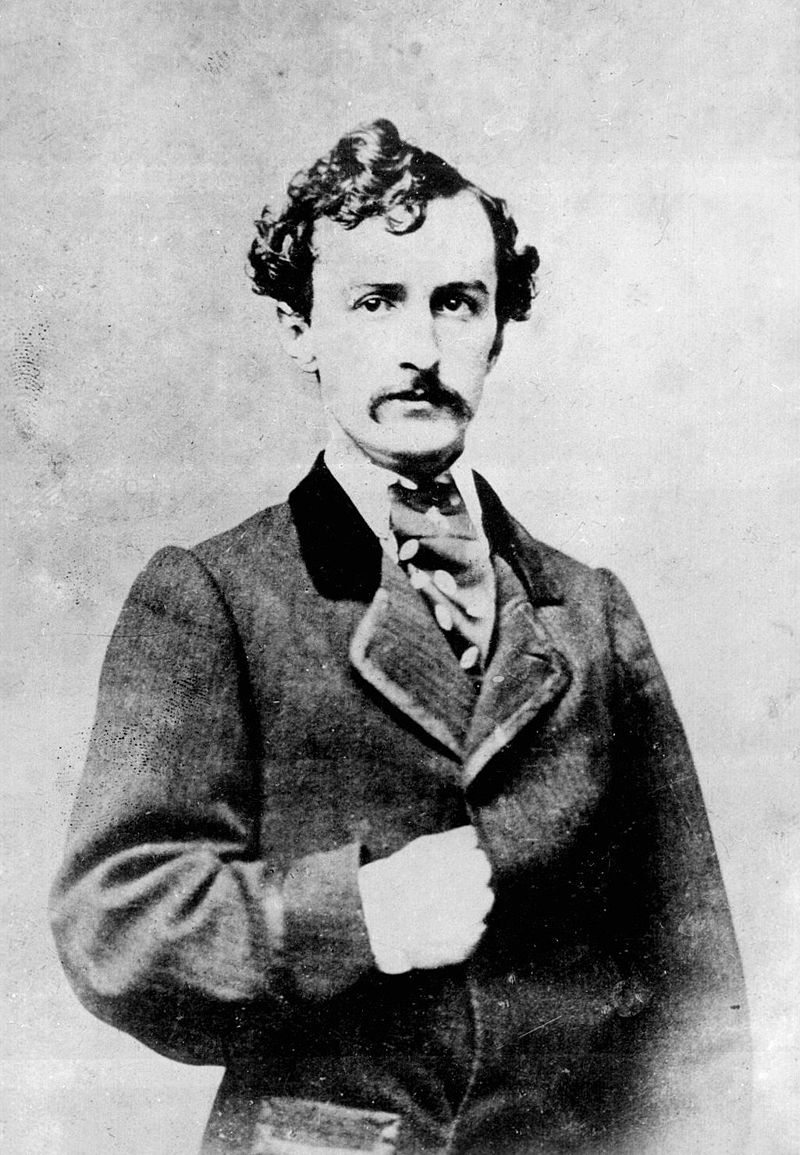
Therefore, today John Booth, who rid humanity of this unpleasant tyrant, deservedly graces the cover of the post