Porridge from an axe

or
He who says he hates the state simply doesn’t know how to cook it

Thanks to Bitarkh for the idea of the article

There is a fairly common negotiation strategy that I know as the Napoleon principle: ask for the impossible, and you will get the maximum. I can’t speak for Napoleon, but today it is practiced, for example, by Trump, and it is also loved by various terrorists who have taken hostages. This strategy is good, but it has one small flaw: it only works when applied from a position of strength. Therefore, when some political activist comes forward with maximalist demands addressed to the state, the first thing I do is calculate what they can threaten if the demands are not met, and usually, I immediately get bored. Empty demands are ignored at best, and punished at worst.

If your negotiating position is weak, it is far more appropriate to apply the opposite strategy, which could be called the “porridge from an axe” strategy, because it is well illustrated by this fairy tale:

A soldier was returning home from war and asked an old woman for a place to stay for the night. She let him in. He asked for something to eat, and she replied that she had nothing herself. Seeing an axe, he said: light the stove, bring the pot, we are going to cook porridge from an axe. She was surprised and did as requested. The water boiled, the soldier tasted the water and asked for salt. Then for grains. In different versions, there were other requests for ingredients; finally, the porridge was enriched with butter, served on the table, and eaten with appetite. As for the axe, the soldier either took it with him to finish cooking and eating, or left it with the old woman along with similar instructions.

If the Napoleonic strategy is used by terrorists who have taken hostages, then “porridge from an axe” is used, conversely, by the negotiators who talk those terrorists into submission. The strategy boils down to gradually wheedling out small concessions, and it is based on the assumption that the second party will incur costs not only from fulfilling the request, but also from refusing it. Another assumption is that the second party must have a larger goal and must believe that a series of small deals leads them toward that goal. If the soldier had not lured her with the promise of porridge from an axe, but simply asked for access to the stove, firewood, water, a pot, salt, and so on, he would have received a firm refusal somewhere at the salt stage, as in, “boiling water is enough for you.” Similarly, a terrorist will release hostages bit by bit if he is convinced that this advances him toward his stated goal, and not simply because he was asked.

In negotiations with representatives of the state, it makes sense for libertarians to use exactly this strategy. That is, one needs to find out what goal a specific official is pursuing, and then begin offering them small steps that should lead them toward that goal in exchange for giving up positions on some things that are not principled for them.

We will develop this topic in the next article.

Let’s assume that I dyed the soldier’s hair black and his forelock gold)))

The Tea Club as a Social Movement

Hi, Ancap-chan! At the end of October, you answered a question about the LPR, during which you read their charter. Could you analyze the Charter of the Tea Club for inaccuracies, potential abuses and flaws, and its compliance with principles?

Anonymous Tea-pot (question accompanied by a donation of 0.00119809btc)

As I indicated during the analysis of the LPR charter, complex multi-page charters are quite unnatural for a compact young organization and are practically useless in the absence of an external enforcer who could, based on the text of the charter, make decisions regarding various conflicts within the organization. If a certain group of people within the organization systematically violates the charter, their opponents will have only one pathetic tool—to announce the expulsion of this group. However, it is utterly unclear why a decision on expulsion should be followed by those expelled. They have the opportunity to continue their activities while calling themselves members of the organization, until the emerging split becomes so unacceptable to the majority of activists that they flee on their own in search of a healthier environment.

Thus, the content of a charter can only be seriously analyzed based on the fantastic assumption that all members of the organization will be guided by it in their actions under any circumstances. Meanwhile, organizations are routinely shaken by scandals, large or small, and each such scandal usually brings stronger apparatchiks into the organization’s leadership, weeding out those for whom the substance is more important than the form of activity for which the organization was created.

It should also be noted that it is practically impossible to meaningfully adjust a charter through democratic methods. All of Hayek’s arguments regarding the impossibility of constructing coordinated plans that take into account the interests of various groups via democratic methods are fully applicable to making amendments to regulatory documents, whether they be charters, constitutions, budgets, and so on—not to mention creating them from scratch. Sooner or later, the question arises of entrusting the drafting of the document to experts and then voting on the final text. Thus, the original text of any charter may be successful to the extent of the expert’s talent who drafted it, and further democratic mechanisms for adjusting the charter are simply meaningless, regardless of whether they are written into the original charter or not.

Don’t think that I am trying to dodge the question: I have managed to get through your charter. It is clear that you tried to create your own LPR “with blackjack and hookers,” meaning you started from the charter of the libertarian party and tried to prescribe mechanisms of interaction within the movement that would better correspond to libertarian principles.

According to your charter, the movement is a collection of regional branches, the activities of which are coordinated by elected steering committees within the branches (as in the LPR) and an interregional council consisting of the chairpersons of the steering committees at the interregional level (unlike the LPR, where this is handled by a body elected at the congress). You have also separated the actual management of the branch from the accounting and control functions, whereas in the LPR the accounting and control body exists more as a formality, and the membership records are kept by the head of the branch. I have no idea how this division works in your practice, but separating the CEO from the HR director seems justified for a large organization, but excessive for a small one. You have also implemented liquid democracy instead of representative democracy when it comes to a large interregional meeting. I don’t know if something similar exists in other Russian organizations or how it works, but generally, the world’s attitude toward such a mechanism is quite favorable.

You also pay a lot of attention to the work of arbitration—the negative experience carried over from the LPR is clearly felt. You didn’t dare implement a pure arbitration court, preferring a compromise model with a council of wise arbitrators joined by representatives of the conflicting parties. It is not hard to guess that if the arbitrators are biased, the arbitration will turn into a farce, and the charter does not provide for a mechanism to deny the jurisdiction of a knowingly biased arbitration. So this scheme is also potentially vulnerable to bureaucratic intrigues, just like any other model with a permanent judicial body.

What would I suggest?

If you were a purely libertarian organization, I would suggest you throw away the charter altogether and be guided solely by libertarian principles: freedom of association, freedom of contract, freedom of choice of arbitrator, and so on. But you aim to attract class-libs as well, so it is better to have framework documents, but it would be better to grant branches the right to adopt their own charters and work regulations, and to abandon rigid territorial divisions (simply a group of movement participants united for joint work, started a treasury, got some useful gear, and solves common tasks until they split up). It only makes sense to strictly prescribe the conflict resolution procedure, and it would be great if this turned out to be something like: after an official accusation is made, the parties must amicably settle their conflict within a certain timeframe with a subsequent official notification of the end of the conflict; if an amicable solution is not reached, they have the right to apply to anyone willing to act as an arbitrator and choose a certain number of these volunteers within a certain timeframe; if a choice cannot be made, the conflict is recognized as frozen, and the parties are deprived of the right to participate in any decisions directly affecting each other’s interests; after a decision is issued by the arbitrator, the parties either voluntarily execute it or leave the movement. In general, something like that, the details may vary.

And that’s basically it. You will get an evolutionary system united by goals, principles, and a conflict resolution mechanism—but without coercion toward something people are not ready for. What more could you possibly need?

De-anonymization service as a destroyer of etatism

Bitark’s Column

Ancap-chan, in her post about LPR and security forces, lamented that in a direct confrontation with the state, the libertarian party behaves not in accordance with its public rhetoric about what ought to be, but like ordinary peaceful law-abiding citizens. One can talk as much as they want about the state being a bandit, about the aggressor’s sanction that allows for the removal of government officials without trial or investigation, and so on, but as we see, this does not translate into a real program of action and likely will not.

Why does this happen? Most would probably say that people are “simply intimidated and afraid to push their luck,” “the state is stronger,” and other such nonsense. But the government of the Russian Empire was by no means a cute bunny and far exceeded Putin’s in terms of cruelty. Nevertheless, it was opposed by determined fellows with their own often suicidal doctrine of individual terror. This was an incomparably greater extremism than the behavior of modern Russian oppositionists, who do not even dare to do what is widely practiced in modern Hong Kong—for example, go out into the street in a mask, shine a weak laser in a policeman’s eye, and then flee unidentified.

Political scientist Ekaterina Schulmann constantly speaks of a global trend toward the reduction of violence and the strengthening of security values. According to Inglehart’s values map, Russians are particularly characterized by values of individualism and security; therefore, it is not surprising that their behavior is so different from that of the residents of Hong Kong, who embrace values of development. Thus, we will have to build our struggle strategies based on this fact. If we want to create a mass resistance movement against the stationary bandit, the methods it uses must be as non-violent as possible.

As we wrote in previous articles, the meaning of the deterrence doctrine is to increase the costs of initiating violence for the aggressor. In this regard, it does not matter exactly how the costs are increased for officials and security forces. But since we want to create a mass campaign (so that as many people as possible participate), the methods must be maximally non-violent, and the necessary actions for participants (the level of difficulty) must be the simplest.

Such a means, of course, is a service for the de-anonymization of officials and security forces. Alexander Litreev launched a project with similar goals called “Russian Elephant,” but only the first name, last name, and photo of security personnel who showed cruelty are added there. Not even a home address. Litreev positions his project as “absolutely legal” (which should be read as: “obeying all orders of the stationary bandit”), so it will have no serious impact on the state. It is foolish to hope for victory by playing by the rules of the bandits, which they write for themselves.

To truly increase the costs for stationary bandits, I envision a service roughly like this:

1) It is implemented as a website but operates under TOR, like all darknet sites such as Hydra. This provides maximum security while maintaining ease of use. The TOR browser is already installed for many people (enough to download and launch, everything works “out of the box”) on all platforms (Windows/Linux, Android/iOS). Despite known cases of .onion site hacks followed by the installation of malicious scripts for user de-anonymization, all of these were carried out by the FBI, CIA, and NSA. Uncle Sam, of course, is just as much of a stationary bandit as Pynya, but he will never help Pynya crush his opponents. Thus, even a bare TOR browser without additional anonymization tools (VPN, disk encryption, Linux instead of Windows, accessing the network via an anonymous phone and SIM card), TOR provides practically 100% anonymity against local guardians of stability, i.e., against the FSB. A low entry barrier will allow for the attraction of the maximum number of people, even those who are not technically savvy. This also greatly simplifies development (it is created as a regular website and then hosted on .onion).

2) The website collects a database of officials and security forces of all ranks, posting absolutely all information that could be found—first name, last name, residential addresses, phone numbers, social media profiles, the wife’s place of work, connections with mistresses, car license plate. We are deterring bandits, so obeying their own “law”/order “On the Protection of Personal Data” is the height of absurdity!

3) The site is populated by concerned users. The entire database is in open access, and its snapshot is posted daily for offline download (so it is not lost if the FSB manages to seize the server). Data appears on the site after verification by moderators to exclude the intentional entry of people not involved with stationary bandits.

4) Each profile of an official or security officer will have crowdfunding (like on Kickstarter) to conduct a campaign to “increase the costs of aggression” (retribution) against that person. People will contribute bitcoins, suggest options, carry out retribution, and send a report to the moderators. If everything is correct, the executor will receive all the money from the fund of that official/security officer. Similarly, one can motivate the collection of data on a specific official (home address, car number, mobile number, etc.).

5) Only non-violent methods of retribution are permitted (killing or causing physical harm to health is forbidden). It is forbidden to list the children of officials and security forces as objects of retribution. In this way, the creators of the service cannot be portrayed to the public as ruthless terrorists, and the bandit’s relatives will not be as enraged as in the case of his death, while those who would like to replace him will be pleased. Here are examples of permissible methods of retribution: posting flyers with photos in the entrance, writing on the door, filling the lock with glue, writing on the car, reporting something to the wife’s workplace, filling the apartment with odorant, splashing with zelyonka. Impermissible: smashing a head, breaking legs, splashing with acid, setting the apartment on fire. Always remember: deterrence is not war!

As you can see, this service does not require the use of violence and is easy to use, which gives good chances of attracting a large number of people.

The libertarian eagle is anonymized and safe; the bandit is deprived of such luxury

Democracy – a dethroned god. Review.

Commissioned by the Tea Club

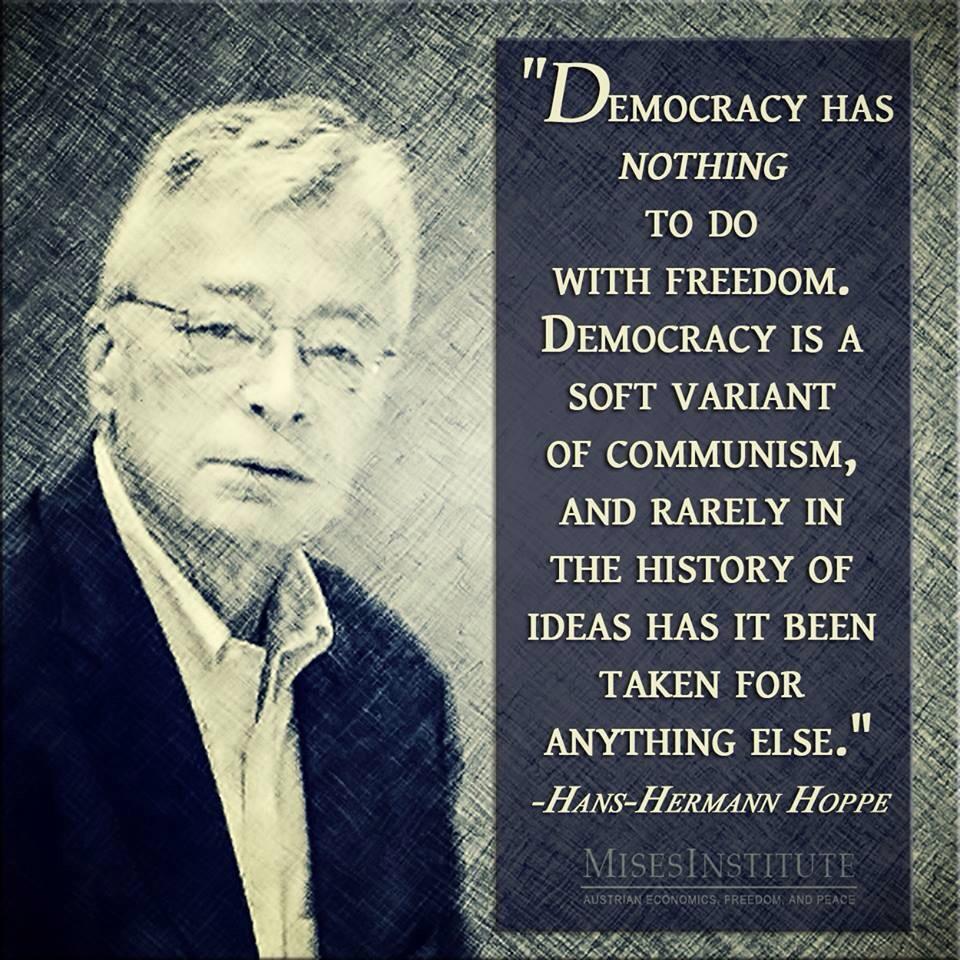
Hans-Hermann Hoppe’s book “Democracy: The God That Failed” is not a cohesive treatise, but rather a collection of essays arranged in an order that allows the author’s ideas to be presented fairly consistently. However, such a composition inevitably leads to self-repetition, and an author with more respect for his readers could have reduced the volume of the book by about thirty percent without compromising the result. But there are advantages to this approach: any of the chapters can be read entirely in isolation from the others if desired. I will not analyze the work chapter by chapter, but will touch upon the main ideas of the book, indicating what seemed valuable to me, and what seemed erroneous or underdeveloped.

Time Preference and Family Values

Hoppe begins by explaining what time preference is, and how it tends to decrease in a more civilized society and increase in a more barbaric one. From this, he concludes that those measures for organizing society that increase time preference are decivilizing measures, and therefore harmful—and vice versa.

He also touches upon another factor affecting a person’s time preference, namely the stages of their life. In childhood, time preference is high; a child is unwilling to wait to achieve their immediate goals. With age, it decreases as a person expands their planning horizons, and toward old age, it should theoretically increase again, since there is less time left to live, and, as Keynes rightly noted, in the long run we are all dead, so there is no point in making plans for a period exceeding the remainder of one’s life.

But, Hoppe joyfully notes, there is such a factor as the family. The desire for the prosperity of one’s lineage allows a person to maintain a low time preference into deep old age, for they know that the wealth they have accumulated will serve the benefit of their descendants. However, this requires the organization of people into stable collectives called families. Therefore, any measures that destroy families increase time preference in society, meaning they are harmful and decivilizing. Hence all of Hoppe’s hatred for communists, hedonists, and homosexuals; hence all of his conservatism. For the sake of instilling conservative values, he is ready to welcome any individual oppressions in the form of expelling individualists from patriarchal collectives, which are the bulwark of true civilization.

It is not difficult to see an elementary logical substitution here. Yes, family values reduce time preference in old age, but who said that this is the only thing capable of reducing it? People frequently do not squander their entire fortune by old age, but they do not necessarily leave everything to their children. Instead, for reasons incomprehensible to Hoppe, they continue to manage their capital prudently until death and bequeath it to various foundations, as did Nobel, Carnegie, or Rockefeller. That is, the family is clearly not the only factor that reduces time preference in old age, nor is it the factor that contributes most highly to the progress of civilization. A foundation, as the founder’s will formalized as a legal entity, often handles the expansion of the planning horizon even better than profligate descendants, who might even be tempted to hasten the benefactor’s end to spend everything sooner. Thus, one of the foundations of Hoppean apology for conservatism turns out to be shaky.

Aristocracy, Monarchy, and Democracy

The central part of the book is an analysis of how a society existing in natural freedom first, for natural reasons, becomes accustomed to seeking advice and the resolution of conflicts from its most competent members, then these individuals gradually turn into a hereditary aristocracy, then the aristocrats are subsumed by the wealthiest, who becomes an absolute monarch, and finally, the monarch is abolished by the Third Estate, and an order reigns in society where absolute power belongs to society as a whole, while temporary appointees rule in its name. At each of the described stages, the personal responsibility of the governors for the results of their management is diluted, the quality of services provided by the elite to society becomes lower, and the price becomes higher.

Fortunately, Hoppe notes, despite all this regress, people have succeeded in developing various useful market mechanisms, and now, in order to return the lost freedom, we do not need to return to natural aristocracy in its archaic form; it is sufficient that all services currently monopolistically imposed by the state be traded on a free market.

In Hoppe’s opinion, reforming the democratic state in this direction will not work, because there are too many managers of public property, the temptation to use power for personal gain is too great, and no libertarian party will be able to recruit enough ideological haters of the state to place them in all government positions. Fortunately, the majority always silently accepts the status quo, so in order to present it with the fact of the state’s abolition, there will be no need to win elections according to government rules; it is enough to rock the boat and then, through the coordinated effort of a determined minority, overturn it.

In short, a certain confusion arises. On one hand, there is the progress of society, during which time preference decreases. On the other hand, there is the regress of systems for managing society, as a result of which time preference increases.

I see little point here in nitpicking the author on the fact that the state hardly matured as a fruit of the evolution of natural aristocracy and its noble activity in resolving conflicts. Rather, it is likely the fruit of the evolution of a gang of robbers and their methods of solving issues through lawlessness, then through “understandings,” and then through laws. It is not so important whether Locke or Hobbes invisibly hovered over the waters on the first day of creation (both hovered, of course), as long as in the process of reconstructing the patterns of history, we arrive by different paths at a single conclusion regarding desired future changes in the organization of society.

The Beautiful Ancap of the Future

The most beautiful part of the book is the description of the functioning of a system of private insurance companies, which simply pay insurance premiums to their clients upon the occurrence of insurance events such as robbery or theft, but as a result, are forced to abolish states out of pure commercial calculation, because this means they will have to pay less to clients in insurance. Hayek’s name is not mentioned once, but this description fully aligns with his idea of spontaneous orders.

Here Hoppe provides a valuable consideration that I have not yet encountered in other authors. It is known that many skeptics argue: if two subjects who have contracts with different protection agencies begin to feud, this should lead to a war between the protection agencies contracted to them. David Friedman responds to this by saying that it is not profitable for agencies to fight, and therefore they will push the clients aside, hash it out among themselves, decide who is right, and present the clients with the fact. This looks logical, but generates bewilderment: how is such a model better than the current state model?

Hoppe provides a different logic. He does not speak of any protection agencies; the company’s task is the insurance of the client’s risks. But only those risks over which the client himself has no power are insured. If a company were to unconditionally pay fire insurance to everyone who insures their house and then sets it on fire, it would go bankrupt instantly; therefore, when drawing up contracts, it is always specified which cases are not insurable. Thus, in the event of a conflict, only the party that was not the aggressor in that conflict should be recognized as having the right to the insurance payout. Moreover, if both parties behaved extremely provocatively, it is not even that important who first resorted to open violence—such a case, where the client was asking for damage to the insured property, is obviously not insurable.

Another interesting reasoning is related to factors affecting the calculation of insurance premiums. They are higher the higher the value of the insured property, and they are lower the lower the costs of its protection. Thus, market logic will lead to the fact that insurance companies, wishing to earn a maximum, will fully contribute to the growth of the price of the client’s property, which is achieved, in particular, through its reliable security and reducing the probability of damage—but exactly this will lead to the margin decreasing, and insurance companies will have to master new markets, meaning come to more dangerous and poor places, for example, those where various criminal groups, like states or other thugs, still conduct their bandit activities. Thus, the activity of insurance companies will naturally lead to the expansion of security and the growth of the once-arisen zone of ancap.

Summary

Despite the fact that the author in a number of cases indulges his own tastes and falls into wishful thinking, the book contains a number of extremely useful ideas that were new to me, which I agree with, and which I will use in the future. Even if these ideas do not belong to Hoppe himself, he still deserves my respect as their popularizer.

Decision-makers and security forces

Many have expressed optimism regarding the recent series of searches of LP members, claiming that this is a mark of quality and a sign that the party is on the right track. I would say that today, repression against political activists is not a sign of fear among those in power, but rather a businesslike scurrying, carried out with a cold heart and without much thought. The grass has grown—it is time to mow. Meanwhile, the grass may comfort itself with the thought that the more it is mown, the thicker it grows.

To be honest, I had a vague hope that since the LP differs from other parties in its radical rhetoric of freedom, this would also be reflected in its behavior in the face of repression. It was not. Protest as performed by the LP is just as legalistic as that performed by Navalny. When security forces burst into a libertarian’s home, they leave just as intact and with the loot as if it had been an ordinary Navalny volunteer or an employee of Open Russia.

So, if anyone believes that Russian libertarians are grim, armed anarchists who will not let themselves be stepped on, or that an attempt to break into one of their homes will immediately trigger a spontaneous rally under their windows—they will have to part with these harmful illusions. Libertarian ideas are not so deeply rooted in the libertarian community that rhetoric regarding the state has translated into practical actions against it.

After all this, I even feel somewhat awkward discussing what the libertarian doctrine of action is in the event of one aggression or another: such discussions begin to look very irrelevant.

Therefore, in this post, I am not providing recipes, because I do not know them. I do not know how I would behave if I were a member of the libertarian party, against whose elected leader blatant state aggression has been undertaken. For me, this is a serious reason to continue refraining from joining the party. I fear that if I begin to declare my views openly, then when the state reaches me—which will happen quickly—I will find myself alone before its functionaries, and at most, I will receive a few pickets in my support.

Please be responsible for your words; there is already too much empty chatter in the world. If you do not feel the resolve to bite the boot that tramples you, do not raise the banner with the motto “Dont Tread On Me.” It is better to hide your libertarianism than to openly discredit it.

NAP and contract enforcement, a discussion

Yesterday’s post about whether violent actions to enforce payment for a completed contract violate the NAP, sparked a discussion, so I am returning to the topic.

As Ekaterina Schulmann loves to point out in her lectures, the world is extremely unfair, and societies where there is little trust, bear additional costs due to this, which exacerbates their poverty and further reduces trust—while trust cannot be restored by simple preaching. This observation applies not only to the citizens of a particular state in general, but also to other groups. In the context of the transition to ancap, we are most interested in the agorist society, those engaged in counter-economics, and therefore voluntarily or forcedly cut off from state services for ensuring contract compliance.

For example, any shadow entrepreneur can easily encounter a situation where they have incurred costs while fulfilling the contract terms, after which they are refused payment. In such a situation, you cannot not only file a lawsuit, but you cannot even bring the situation to public attention, because the activity is shadow, and publicity is even more disadvantageous than the losses from unpaid work. Without publicity, the institution of reputation does not work.

Take sex work in modern Russian society as an example. It is illegal, so in case of non-payment under a contract, these funds cannot be recovered through the court, and you cannot even draft a written contract with specified sanctions for non-payment, as it would be evidence. Therefore, even an individual entrepreneur usually has to cooperate with someone to whom she can turn for protection in such cases, so that they can achieve payment through force or the threat of its application. These are additional costs that society bears due to a lack of trust, suivante which allow such a business to remain stably profitable; without the purchase of contract enforcement, sex workers quickly become sex slaves.

In legal business, this manifests itself less often, but it is quite easy to imagine, for example, how a drunk debauchee is kicked out of a bar where he is unable to pay for the damage he caused (see also my old article on vigilantism). Here, a conditional mutual offset of damages is far more common, and not an invoice for payment post-factum, although variants are possible.

Nevertheless, it must be clearly understood that all cases where direct violence is practiced instead of civilized proceedings with installments, penalties, and seizure of property, etc., are precisely excesseses, and the more trust there is between people in society, the fewer such excesses.

In the post Libertarianism ex machina, I referred to Alexander Auzaan’s lecture, where the conditions necessary for the stable existence of a stateless society are discussed. He calls the balance of the potential for violence as the key condition. When a sex worker or a bar owner hires security, they level the balance of the potential for violence, countering the potential aggression of customers with the potential aggression of security. The second condition mentioned in the lecture is a stable community composition. This factor allows the transition from a classic prisoner’s dilemma to a repeated one, launches the institution of reputation, makes it possible to predict others’ actions—and gradually develops trust in society, even if the various additional measures proposed by Ekaterina Schulmann are not used—namely, joining various social organizations to build experience in peaceful, creative interaction (though with them the process is significantly accelerated).

The Internet allows such stable communities to form even without being tied to a specific compact territory: the transmission of information is extraterritorial, and communities are based precisely on the exchange of information. Transaction guarantees, through mechanisms of collateral, escrow, insurance, and other non-violent instruments—these are services that appear on modern markets at fairly early stages of their development, and immediately radically reduce both the level of costs from contract violations, and the level of potential violence necessary to operate in such a market.

So do not violate the NAP—it is not only unsightly, but also unprofitable, there are better tools.

Should one beat someone over the head with the NAP for non-payment under a fulfilled contract?

L29Ah (question accompanied by a donation of 0.00035466btc)

To start, I would like to recommend a recent column by Bitarch about contract enforcement. It provides several historical examples of how, in a free market, contract enforcement happened not through violence, but through the refusal to cooperate, and indicates that this is an inevitable consequence of a sufficiently balanced potential for violence in society — and ancap is presumably just such, otherwise a dominant aggressor would not be long in appearing. Therefore, relatively stable markets usually already possess all the necessary tools for peaceful conflict resolution — such as arbitration, rating systems, and sanctions.

Nevertheless, reputation works well only where it is easy to refuse cooperation by replacing a defaulting counterparty with their direct competitor, and where all other market participants also monitor such situations and strive to deal with counterparties who have a good reputation.

However, if you have a short planning horizon, and it is not very important to you what long-term negative consequences the person who did not pay for your work will face, but you would like to quickly receive the money under the contract and spend it on urgent needs — then it is important to have threats in reserve that are more serious than “I will no longer do business with you, and I will try to make sure everyone follows my example.” For example, the ability to shove a barrel into his liver, after which you offer to part with the car keys as collateral that the contract money will be paid tomorrow. Or, as you indicated in your question, simply beating him up.

At the same time, it is important to understand what exact reputation you are creating for yourself with such actions. If you are satisfied with a reputation as hot-tempered but forgiving (beat them up and forgave the debt) — well, go ahead, crack some knuckles, then write off the losses, and you’re even. If you prefer the reputation of a tough guy who isn’t to be trifled with, you can try beating them up first, and then declare that this was the interest on the debt, while the principal must be returned by a certain date, or new interest will be charged. But this is already a serious claim that you are capable of completely determining the rules of the game in this area (since you have de facto revised the terms of the contract unilaterally, which is no less of a blunder than a breach of contract by the party withholding payment), and many may find a reason to challenge such a claim, even if you were previously, in essence, irrelevant to them.

So I would recommend avoiding violence whenever possible and limiting yourself to threats of violence. Demonstrate to the contract violator your ability to cause them unacceptable damage, and then offer, as an alternative to such a miserable scenario, to revise the terms of the contract by providing the possibility of payment in installments — or, if that is clearer to you, putting them “on the clock.” And, again, it is better to get their consent to the new terms in an explicit form, because what use is it to you to let go of a person whose only desire is to get as far away as possible without actually paying the bills. It is far more profitable if they leave happy, understanding that they got off easy, that it is actually realistic to pay the debt under the new terms, that their business reputation will not suffer, and that they don’t need to run from anyone.

And in conclusion, if you are concerned specifically with the formal compliance of certain actions with the non-aggression principle, I will describe the conflict from that point of view.

You weren’t paid, you act in accordance with the clause of the contract regarding delays: usually, both a penalty and a specific arbitration body are specified there. The NAP is not violated.

You weren’t paid, you beat up the non-payer, after which you proposed to consider that the parties are even, and the beaten person agreed. There was a mutual violation of the NAP followed by a reconciliation of the parties.

You weren’t paid, you beat up the non-payer, after which you demanded the return of the debt — there was a violation of the NAP on your part, unless, of course, the beating was written into the contract as a disciplinary measure in case of payment delay or even as the payment itself (the classic description of labor relations known to us, ending with the words “you shouldn’t have chased after cheapness, priest”).

You weren’t paid, there is no hope for arbitration, you insist on a revision of the contract through threats, after which the new contract is fulfilled by the counterparty — there is no violation of the NAP (but if you overdid it, the situation may only become more complicated; this is a favorite plot of action movies, and they don’t make action movies about peaceful and cloudless market relations).

Contract settlement

Crowdfunding. Practice

No sooner had I posted the text about how crowdfunding is the most obvious way to finance the production of public goods in a free market, as an illustration came along.

The St. Petersburg branch of the LPR is renting an office, and to raise funds for its lease, they decided to hold a regular stream. Today at 20:00 Moscow time on the YouTube channel Ancap-podcast the show “Brewing Moonshine” will take place, during which the host intends to drink a glass of moonshine for every 1000 rubles in donations. I don’t know if they’ll be distilling it on the spot or pouring ready-made, but it could turn out to be amusing.

I was offered 300 rubles to post this announcement, and I decided to briefly deviate from my rules, according to which a resource review should not stand alone, but be accompanied by my answer to a donation-backed question. Today we are holding the funeral without the deceased.

I think I’ll drop by to listen to the stream too, although I intend to drink martini with tonic while doing so, if you’ll excuse me.

https://youtu.be/ESZmGW7DKhM

Kickstarter for public goods

Bitark’s Column

In discussions between libertarians and statists, the question “Who will build the roads under ancap?” comes up almost every time. There are many possible answers to this, but I have not encountered a beautiful, universal solution for the problem of providing public goods in a stateless society. At least not until yesterday, when in a stream by the “Antigovernment” community, Savva Shanaev introduced an idea by Alex Tabarrok that is little known in Russia: “Dominant Assurance Contracts”.

Public goods include a wide variety of benefits that anyone can use regardless of whether they paid for them or not — roads, bridges, street lighting, storm sewers, lighthouses, protective dams, herd immunity resulting from universal vaccination, law enforcement, strategic deterrence, waste recycling, sewage treatment, public parks, and much more. The main problem with their provision is the free-rider effect. When it is impossible to charge for the use of public goods, no one will simply pay for them, viewing them as a “given” or hoping that someone else will pay.

The stationary bandit (the state) constantly exploits this to prove its necessity. State propaganda claims that only the state can build roads and bridges, and therefore a territorial monopoly and taxation are needed to fund them.

However, there is a simple and clear way to provide public goods in a completely free market. It has already been implemented on the well-known platform Kickstarter, and without the state, it will be used far more often than it is now. The principle of its operation is roughly as follows.

For example, residents of a neighborhood are tired of breaking their legs and damaging their cars in potholes on the road. An activist contacts a road paving company and gets an estimate. Then, they go to a crowdfunding platform and create a fundraising campaign, specifying the required amount and the deadline for collection. They send letters to the neighborhood residents asking for any possible assistance in funding the road repair and provide a link to the crowdfunding campaign. Anyone can go there and see how much money has been contributed so far, how much more is needed, and when the collection ends. If the required amount is collected by the deadline, the campaign is considered successful, and the road repair company receives the order. If the full amount cannot be collected by the specified date, the money is returned in full to the residents. It is their choice; it means they truly do not need the road repair, and it is absolutely unethical to rob the population of the entire country through taxes to repair their road. Those who cannot stand living without a road move to neighborhoods with a more demanding population, and over time, a natural separation occurs based on the level of demand for infrastructure quality.

Everything is fine, people are satisfied

Monopolies-2, review

On November 4, I was very sad. I am used to watching the broadcast of the Adam Smith readings held in Moscow every year, but this year the organizers deprived me of this opportunity for the first time, so I wish them a speedy removal and replacement. As I understand it, although the Adam Smith Center is formally responsible for this, in fact, the organization was entrusted to the same team that organized the summer debates between Shulman and Solovyov, as well as the lecture by Hans-Hermann Hoppe. These guys always disregard the broadcast and insist that no one else should conduct it. Monopolists, for goodness’ sake. Monopoly is expensive and bad. Always. Even if it is a monopoly on libertarianism or on organizing libertarian conferences. (Update: as I have been told, the team is actually different. Nevertheless, in my opinion, the refusal to provide a live broadcast remains a wrong move)

Fortunately, the Adam Smith Center does not have a monopoly on organizing libertarian conferences. On November 10, the second conference in the TED Talks format dedicated to monopolies took place in Moscow. The conference is conducted by the Moscow branch of the Tea Club. It is known that the LPR has rather strained relations with the Tea Club, but it is precisely thanks to their competition that we have more high-quality educational content online, so we can only welcome their rivalry.

Alas, the Tea Club also failed to provide a broadcast, but on the other hand, they began publishing recordings of the speeches on November 16 and finished on November 27. The recordings are collected in a playlist; I watched them all at once today and, as per tradition, will briefly go through all of them.

  1. Dmitry Kornienko. How the state teaches history. This discusses specifically the experience of the Russian state, without invoking foreign examples. Mention is made of an important difference between Soviet education and modern Russian education: the monopoly on knowledge has disappeared, although the monopoly on education has remained. One can lie, but students will know that you are lying and have no reason to remain silent about it. Thus, the tasks of forming a unified understanding of history have become more difficult, and, in essence, the state monopoly is ceasing to cope with them.
  2. Igor Drandin. Monopoly on discourse. Igor has extensive experience in the unpleasant role of being the liberal punching bag on federal TV channels; he shares the secrets of this non-trivial profession and speaks about the pros and cons of appearing on television. The most compelling argument presented by Igor is that TV debates are a very tough school of debating, and it is foolish to refuse such training if enemies practice this exercise daily. For instance, Navalny lost in debates to Girkin, Svetov to Kagarlitsky and Roizman—they lack the skill, as blogging and lecturing train one for something entirely different. Meanwhile, in public politics, the skill of debating is just as useful as the skill of speaking at rallies. I will note, however, that television itself is unnecessary for acquiring such skills, and it would be great if Drandin himself could find a way to pass these acquired skills to those politicians who did not participate in TV debates.
  3. Vyacheslav Shirinkin. Monopoly on a favorite band. Not all monopolization processes are linked to the state. Vyacheslav talks about various psychological aspects related to people’s love for exclusivity, as well as how to break into a market with a high barrier to entry.
  4. Vadim Novikov. To be or not to be for antitrust in Russia? Unfortunately, the recording turned out to be ruined, and the sound is very poor. The main thesis of the report: there is no point in tackling complex cases until the simple ones are sorted out. First, defeat protectionism in foreign policy, then try to defeat it in the domestic market.
  5. Roman Yuneman. Electoral monopoly. A candidate who won the elections to the Moscow City Duma shows in detail how the tool used to take away his victory is unlike an engine for fair elections, and why it is now important not only to contest the election results of a specific district in court but also to prevent the flawed practice of electronic voting from spreading across the entire country. The report is especially useful for the heralds of technological progress as a sort of sobriety check: if the goal is to counter falsifications, then simple mechanisms are better than complex ones.