Let’s imagine the following situation arising in an imaginary ancap society. In my opinion, someone has caused damage to my property, but in the opinion of that someone, he caused me no damage. And the circumstances of this case are such that it is very, very controversial; it is difficult for an objective party to determine who is right. As a result, this leads to a situation where, across a large sample of different courts, half of them side with me, and the other half side with the party I am accusing. To my suggestions to pay at least a portion of the compensation demanded by me (and by the courts that sided with me), the opponent categorically brushes them off, because, in his opinion, he did not cause damage to my property, and therefore does not owe me a single penny.
Under the conditions of a state, such a problem is reliably solved by a hierarchy of courts. Yes, someone will remain dissatisfied, but that is the whole essence of the institution of the court. In the conditions of ancap, however, we arrive at a complex conflict where my bailiffs and my opponent’s security must, in effect, start fighting each other, since both conflicting parties are equally right. What solution does ancap offer for such situations? And how should I personally behave in such a situation?
The function of a court is to help the parties resolve their conflict. The only way to do this is for both parties to the conflict to recognize the jurisdiction of a particular court in a specific case. If the case is complex and convoluted, we cannot know in advance the position of any specific pre-designated court until it completes the proceedings. Therefore, all the parties to the conflict need to do is find a court that has a good enough reputation, is acceptable in price, and is willing to take on the case. Then, both parties enter into an agreement with the court that they are ready to execute its verdict in this case, and only after that does the court even begin to delve into the subject.
Since the case is so murky, the final court decision will likely be quite a compromise, such as one party receiving partial satisfaction of their claims while paying some compensation to the other party. But, however, we cannot know this in advance.
Naturally, each party to the conflict will be interested in the impartiality of the court; therefore, they will probably consider it important to include a clause in the contract stating that they reserve the right to withdraw from the process before the end of the proceedings if they can demonstrate the court’s interest in a particular outcome.
If one of the parties refuses in advance to recognize any verdict other than one that completely relieves them of obligations, they are thereby refusing the court as such, which means they intend to continue an open conflict with the second party. In this case, the party that agrees to the court can wave this readiness around, saying, “I am not the one starting a war here, I am merely defending myself,” and thereby gain new allies while gradually stifling the aggressor with sanctions, forcing them into peaceful negotiations.
By the way, peaceful negotiations, without any external arbitrator, are also a way of resolving a conflict, so a court is not a mandatory procedure for this at all.
As has been noted repeatedly by many, the state of affairs in international politics very much resembles ancap
Supporters of authoritarian power sometimes frighten libertarians with artificial intelligence (AI) systems. They try to prove to us that after their implementation, all our struggle will become meaningless, because the state will be able to instantaneously detect and nip any oppositional activity in the bud.
However, AI, like any other technology, is a double-edged sword — just as a stationary bandit can use it against us, we can use it against the authorities. The use of AI for the deanonymization of security forces by projects like “Scanner” and “Russian Elephant” is only one possible example.
Also, such systems are prone to false positives. This insurmountable property of AI can be used intentionally by introducing false targets to overload the system. Not the neural network itself, but the investigative bodies and security forces, who will have to spend effort investigating fake cases, overlooking real oppositionists. And if politicians are substituted as false targets, the entire system of the stationary bandit will fall apart.
For example, there is a large amorphous country in the north of the continent; the climate there is cold, there are few valuable resources, and a freedom-loving people live there, where almost everyone has an AK under their bed. There are cities in Ancapistan, where order is maintained by private companies and a small PMC for special operations. Suddenly, some valuable resource is found in this beautiful country. A neighboring country, Etatistan, is an ordinary country with corruption and standing armed forces (of a sort). And Etatistan decided to seize this resource. It failed to acquire it through market methods (the landowner did not sell his land, and blackmailing him to get it also failed), and Etatistan declares war on Ancapistan. And my question is: how can Ancapistan defend itself in order to maintain its independence and remain Ancapistan? How can an armed people, who have plenty of firearms and light armored vehicles (like jeeps and BMPs), withstand an army with aviation and heavy equipment?
Baker
This question has been hanging for a long time; I was too lazy to answer it because I had already answered a very similar one. And then a post on the Freedom pride channel appeared, which touches upon a related topic. Why not take advantage of such a free ride?
As is easy to see, the topic of direct military confrontation between a non-state society and a state military machine worries many, because war is historically the most important thing a state had to be able to do if it wanted to survive; and thanks to its competencies in military affairs, practically the entire Earth is today divided among states, while non-state societies lead a marginal existence on the fringes of civilization.
Zolotorev, whom I am quoting, emphasizes that the ancap community, all other things being equal, is definitely wealthier than the state; due to decentralization, it can afford more flexible tactics, and the costs of implementing a state from scratch on the territory of Ancapistan conquered by the state would be disproportionately high for the state—in other words, the game would not be worth the candle.
Freedom pride shows why it would be difficult for a single gang to seize power in a conditions of an already established ancap. But it also states that if it were not a gang, but a state, it would become a problem.
Therefore, in conclusion, I want to suggest you read my longread on the doctrine of deterrence, which shows exactly that a means has already been invented to prevent a state from attacking you—the threat of guaranteed destruction of the state leader. The state is centralized, and this is its weakest point: it is enough to demotivate a very small circle of people from attacking, and the attack will not take place.
So, of course, an AK under the pillow is great sports equipment, but the key role in the conflict will be played by that very small PMC for special operations you described. This “department for working with difficult clients” at the insurance company, in the event of military action, simply captures the commander-in-chief of Etatistan and twists his balls until he agrees to withdraw the troops and pay a penalty. And if they can’t capture him alive, the problem will be solved by a dozen Tomahawks or something along those lines. This is significantly cheaper than heavy armored vehicles and other means of destroying large military formations that Etatistan possesses.
I will note that Etatistan cannot respond symmetrically, as there is no government in Ancapistan. And even sabotage at a PMC military base would only lead to the insurance company simply having to hire another PMC somewhere else, or simply announcing a substantial reward for the head of the dictator of Etatistan.
Although, to be honest, personally I don’t quite understand why the deposit could not be acquired through market means. Everything has its price, and if a price per share with a large premium to the market is offered, what is the point of refusing? But since that is the condition of the problem, then the word goes to the Tomahawks, provided that the shareholders of the deposit are willing to pay for it.
Suppose states and simply wealthy people had access to killer bees. In that case, the war between the North and the South would not have happened, and slaves in the South would not have been freed. On the other hand, Lincoln would not have employed the flawed practice of printing greenbacks, which led to the Long Depression, and perhaps in the end the world would not have fallen into leftism and we would still be on the gold standard (oh, dreams, dreams). However, even today, one might be able to travel to the Confederacy and legally buy oneself a slave girl for a few gold coins. Or not? In short, my question is: who would have freed the slaves had DS been developed before the US Civil War?
анонимный вопрос
Throughout the nineteenth century, slaves were freed all over Eastern Europe, in Russia, and toward the end of the century, in Japan as well. The government freed them without waiting for revolutions and civil wars. There were a multitude of prerequisites for this, primarily economic. In Australia, an economic boom also occurred after the abandonment of slave labor in agriculture, and the economy there was quite similar in structure to the economy of the southern US states.
Even if the southern states had managed to resist this trend for a while, slaves would have been finally freed in the 20th century by tractors and cotton pickers.
There is an opinion that the Union and the Confederacy would have developed much more dynamically had a war not occurred between them. The Union would have had to temper its protectionist zeal because the Confederacy, advocating for a free market, was right next door. The Confederacy would have had to soften the condition of slaves, aiming roughly for the prosperity level of Irish immigrants in the North, so that the flow of fugitives would remain within more or less acceptable proportions. And, of course, both countries would not have suffered such human losses and would not have damaged their economies so severely. By the way, in the absence of war, two transcontinental railroads would have been built instead of one.
So, Lincoln paid for his disregard for the Constitution quite justly.
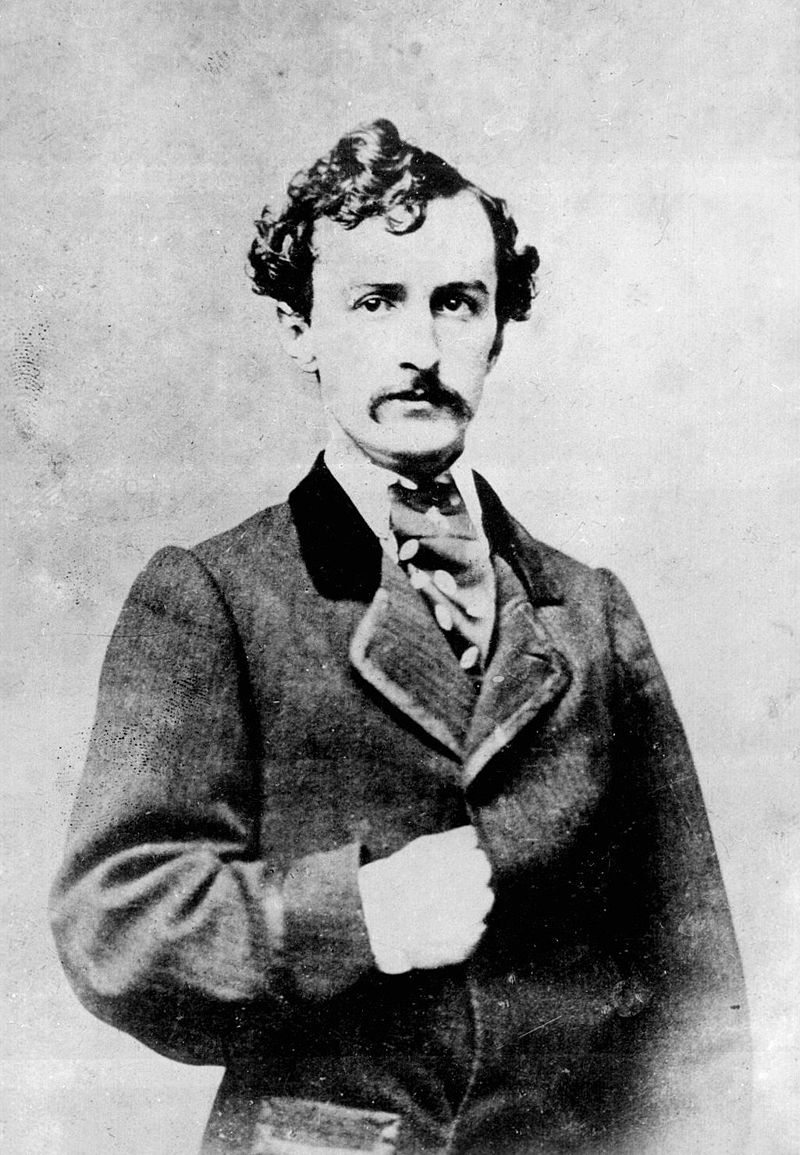
Therefore, today John Booth, who rid humanity of this unpleasant tyrant, deservedly graces the cover of the post
You know that my channel is completely non-political in nature. I have no right to call anyone to the barricades, as I maintain my own anonymity; I am quite skeptical about the prospects of decent individuals participating in legal politics, about the prospects of registering a couple of potentially good political parties—and so on. But regarding what has been happening in recent days, I have developed a distinct personal interest. The Russian government is depriving me of the opportunity to listen to people who interest me.
For a month, Aleksey Navalny, the host of the popular weekly program “Russia of the Future,” has been lost to me. The channel’s attempts to find an adequate replacement have not even come close to success so far. For a month, I have been deprived of Mikhail Svetov’s programs on SVTV—now, instead of interviews with various interesting people, the channel shows imperial stormtroopers beating peaceful citizens to touching music. For a month, I have been cut off from the best weekly program on economics, hosted by Vladimir Milov. Even Egor Zhukov’s channel, which provided rather thoughtful content on a wide variety of topics, has now closed for an as-yet-unclear period. Such a violation of my consumer rights by the state, of course, does not add to my affection for the institution of the state in general and the Russian political regime in particular.
I don’t have many opportunities left to somehow harm the state in return. I no longer pay personal income tax or various other personal taxes. I already try to choose stores that do not pay VAT (this is visible on the receipts), and whenever possible, I shop at the bazaar. For the state, I practically do not exist.
However, I have this channel, and I would like to use it to convey a simple thought as widely as possible. The state is your enemy. In open confrontation, it is stronger, but it is very vulnerable to guerrilla warfare. Do not feed the state with your money. If you are forced to work for it, work poorly. View yourself as a spy or even a saboteur in the enemy’s rear. Plunder state property: it will be better in private hands (this, of course, does not refer to various urban improvement items; why spite yourselves). Squeeze all the social benefits out of the state that it has carelessly allowed you to claim. Do not hesitate to do this using fake documents if you have the opportunity. Decorating the city with leaflets and graffiti saying that the state is the enemy is a great idea and a classic of guerrilla struggle. If you want to kill a cop—think thrice.
Before deciding on things that the state opposes particularly harshly, master the art of conspiracy. At least the basics, such as the fact that your smartphone is not only an invaluable assistant but also a spy that will help the state find you, and Vkontakte is simply a garden plot where the state grows criminal cases. Think not only about satisfying your own demand for justice but also about the PR effect. It is better if the direct damage to the enemy turns out to be smaller, while the state loses more in the eyes of society. Ultimately, the state must be expelled precisely from people’s heads, and it would be enough if it were only from ours—but we will have to reach the last grandmother.
As for the recent initiatives of the Russian security forces, I very much hope that they will serve to unite the opposition. For the state, we are all—regardless of the nuances of our ideas about the desired society—equally enemies. Let’s not feud with each other. I hope that Gudkov meets Svetov at the doors of the detention center, they shake hands, and go together to record a stream with prison tales and plans for joint action. I hope that Zhukov then arrives with a bouquet of flowers and is also happily welcomed into the company. I hope that people stop reminding Svetov and Navalny about various ancient questionable posts on LiveJournal, and if someone does, they are snapped at. I hope that Svetov starts collaborating with the Tea Club. Who said what bad thing to whom and how they threatened—it doesn’t matter anymore, we are not in that position now. It would be good if simultaneous imprisonment in a detention center helps the ambitious leaders of the Russian protest reach this simple understanding.
Every time we mention the deterrence doctrine, it sparks a discussion. The first time, we spoke with the host of the Antistate channel, and now it has caught the attention of Alexander Elesev, the host of the Dobroum channel. Thus, the idea is controversial, and it is worth continuing to provide clarity, but not for too long, so that the reader does not get bored.
Alexander is far from the first person to voice this reproach: “You intend to fight the state; it’s useless, you will be declared terrorists and destroyed like the militants in Chechnya.”
However, the deterrence doctrine has nothing to do with war. If it can be used with the word “war” at all, then only as “cold.” The confrontation between the USSR and the USA in the 20th century, often called the “Cold War,” was in fact a manifestation of DD.
War is a conflict between several parties, the goal of which is to impose one’s will on the opponent. War is generally conducted by violent means (even if it is a cyberwar, there is an infringement on property). War can be waged until a peace treaty is concluded or until one of the parties completely loses its agency.
Deterrence is also a situation of conflict, but the main goal of deterrence is to make the use of aggressive violence disadvantageous for the opponent. Deterrence in itself is not violence, but only the threat of some damage, which may not be associated with violence at all, if we are talking, for example, about reputational damage. For example, you may not like that a gay couple is walking hand in hand, and you may want to throw filth at them. If they are unarmed, you will easily do so and receive moral satisfaction. But if they are armed, besides moral satisfaction, you have a non-illusory chance of catching a bullet. Weighing the benefits and costs, you will likely prefer not to interfere in other people’s affairs and send the filth you carefully prepared where it belongs: down the drain. Also, you might decide not to stand in the way of even unarmed gays if the name of the previous attacker is currently being dragged through the mud on every corner in the most unpleasant way. In this case, the fear of non-violent punishment will work as a deterrence mechanism.
Another important difference between DD and war: as long as deterrence takes place, there are winners, but no losers. Everyone continues to live their life, without violence and coercion to act, because deterrence is coercion to inaction. In the case we are discussing, when a person carries out secession and unilaterally exits the jurisdiction of the state, he does not overthrow the government and does not call for its overthrow. He does not interact with the state at all and suggests that state representatives reciprocate.
Let’s imagine this situation as a game and draw a simple matrix that describes this game:
If the official does not hinder the secession, his loss is minimal: from slight irritation to dismissal. If he successfully hinders it, the gain is also minimal: from slight moral satisfaction to a professional reward. If a person does not care about deterring the state but encounters no opposition, his gain is maximal. If he has to take deterrence measures and no opposition occurs, the gain decreases. Finally, if the person suffered from state opposition, or the official suffered as a result of the realization of the threat stated by the person, they lose to the maximum, and roughly to the same extent.
What can we see from this matrix?
If the game is a one-time event, then the person, wishing to maximize gain, relies on luck and applies no measures to deter the state. The official, however, wishing to maximize gain, hinders the secession and receives a reward from superiors.
If the game is repeated time and again with the same or new players, then the person more and more often incurs additional costs and chooses the deterrence doctrine, and the official, fearing this circumstance more and more, more and more often closes their eyes to the secession, preferring a small loss to a large one.
Nevertheless, there will still be free riders in society who prefer not to take any measures. If the officials are sufficiently frightened, the bluff will work.
An example of a similar game is the interaction between citizens who have the possibility of concealed carry and criminals. A weapon works as a tool of deterrence, and in a society where a citizen has the right to armed self-defense, violent crimes decrease. At the same time, unarmed free riders benefit from such a positive externality as increased safety, without spending on weapons themselves — but only as long as there are not too many of them.
A gun is a very compact and convenient deterrence tool against a person or a small group of people, but not against the state. That is exactly why we propose various more or less successful options for protection from the state, available both to organizations like ECU and to individuals.
Based on theoretical calculations that do not contradict historical examples, we indicate that the optimal deterrence doctrine against the state is the threat to specific functionaries who make decisions or execute them.
It is quite rightly pointed out to us that if the threat looks too intimidating, the state figures may take the risk of being under attack for a while and begin preventive purges, in other words, start a war. Similarly, harsh opposition to low-level security forces can cause a feeling of solidarity with fallen comrades. To minimize the danger of such an outcome, we suggest, first, to maximize the anonymity of those carrying out the threats, and second, to make threats non-lethal whenever possible, emphasizing ridicule and other types of humiliation, or, in the worst case, property damage. Here, one really wants to refer to the project announced recently by Alexander Litreev with the very telling name Russian Elephant. Alexander regularly deanonymizes various offenders in power, and it seems he now intends to put this on a conveyor belt.
And if we are to delve into philosophical generalizations, then maxims such as “live and let live” and “do not do to others what you would not want done to yourself” are not just good wishes. These are lines from a safety manual, written, as usual, in blood. This is the same kind of life wisdom as “don’t eat yellow snow” (remade by domestic meme-makers into “don’t eat yellow snack,” with an obvious reference to the NAP) — and this wisdom appeared precisely because people have successfully practiced the deterrence doctrine for many centuries.
If you have fresh interesting ideas about what non-violent threats and mechanisms for their implementation could be applied by a citizen against state employees of various ranks, share them in the comments or via DM. Authors of the most successful ideas can expect a reward in bitcoins.
If you look threatening enough, people will not dare to attack you. This simple consideration gives rise to rather complex spontaneous orders. We see them in the behavior not only of humans but of many other biological species. Even plants try to portray themselves as something very dangerous that is better left untouched. Similarly, libertarians tend to put animals on their banners that have succeeded in applying the doctrine of deterrence, such as the rattlesnake or the porcupine.
A vivid demonstration of the doctrine of deterrence in the animal kingdom
In military theory, the doctrine of deterrence began to gain popularity in the 19th century and became the dominant view after the appearance of nuclear weapons. The original reasoning was simple. It was necessary to ensure that waging war would be inherently disadvantageous. Since the goal of war, according to Clausewitz, is a peace that is better than the pre-war state, then the means of waging war must be made as horrific and large-scale as possible, so that no one would even think that a country could obtain an economic gain as a result of war. True, a contrary consideration was voiced in parallel: that war, first, would divert many working hands to the front, and second, would provide industry with military orders, which means that workers would receive a sharp increase in wages—thus, they have every reason to desire a great war. And although the First World War showed that, for some reason, famine and poverty began instead of an increase in well-being, this did not prevent Keynes from appearing shortly after with his ideas that during a crisis one must spend more, as this is the best way to achieve wealth.
During the interwar period, the Douhet doctrine spread, suggesting that an opponent’s will to resist could be easily broken by indiscriminate strategic bombing of production facilities in the rear—again, military theorists harbored the thought of how obvious economic senselessness of a confrontation could prevent the start of a slaughter. But the Second World War vividly demonstrated that losses only contribute to cohesion, and a total war begins far beyond any pre-war rational calculations.
After the end of the Second World War, humanity immediately began preparing for a new war, this time a nuclear one. Nuclear powers conducted active tests of new weapons and delivery systems, developed doctrines for their use, and built bunkers to shelter government bodies and headquarters. And then, finally, the most important event of the 20th century, in my view, occurred: the Cuban Missile Crisis. For the first time in human history, two powers, fully equipped for war, having launched their propaganda machines at full throttle, having mobilized troops, and having irreconcilable contradictions in their development doctrines implying the complete defeat of the opponent—did not dare to start a war and launched de-escalation. What happened? The governments of both countries clearly realized that if war began, they would become the first targets and would be destroyed with almost complete certainty. This realization proved to be enough.
It became clear exactly what should be the basis of the doctrine of deterrence. Not an economic blockade and sanctions, not the readiness to bomb a country back to the Stone Age, but only the guarantee of the destruction of the leadership. As long as the head of state can sacrifice his subordinates, he will be ready to fight. As soon as he himself becomes a piece on this chessboard, his motivation for war decreases sharply.
As is known, a new, previously non-existent product usually first becomes an object of fabulous luxury, but gradually, thanks to its attractiveness and the super-profits generated by its production, it attracts investment, becomes increasingly mass-market, and its price drops. Eventually, the product becomes virtually accessible to everyone.
The product “deterring the opponent through the guaranteed destruction of its leaders” was very expensive, and initially only superpowers could afford it. However, over time, on one hand, the circle of nuclear powers expanded, the cost of nuclear weapons decreased, and their consumer qualities grew; on the other hand, people’s tolerance for military losses decreased.
A good illustration of this trend was the last conventional war between civilized countries—the Falklands conflict. It is interesting because during the war, both sides more or less carefully observed the norms of international law relating to the laws and customs of war, and the conflict itself was clearly geographically localized around the disputed zone. In other words, the parties could no longer afford a total war, were forced to exercise restraint, and quickly transitioned from the hot phase of the conflict to diplomacy.
When high-precision weapons appeared, the great powers began using them to eliminate the leaders of opponents in underdeveloped countries. However, this, on the other hand, further lowered the entry threshold into the circle of countries that could afford a doctrine of deterrence through threats to leaders, since this no longer even required bypassing IAEA restrictions, as Israel did in its time, according to unofficial information.
However, progress in the relevant technologies does not stand still; high-precision weapons continue to become cheaper, and now we are frightened by something like this:
It is obvious that sooner or later, cheap, long-range, high-precision, anonymous weapons will be available to a very wide circle of subjects, including private individuals. And this means that humanity has come very close to the libertarian dream—to ensure guarantees of non-aggression from the state.
In February 2019, the first act of full-scale seasteading in history took place. A couple of bitcoiners, American Chad Elwartowski and Thai Nadia Tepdet, established a small residential platform 15 nautical miles off the coast of Thailand—that is, outside territorial waters, but within the two-hundred-mile exclusive economic zone. In April, the Royal Thai Navy destroyed the platform, which according to maritime law constitutes military action against a sovereign power. Thus, states once again demonstrated that maritime law works only between sovereign subjects, which are only states, and not people.
Now let’s fantasize. Seasteaders continue to mind their own business peacefully: Chad continues to please the public with statements like “I hope my lawyer will be able to reach a reasonable agreement with the Thai government,” Nadia is waiting for political asylum in the USA. Meanwhile, a small drone drops a bomb on King Rama X, after which an entry left by an unknown person appears on the bitcoin blockchain, stating that any head of state who dares to prevent free people from settling outside the jurisdiction of the state will be destroyed in the same way. A few months after the Thai crisis, the seasteading institute announces its intention to establish a residential platform 15 nautical miles off the coast of Vietnam…
Not every state is ready to trade a king for a party-goer
I think not much time will pass before people realize that placing platforms in neutral waters is already boring—look how many have been stuck there—and they will start announcing the secession of their own land-based territories, predicting, in case their sovereignty is not recognized, a sobering retribution against the head of their state by anonymous well-wishers who are simply close to the ideas of freedom and are therefore ready to defend them throughout the world…
Then more. People realize that sovereign territory is an atavism, that sovereignty can be extraterritorial—and they will begin to declare their independence from the state, without even bothering to leave its borders. Get insurance from an anonymous fund for sobering up etatists—and live your life, without taxes and repressions. A tax agent arrives—you show him your insurance policy, his face changes, he apologizes and leaves. Everything is orderly, peaceful, ancap-style.
What is needed for such fantasies to become a reality?
A clear understanding that states begin to speak the language of law only with those behind whom they see power.
Decentralized asymmetric defense. It is impossible to protect a territory from the state; it is not even worth trying. One can only create a threat to the decision-makers on the opponent’s side—the higher the better. Of course, moral pressure should also be exerted on the executors, but making them bitter is extremely harmful: they should not see you as a deadly enemy, otherwise you risk arriving at a total war instead of deterrence. A bitter enemy no longer needs propaganda; he hates you personally and is ready to rip your throat out.
A strike against key state figures should come not from those attacked by the state, but as anonymously as possible.
Exactly what means are used for deterrence is, for the most part, unimportant, as long as the restrictions are met: the weapon must provide minimal risk of collateral damage, have decent range, be as accurate as possible, and be as cheap as possible. It does not even have to be lethal; an educational effect can be achieved without such radical measures as killing. This could be the disclosure of critical personal data, such as a family’s home address, the draining of money from bank cards, slashed tires, or a bag of feces on the head instead of a bomb—after all, many analogs to the porcupine’s needle can be imagined in the modern world!
Widespread advertising is needed. Actions within the doctrine of deterrence should be vividly highlighted, skillfully directed, and ideally place the targets of influence in the most idiotic position. It is public shame that works most effectively both against public elected figures and against dictators swelling with a sense of their own importance.
Modern democracies actively use the blurring of responsibility, where certain non-legal laws are passed by collective bodies. However, here lies not only strength but also weakness. It is relatively easy to protect one supreme commander-in-chief, but try constantly guarding an entire battalion of parliamentarians! The doctrine of deterrence opposes collective decisions with collective responsibility.
Of course, the doctrine of deterrence will not work with everyone; there may always be a particularly stubborn functionary who is indifferent to all your warnings. The same tactic as for public campaigns will work here: you simply need to switch to a superior, so that he will order the overzealous subordinate to stand down. In general, when constructing a strategy for deterring an opponent, all developments in conducting public campaigns can be adopted almost in full.
Yulia Latynina likes to repeat that society is structured just like an army, and one influences the other. An unintended consequence of exactly how civil society will deter an institutional aggressor will be certain changes in the structure of society itself. A maximally decentralized principle of coordination and a strive to achieve goals through indirect means will inevitably foster in society a system of those very extraterritorial contractual insurance jurisdictions that I have already talked your ears off about here on my channel. That is exactly how spontaneous orders work.
The most weighty objection against the doctrine of deterrence is as follows: Yes, of course, society can terrorize poor, frightened bureaucrats in the wet dreams of European hipsters. But these hipsters will sing a different tune when conditional “collectivos” start killing them at night—the state has a much richer arsenal of means not only for legal prosecution but also for proxy violence.
Yes, indeed, the state can very easily raise the stakes in this game, and soft “deterrence by denial” with its bags of feces and other attempts to ensure reputational damage will stop working (if the opponent’s leader cannot win beautifully, he may retreat, or he may decide “to hell with it, I will win ugly”), after which civil society will eventually have to adopt hardcore “deterrence by punishment” and use lethal means. But here it is important not to slide into total war, to conduct purely pinpoint actions and actively broadcast to the outside world through the voices of uninvolved parties: “What are you doing? Why are you driving these poor people to despair? Do you find it hard to make insignificant concessions? Why do you need this war?”
The whole point of the doctrine of deterrence is for the opponent to decide: the game is not worth the candle. Even in the most neglected cases, this is a perfectly solvable task.


'/%3E%3C/svg%3E)